
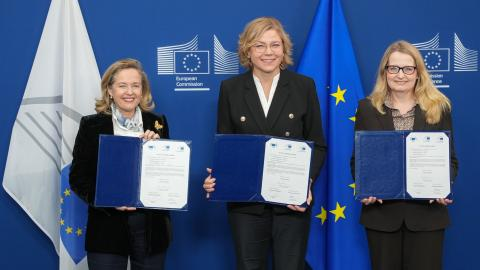
Brussels, Belgium – The European Investment Bank (EIB) Group and the European Commission have announced a new partnership to accelerate the development of large-scale artificial intelligence (AI) gigafactories across Europe. The joint initiative, formalized through a Memorandum of Understanding (MoU), aims to bolster Europe’s technological sovereignty, strengthen its digital infrastructure, and enhance its global competitiveness in advanced computing.
The collaboration sets an ambitious target: the creation of up to five major AI gigafactories — cutting-edge computing hubs designed to power the training of next-generation AI models. These gigafactories will play a vital role in supporting Europe’s ambitions to lead in fields such as medicine, clean technology, and space innovation.
Pooling Resources for Technological Independence
Under the MoU, the EIB Group and the European Commission commit to pooling financial and advisory resources to boost Europe’s capacity in advanced computing and AI. The gigafactories will serve as foundational infrastructure for developing large-scale AI systems that demand immense computing power and specialized chips.
“Europe is a technological powerhouse,” said EIB Group President Nadia Calviño. “By supporting the rollout of major AI gigafactories, we scale up computing capacity and create the conditions for innovation to thrive.”
Each gigafactory will run on approximately 100,000 of the most advanced AI chips, a capacity nearly four times greater than current-generation AI facilities. These will join 19 AI factories already being set up across the continent under the European High Performing Computing Joint Undertaking (EuroHPC JU), marking a significant step toward achieving Europe’s AI infrastructure goals.
€20 Billion InvestAI Initiative to Drive Growth
In February 2025, the European Commission committed €20 billion under its InvestAI initiative to fund the establishment of up to five AI gigafactories across the European Union. The EIB Group will complement this with loans and other financial instruments to attract private sector investment, fostering a resilient and scalable AI ecosystem for startups, researchers, and enterprises.
“AI will spur our research and innovation and boost our competitiveness,” said Henna Virkkunen, European Commission Executive Vice-President for Tech Sovereignty, Security and Democracy. “We will help mobilise unprecedented capital for European AI gigafactories that will enable all our scientists and companies to develop the most advanced, very large models needed to make Europe an AI continent.”
Turning Innovation into Investment
Beyond financing, the MoU outlines a series of concrete cooperation measures between the EIB Group and the European Commission. This includes advisory support through the InvestEU Advisory Hub, which will help enhance the bankability of investment proposals and turn innovative AI concepts into viable, fundable projects.
The initiative is closely linked to the EIB Group’s flagship TechEU Programme, which focuses on mobilising €250 billion by 2027 to support innovative European companies and infrastructure. TechEU aims to bridge the financing gap for high-risk, high-impact projects, especially in areas such as AI, cleantech, life sciences, defence, and space technologies.
EIB: Financing Europe’s Innovation Agenda
The European Investment Bank is the EU’s long-term lending institution, owned by its Member States. In 2024, the EIB Group — which includes the European Investment Fund (EIF) — signed nearly €89 billion in financing for over 900 high-impact projects across Europe. About half of this funding targeted cohesion regions, while nearly 60% supported climate action and environmental sustainability.
The EIB’s investments align with eight core EU policy priorities, including digitalisation, innovation, security, and building a stronger, more competitive Europe.
A Unified Push for Europe’s AI Future
Through the joint EIB–European Commission initiative, Europe is signaling its intent to take a leadership role in AI infrastructure, ensuring that technological progress aligns with the continent’s values of sustainability, security, and inclusivity.
By coupling public investment with private sector participation, the EU aims to create an AI ecosystem capable of competing globally — one that not only powers economic growth but also drives breakthroughs in healthcare, green technology, and scientific research.
The upcoming AI gigafactories represent more than a technological upgrade; they embody Europe’s long-term vision for digital sovereignty and innovation leadership in an era defined by artificial intelligence.

Ruchi Kumar is the associate editor at Entrepreneur News Network and TVW News India, where she leads editorial strategy, brand storytelling, and startup ecosystem coverage. With a strong focus on innovation, business, and marketing insights, he curates impactful narratives that spotlight India’s evolving entrepreneurial landscape. She has written extensively on fintech, AI and emerging startups.