
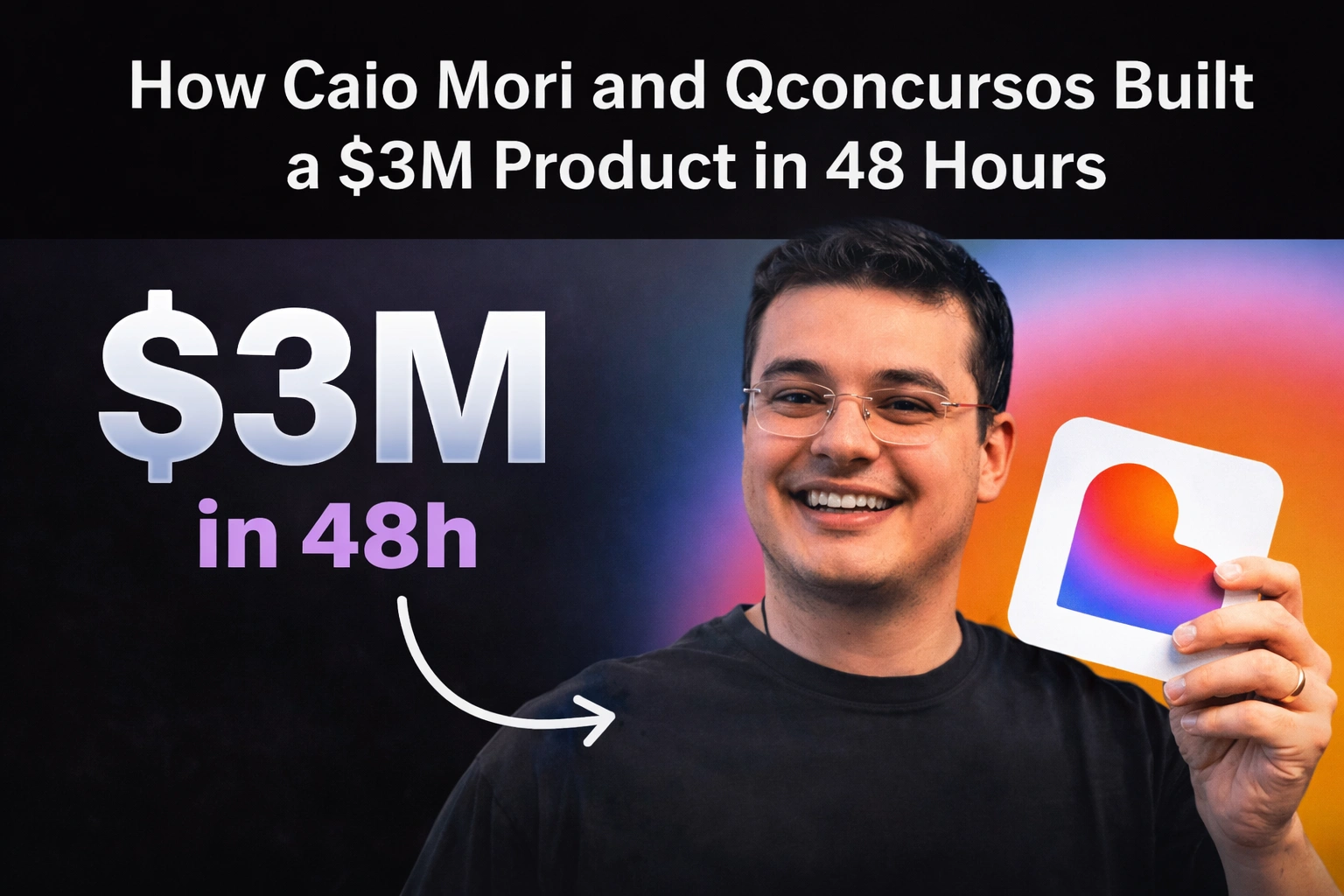
San Francisco, January 2026: In a world where speed defines success, few stories illustrate the future of software creation as dramatically as that of Caio Mori’s Qconcursos. In just 48 hours, the company generated $3 million in revenue from a product that took only 30 days to build, powered by a tiny team of two developers.
This wasn’t a lucky break — it was the culmination of a new philosophy sweeping through the software industry: Vibe Coding.
What once took sprawling teams and months of development now happens in weeks — and the results are shaking up every assumption about what’s possible in the startup world.
This is a deep dive into how Qconcursos, under Caio Mori’s leadership, became the poster child for the “Vibe Coding Era.” We’ll unpack the strategy, technology, and mindset that turned a 30-day build into a multi-million-dollar success story — and what it means for the future of software development, entrepreneurship, and innovation.
The Birth of the “Vibe Coding” Era
The term “Vibe Coding” started trending in early 2025, first popularized by Andrej Karpathy, one of AI’s most respected thinkers and engineers. The idea is simple but revolutionary:
Instead of developers manually writing thousands of lines of code, they “guide the vibe” — using natural language prompts to communicate intent, logic, and user experience directly to AI-powered development tools.
In traditional coding, a developer spends 80% of their time on “boilerplate” — repetitive tasks like authentication, data schemas, and UI setup. With Vibe Coding, that’s automated.
“Developers have moved from writing syntax to orchestrating intelligence,” says Caio Mori. “You don’t tell the machine what to type; you tell it what you want the experience to feel like.”
For Qconcursos, this mindset shift became the foundation of their explosive growth. By focusing on user value instead of technical busywork, their team achieved in 30 days what typically takes most companies six to nine months.
How Qconcursos Built a $3M Platform with AI
At first glance, Qconcursos’ achievement seems impossible. Building an enterprise-grade platform with only two developers?
But the secret lies in their AI-native tech stack, centered around a tool called Lovable — an AI-powered builder that generates production-ready code directly from human prompts.
Here’s how their tech stack came together:
| Feature | How Lovable Handled It | Strategic Advantage |
|---|---|---|
| Frontend | React + Vite + Tailwind | Instant, professional-grade UI with modern design and speed. |
| Backend | Supabase (PostgreSQL) | Handles heavy traffic and large datasets without a dedicated backend team. |
| Logic Layer | Natural language prompts | 2 developers achieved what a 20-person engineering team would take months to do. |
| Ownership | GitHub Sync + Code Export | No vendor lock-in. Qconcursos owns every line of code generated by AI. |
This setup eliminated the most time-consuming parts of software creation — allowing developers to spend time on innovation, not implementation.
Instead of being bogged down by configuration and syntax, they used AI copilots to automate infrastructure and used prompt engineering to shape design, UX, and data flow.
The “48-Hour Millionaire” Strategy
While the tech foundation was critical, the financial success came from a strategic masterclass in speed and precision.
a) Leveraging a Legacy Audience
Qconcursos wasn’t a new player — it already had a massive user base of students and educators. Instead of chasing new customers, the team looked inward, asking:
“What’s the one pain point our users would pay to solve — immediately?”
By using AI to rapidly develop the solution, they didn’t need six months of market testing. They built, launched, and monetized in record time.
b) The 30-Day Sprint
Traditional product timelines — 6 to 9 months for a new release — are now outdated.
Qconcursos built and launched their new product in just 30 days, capitalizing on a spike in user demand that would’ve been gone by the time a conventional development cycle ended.
c) Hyper-Surgical Features
Every new feature solved a specific, validated problem. There was no fluff.
Their mantra: “Build what matters, skip what doesn’t.”
That focus allowed them to create premium experiences users actually paid for, not just admired.
Why Vibe Coding Changes Everything for Founders
The implications of Vibe Coding go far beyond Qconcursos. It’s rewriting the rules of what it means to build a company, structure a team, and bring an idea to market.
MVP Timelines Have Collapsed
The era of the 3–6 month MVP is over.
In 2026, if a startup can’t launch a working version in 2–4 weeks, it risks losing market relevance.
AI-native development tools mean founders can test 5 ideas in the time it once took to launch one.
Smaller Teams, Bigger Impact
The new startup model doesn’t require armies of engineers. It requires a few “full-stack orchestrators” — people who can blend product intuition, user empathy, and prompt engineering.
These modern creators don’t obsess over syntax; they focus on product-market fit, user behavior, and rapid iteration.
Lower Cost of Failure
Because AI drastically reduces the cost of experimentation, startups can now afford to fail — fast and cheaply.
Launch five products, kill four, and scale the one that hits. The economics of innovation have fundamentally shifted.
The Rise of AI-Native Product Design
The “Vibe Coding” movement isn’t just about efficiency; it’s about creative liberation.
Developers, freed from repetitive tasks, are now focusing on human-centered design, narrative building, and emotional intelligence in UX.
In Caio Mori’s words:
“The best products don’t just work — they feel right. AI lets us focus on that feeling.”
With AI tools handling logic and structure, founders can iterate on the vibe — the emotional experience, the tone, the way the product interacts with its user.
This is leading to a new generation of “emotionally intelligent” software that resonates with human users in deeper ways.
Lessons for Entrepreneurs in the Vibe Coding Era
For startup founders and investors, Qconcursos’ story isn’t just inspiring — it’s instructive.
Here are the key lessons from their 30-day sprint to $3 million:
Move at the Speed of Relevance: Market timing beats perfection. Build quickly, release early, and improve through user feedback.
Don’t Chase Features, Solve Problems : Every new line of code must drive user value. The fastest way to build loyalty is to make real pain disappear.
Think in Systems, Not Sprints: Vibe Coding enables continuous iteration. Products are no longer static launches — they’re living systems that evolve daily.
Build for Ownership : By retaining full code ownership via GitHub export, Qconcursos avoided “vendor lock-in.” Founders must prioritize autonomy over convenience.
Prioritize Talent Who Think in Prompts
Tomorrow’s most valuable engineers will be “prompt architects” — those who can translate human needs into machine-executable logic.
The Broader Implications: From Coding to Creation
The story of Qconcursos signals a broader societal transformation — one where creative intent replaces technical complexity as the key driver of innovation.
Vibe Coding democratizes creation.
Students, solo founders, educators, and small teams can now build world-class digital products without massive resources.
This is a seismic shift — not unlike the rise of cloud computing in the early 2010s or the mobile app revolution a decade before that.
And just like those waves, Vibe Coding will create new giants — companies built not on size, but on speed, precision, and empathy.
What’s Next for the Vibe Coding Revolution
As 2026 unfolds, we’re seeing early signs that Vibe Coding is moving from a niche concept to a mainstream development philosophy.
Platforms like Lovable, Replit, and Devin AI are leading the charge, turning text prompts into deployable software in minutes.
Companies like Qconcursos are proving that this model can scale, monetize, and deliver enterprise-grade performance.
The next frontier?
Real-time AI orchestration — where founders can deploy, test, and iterate software live through natural language conversations with AI copilots.
In this new paradigm, the product manager becomes the conductor, and AI is the orchestra.
Conclusion: The Future Belongs to the Fast
Caio Mori’s Qconcursos didn’t just build an app; they built a blueprint for the next decade of entrepreneurship.
The Vibe Coding era is not about replacing developers — it’s about elevating them to creators, strategists, and storytellers.
In an age where ideas can be built, launched, and monetized in days, success will no longer depend on who codes the best — but on who vibes the fastest.
The message is clear:
If you can’t ship in 30 days, someone using AI already will.

Ruchi Kumar is the associate editor at Entrepreneur News Network and TVW News India, where she leads editorial strategy, brand storytelling, and startup ecosystem coverage. With a strong focus on innovation, business, and marketing insights, he curates impactful narratives that spotlight India’s evolving entrepreneurial landscape. She has written extensively on fintech, AI and emerging startups.