

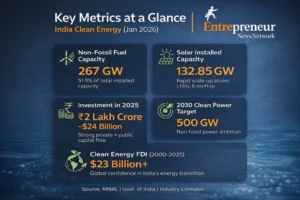
New Delhi, January, 2026 – For decades, the global narrative on climate change positioned India as a “developing challenge.” By early 2026, that script has been officially written. India has not just joined the green race; it is setting the pace. While traditional powerhouses grapple with aging infrastructure and political gridlock, India’s “Green Growth” engine has hit a historic velocity, achieving its 51.5% non-fossil fuel capacity target four years ahead of the 2030 schedule.
A Multi-Billion Dollar Momentum
The financial year 2024-25 was the tipping point. According to data from the Ministry of New and Renewable Energy (MNRE), India added a staggering 44.5 GW of clean energy capacity in a single twelve-month window. To put that in perspective, that is roughly the entire power capacity of a country like Vietnam added in just 365 days.
As of January 2026, the total renewable energy (RE) capacity stands at 267 GW. Solar power remains the crown jewel, crossing the 130 GW mark, bolstered by the government’s PM Surya Ghar: Muft Bijli Yojana. This ₹75,000-crore scheme has successfully pushed rooftop solar into 10 million households, creating a decentralized power grid that was once thought impossible in a country of India’s complexity.
The investment climate has responded in kind. In the first three quarters of 2025, clean energy investments surged to $19.8 billion (approx. ₹1.66 lakh crore), a 35% increase from the previous year. Foreign Direct Investment (FDI) in the sector has now surpassed a cumulative $23 billion, with sovereign wealth funds from the UAE, Singapore, and Norway leading the charge.
Titans and the Disrupters
The “India Green Story” of 2026 is being written by two distinct groups: the legacy giants pivoting to green and the deep-tech startups reinventing the wheel.
The Legacy Pivot: Adani Green Energy, led by CEO Amit Singh, has commissioned the world’s largest renewable energy park in Khavda, Gujarat. Spanning 538 sq km—five times the size of Paris—this project alone is on track to generate 30 GW. Simultaneously, Reliance New Energy, under the vision of Mukesh Ambani, has begun commercial production at its Dhirubhai Ambani Green Energy Giga Complex in Jamnagar, aiming to bring the cost of Green Hydrogen down to the “1-1-1” target: $1 for 1kg in 1 decade.
The Startup Renaissance: While the giants build the parks, startups are building the brains.
-
Ather Energy (Tarun Mehta & Swapnil Jain): Ahead of its highly anticipated 2026 IPO, Ather has shifted from being a premium scooter manufacturer to a national energy infrastructure player. Their “Ather Grid” now supports multi-brand fast charging across 2,500+ locations, turning EVs into a viable reality for Tier-II cities.
-
Clean Electric (Akash Gupta & Abhinav Kushwaha): This Pune-based startup is solving the biggest barrier to EV adoption: charging speed and fire safety. Their patented liquid-cooling technology allows 0-to-80% charging in just 12 minutes, a feat that has attracted massive Series A funding from pi Ventures and Kalaari Capital.
-
Lohum (Rajat Verma): Addressing the “Circular Economy,” Lohum has become India’s largest producer of sustainable Li-ion battery raw materials through recycling. By “mining” old batteries instead of the earth, they are securing India’s supply chain for critical minerals like Lithium and Cobalt.
-
SolarSquare (Neeraj Jain & Shreya Mishra): Focusing on the residential solar revolution, they have scaled to over 100 cities, proving that rooftop solar is the new “consumer appliance.”
Beyond Power: The Green Hydrogen
The most exciting frontier in 2026 is Green Hydrogen. Under the National Green Hydrogen Mission, India has allocated incentives for 450,000 tonnes per annum of green hydrogen production.
Investors are eyeing the “Cost of Production” metric closely. In late 2025, a pilot project in Karnataka achieved a production cost of ₹260 ($3.10) per kg, with projections suggesting it will drop to ₹150 ($1.80) by 2028. This makes India one of the most competitive exporters of Green Ammonia to the European Union and Japan.
The Infrastructure Gap: A $350 Billion Opportunity
Despite the euphoria, the road to the 500 GW target by 2030 requires “patient capital.” India needs approximately $350 billion (₹29 lakh crore) in additional investment over the next four years to upgrade its transmission grids and scale Battery Energy Storage Systems (BESS).
States like Tamil Nadu and Rajasthan are leading the way by implementing “Green Energy Corridors,” ensuring that power generated in windy or sunny remote areas can reach industrial hubs like Mumbai and Delhi without wastage.
The Global Verdict
At the Davos 2026 summit, the consensus was clear: India is no longer a “potential” market; it is the “primary” market. With a combination of aggressive policy (like the Production Linked Incentive or PLI schemes), a massive domestic market, and a world-class startup ecosystem, India has turned the climate crisis into its greatest economic opportunity.
The “Cleantech Rising” headline isn’t just a trend—it’s the blueprint for the next decade of Indian wealth creation. As Tarun Mehta of Ather Energy recently noted, “The 20th century was built on oil we didn’t have; the 21st century will be built on the sun and wind we have in abundance.”
Conclusion
India’s clean energy transformation in 2026 is not just an environmental milestone — it’s an economic revolution. With renewable power surging, startups innovating at scale, and global investors backing its vision, India is rewriting the world’s green playbook.

Ruchi Kumar is the associate editor at Entrepreneur News Network and TVW News India, where she leads editorial strategy, brand storytelling, and startup ecosystem coverage. With a strong focus on innovation, business, and marketing insights, he curates impactful narratives that spotlight India’s evolving entrepreneurial landscape. She has written extensively on fintech, AI and emerging startups.