
Delhi , India – January, 2026 – In 2026, Indian startup fundraising is no longer about storytelling alone.
It’s about precision, timing, and proof.
Every week, venture capital firms review hundreds of pitch decks from SaaS startups, fintech founders, D2C brands, and AI companies—yet only a handful make it past the first meeting.
So what separates the winners?
After studying how top Indian founders raise capital, one pattern stands out:
They don’t pitch ideas. They pitch execution systems.
This Google Discover–optimized guide breaks down the modern startup pitch framework for India, built specifically for SaaS, fintech, D2C, and AI startups preparing to raise capital in 2026.
The Hidden Shift in Indian Startup Fundraising (2026)
Indian VCs have quietly changed what they optimize for.
Five years ago:
-
Vision > Viability
-
Growth > Governance
-
Storytelling > Systems
Today:
-
Unit economics > vanity growth
-
Regulatory clarity > disruption narratives
-
Founder credibility > slide design
This shift is especially visible in:
-
SaaS fundraising (predictability matters)
-
Fintech investing (risk and compliance matter)
-
D2C capital allocation (profitability matters)
-
AI startup funding (depth matters)
-
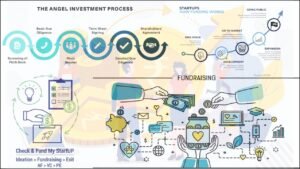
The Angel Investment Process
To survive this shift, founders are adopting a MECE-based pitch framework, a structured thinking model popularized by McKinsey & Company.
The MECE Startup Pitch Framework (Built for Discover & Investors)
MECE stands for Mutually Exclusive, Collectively Exhaustive—a fancy way of saying:
“Answer every investor question clearly, once, and completely.”
This framework forces your pitch to answer three core questions:
-
Why this team?
-
Why this market, now?
-
Why this round makes sense financially?
Let’s break it down—sector by sector.
1. Why This Team Wins (Especially in Fintech & AI)
In India, investors don’t just back intelligence.
They back judgment under complexity.
What VCs Look For in 2026
Fintech founders
-
Prior exposure to RBI-regulated environments
-
Clear understanding of compliance and risk
-
Comfort operating under frameworks defined by the Reserve Bank of India and Securities and Exchange Board of India
AI startup founders
-
Deep technical ownership (not outsourced models)
-
Proprietary or hard-to-replicate datasets
-
Ability to explain systems simply
SaaS founders
-
Experience scaling ARR
-
Clear founder–market fit
-
Sales or distribution advantage
D2C founders
-
Supply chain and sourcing control
-
Brand + margin understanding
-
Repeat purchase intuition
This is what investors call an “unfair advantage.”
2. Product Value That Google Discover (and VCs) Care About
Discover favors clear outcomes, not buzzwords.
So do investors.
Outcome-Driven Positioning by Category
SaaS startup
“We help Indian finance teams close books 35% faster.”
Fintech startup
“We reduce SME loan defaults by 22% using transaction-level risk signals.”
D2C brand
“42% of customers repurchase within 90 days—without discounts.”
AI startup
“Our model cuts last-mile logistics costs by 18% in live deployments.”
Outcome clarity:
-
Improves Discover engagement
-
Signals monetization readiness
-
Makes differentiation obvious
3. India Context Is No Longer Optional
A major reason Indian startups fail to scale is metro bias.
In 2026, VCs expect proof that your product works in:
-
Tier-2 and Tier-3 cities
-
Low-bandwidth environments
-
Mobile-first usage patterns
-
Vernacular workflows
This is especially critical for:
-
Fintech platforms
-
Mass-market D2C brands
-
Horizontal SaaS tools
If you’re building for Bharat, your pitch must show it.
4. Traction Metrics That Stop the Scroll (and the Meeting)
Google Discover rewards content that feels concrete and credible.
So do investors.
What Metrics Matter in Each Category
-
SaaS → ARR growth, churn, net revenue retention
-
Fintech → Transaction volume, approval rates, loss ratios
-
D2C → Contribution margin, CAC:LTV, cohort retention
-
AI → Production usage, accuracy lift, enterprise pilots
One rule:
Your North Star Metric should appear in the first 5 slides—or first 30 seconds.
5. Market Sizing That Sounds Intelligent (Not Lazy)
Saying “India has 1.4 billion people” is an instant credibility killer.
Bottom-Up Market Examples
SaaS
“400,000 Indian businesses actively pay ₹8,000/month for finance software.”
Fintech
“120 million MSMEs process digital payments daily, but lack credit access.”
D2C
“25 million urban consumers buy premium personal care online 4+ times a year.”
Bottom-up logic signals:
-
Pricing realism
-
Focus
-
Revenue scalability
6. The Fundraising Math That Actually Gets You Funded
Clean Cap Tables Are Mandatory
Across SaaS, fintech, D2C, and AI:
-
Too many early investors = red flag
-
No ESOP pool = red flag
-
Excessive dilution = red flag
Structure equals seriousness.
The 10× Rule (Still Non-Negotiable)
If you raise at:
-
$50–60M valuation
You must show a believable path to:
-
$500–600M+
That usually means:
-
SaaS → $25–30M ARR
-
Fintech → massive scale + margins
-
D2C → brand + profitability
-
AI → enterprise adoption + moat
No math = no money.
7. The Data Room That Signals “This Founder Is Ready”
A prepared Virtual Data Room (VDR) dramatically improves close speed.
Must-have folders
-
Corporate & cap table
-
Financials & unit economics
-
Product & tech architecture
-
Sales, GTM, pipelines
-
Legal & HR compliance
Prepared founders don’t chase capital—capital catches up.
What the Top 1% of Founders Do (And Others Don’t)
They Surface Bad Metrics Early
Churn up? Margins down?
They explain why—and what’s already changing.
They Personalize Investor Outreach
5–7 investors.
Custom first slides.
Clear thesis alignment.
They Send Investor Updates Before Funding
Fundraising becomes momentum—not persuasion.
Final Discover-Friendly Takeaway
In 2026, successful fundraising in India isn’t about hype.
It’s about:
-
Structured thinking
-
Category-specific metrics
-
India-aware execution
-
Radical clarity
If you’re building a SaaS startup, fintech platform, D2C brand, or AI company, this MECE-based pitch framework isn’t optional—it’s your baseline.

Ruchi Kumar is the associate editor at Entrepreneur News Network and TVW News India, where she leads editorial strategy, brand storytelling, and startup ecosystem coverage. With a strong focus on innovation, business, and marketing insights, he curates impactful narratives that spotlight India’s evolving entrepreneurial landscape. She has written extensively on fintech, AI and emerging startups.