
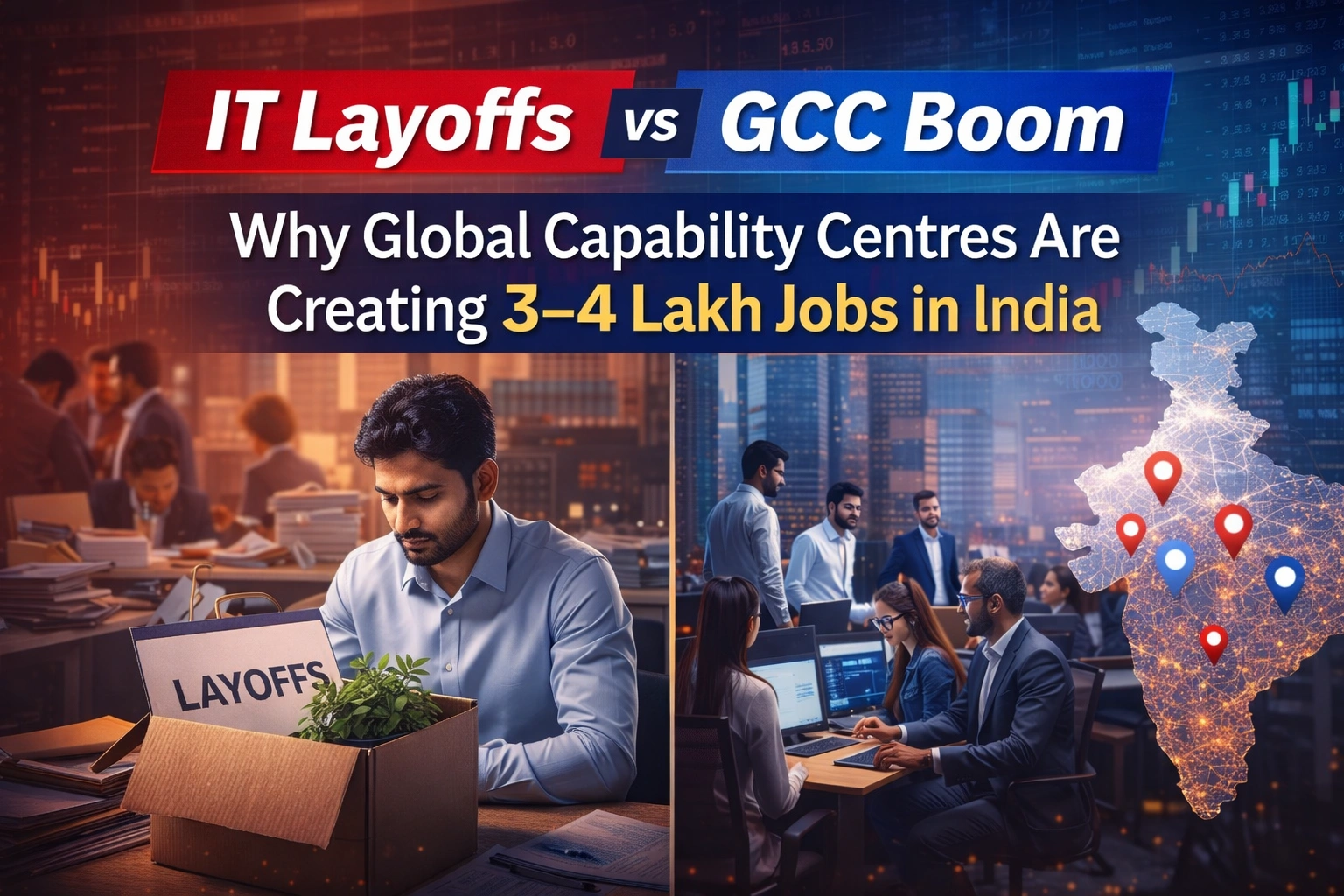
If you work in IT services — or are trying to enter the industry — you’ve likely seen the headlines: TCS cutting jobs. Infosys reducing headcount. Wipro laying off employees.
Collectively, major IT services companies have reduced tens of thousands of roles. Naturally, this creates anxiety among professionals and fresh graduates.
But here’s the bigger picture.
While traditional IT services firms are trimming roles, Global Capability Centres (GCCs) in India are expected to add 3–4 lakh jobs this year alone. And this shift could redefine the future of India’s tech workforce.
Let’s understand what GCCs are, why they are growing rapidly, and how professionals can tap into this opportunity.
What Are Global Capability Centres (GCCs)?
Traditionally, IT services companies like TCS, Infosys, and Wipro execute projects for global clients.
For example:
-
Walmart gives a project to TCS.
-
You work at TCS.
-
You deliver that project for Walmart.
That’s the classic IT services model.
However, large multinational companies eventually realized something:
Instead of outsourcing work to vendors, why not set up their own dedicated centres in India and directly hire talent?
That’s exactly what a Global Capability Centre (GCC) is.
A GCC is an offshore centre owned by a multinational company that handles global operations, technology development, R&D, product engineering, finance, and strategy — directly for the parent organization.
When you work in a GCC:
-
You are employed directly by the global company.
-
You use their email domain.
-
You follow their policies and compensation structures.
-
You may receive stock options.
-
You work on global products — not as a vendor, but as part of the core organization.
The only difference? You are located in India, not at the global headquarters.
GCCs Are No Longer Back Offices
Many people assume GCCs handle basic back-office or call centre tasks.
That perception is outdated.
Today’s GCCs in India work on:
-
Artificial Intelligence (AI)
-
Machine Learning (ML)
-
Product development
-
Cloud architecture
-
Cybersecurity
-
Global R&D
-
Strategy and analytics
-
Advanced finance and risk modeling
Companies realized India offers:
-
Cost efficiency
-
High-quality engineering talent
-
Strong innovation capabilities
If hiring an engineer costs 100 units in the US, it might cost 40–50 in India — often with comparable quality.
This cost-quality advantage has turned India into the global GCC capital.
The Scale of GCC Growth in India
This is not a small niche industry.
-
India currently has 1,800+ GCCs
-
Employing nearly 1.9 million professionals
-
Generated $64.6 billion in revenue last year
-
Expected to reach $100 billion by 2030
-
Workforce projected to grow to 2.5–3.5 million in the next five years
Interestingly, many IT professionals are voluntarily moving from IT services to GCCs. Lateral movement from IT services to GCCs has increased significantly over the past two years.
Freshers are also in demand — with 80,000 to 90,000 fresher hires expected this year.
Major Companies with GCCs in India
Some of the biggest global corporations operate GCCs in India:
-
Google
-
Microsoft
-
Amazon
-
Apple
-
Intel
-
SAP
-
Salesforce
-
JP Morgan Chase
-
Goldman Sachs
-
Wells Fargo
-
Citigroup
-
Bank of America
-
Walmart
-
AstraZeneca
-
Pfizer
-
Johnson & Johnson
For example:
-
JP Morgan employs over 55,000 people in India
-
Goldman Sachs’ Bengaluru office is its second-largest globally
-
Microsoft recently opened a major Hyderabad facility
-
Amazon’s Hyderabad campus is one of its largest globally
India hosts over 50% of the world’s GCCs.
Salary Comparison: IT Services vs GCC
One major attraction of GCCs is compensation.
Freshers
-
IT Services: ₹3–5 lakh per annum
-
GCC Entry-Level: ₹6–10 lakh
-
Top GCCs (Google, Amazon, etc.): Can go significantly higher
3–7 Years Experience
-
IT Services: ₹8–15 lakh
-
GCCs: ₹15–25 lakh
-
Top GCCs: Even higher
Senior Roles
-
IT Services: Often capped around ₹30 lakh
-
GCCs: ₹30–50+ lakh possible
Stock Options (Major Advantage)
Most GCCs offer:
-
RSUs (Restricted Stock Units)
-
Stock appreciation rights
-
Equity in listed global companies
This can increase total compensation by 20% to 100%, something rarely offered in IT services.
Most In-Demand Roles in GCCs
Technical Roles
-
AI/ML Engineers
-
Generative AI Architects
-
Data Scientists
-
Cloud Architects
-
Cybersecurity Specialists
-
Full-Stack Developers
-
MLOps Engineers
Non-Technical & Hybrid Roles
-
Product Managers
-
Business Analysts
-
Risk Modeling Experts
-
Finance Professionals
-
UX/UI Designers
-
Domain Specialists (Banking, Healthcare, Retail, Logistics)
GCCs are building products for global markets — not just maintaining legacy systems.
How to Get Hired in a GCC
Hiring at GCCs is more selective than mass IT services recruitment.
Typical Hiring Process
-
Recruiter screening call
-
Technical interviews (1–3 rounds)
-
Case studies or problem-solving
-
Behavioral interviews
-
Hiring manager round
-
HR compensation discussion
Referrals matter significantly. Referred candidates have much higher selection chances.
Roadmap to Move from IT Services to GCC
If you’re already working:
-
Assess skill gaps (1 month)
-
Upskill through certifications or bootcamps (3–6 months)
-
Build a strong portfolio (2–3 months)
-
Apply strategically with referrals
Focus on combining:
-
Domain expertise (banking, healthcare, fintech, retail)
-
A high-demand skill (AI, cloud, data science)
If you’re a fresher:
-
Build real projects
-
Maintain an active GitHub
-
Contribute to open-source
-
Don’t rely only on campus placements
Where Are GCCs Growing?
Top cities:
-
Bengaluru
-
Hyderabad (fastest-growing)
-
Chennai
-
Pune
-
Delhi NCR
-
Mumbai
Tier-2 cities like Ahmedabad, Coimbatore, Kochi, Indore, Jaipur, and Lucknow are also emerging.
Risks to Consider
GCCs are not risk-free.
-
Layoffs can still happen.
-
Time zone differences may require odd working hours.
-
Possible long-term glass ceiling if promotions are HQ-driven.
But the growth momentum remains strong.
Final Thoughts: The GCC Wave Is Real
Five years ago, few discussed GCCs. Today, nearly 19 lakh professionals work in them — and millions more may join soon.
Higher salaries. Stock options. Global exposure. Advanced tech roles.
Just like India rode the IT services wave in the 1990s and 2000s, today may be the era of the GCC boom in India.
The question is:
Are you ready to ride this wave?

Ruchi Kumar is the associate editor at Entrepreneur News Network and TVW News India, where she leads editorial strategy, brand storytelling, and startup ecosystem coverage. With a strong focus on innovation, business, and marketing insights, he curates impactful narratives that spotlight India’s evolving entrepreneurial landscape. She has written extensively on fintech, AI and emerging startups.