
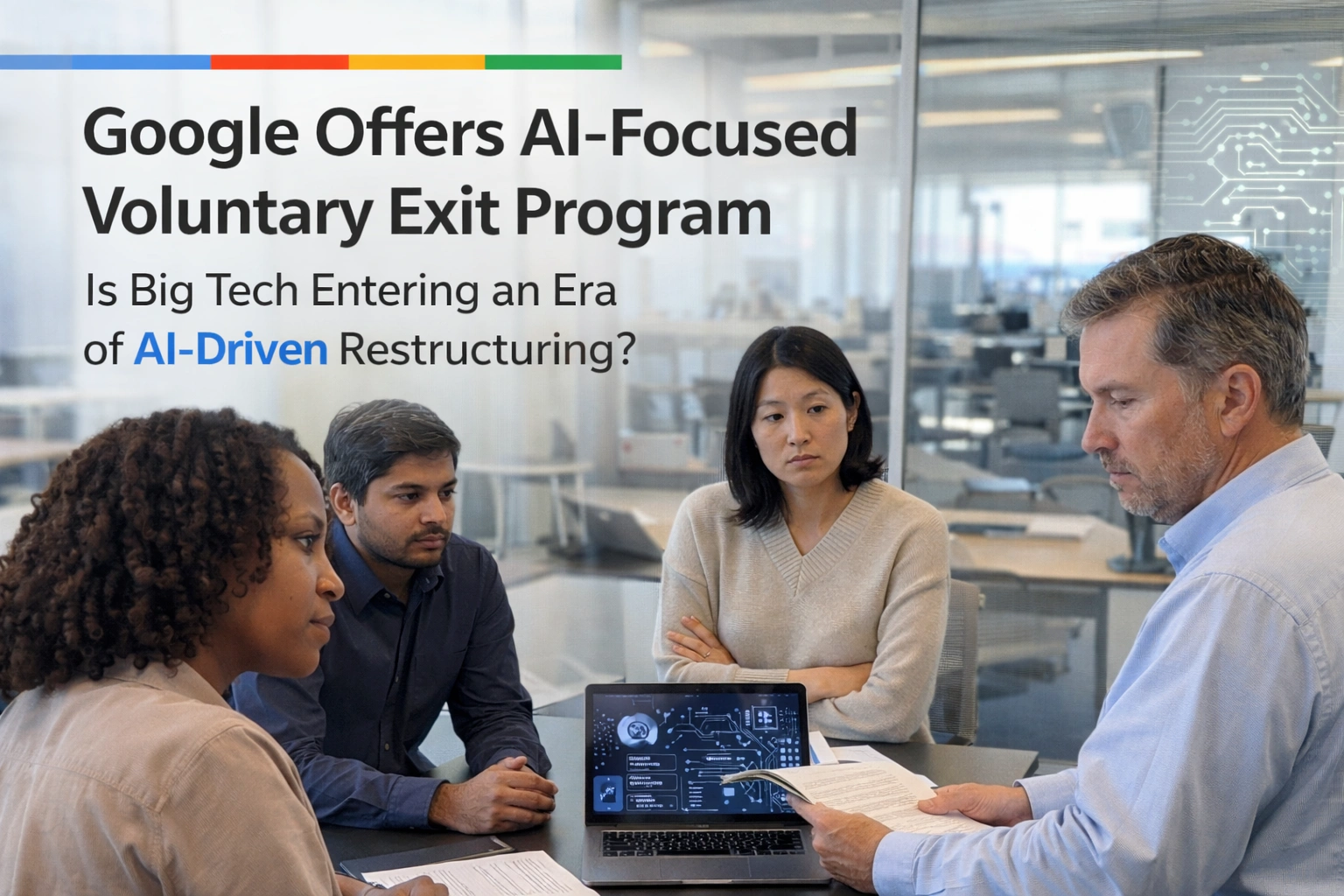
Imagine working at Google, one of the most powerful tech companies in the world and receiving an internal memo stating that while 2025 has been successful, the pace of change is about to accelerate dramatically. The message is clear: the future is AI, and everyone must be fully aligned. If not, there’s a voluntary exit package waiting.
This is not hypothetical. Google has introduced a voluntary exit program for certain employees within its Global Business Organization in the United States.
Google’s AI Push and Voluntary Buyouts
As per media reports, the memo, reportedly sent by Google’s Chief Business Officer, emphasized that artificial intelligence will define the company’s next chapter. Employees who feel out of sync with this high-speed, AI-first direction have the option to accept a buyout package.
The program applies to specific teams, including solutions, sales roles, and corporate development. However, customer-facing sales teams are excluded — likely to avoid disruption to Google’s core revenue engine.
While Google has not disclosed the exact financial details of the current offer, a similar buyout last year reportedly included at least 14 weeks of pay, plus one additional week for every year of service. For a decade-long employee, that could mean nearly six months of compensation.
Why Voluntary Buyouts Instead of Layoffs?
Buyouts are often seen as a softer alternative to mass layoffs. They reduce legal risks, limit regulatory complications, and generate fewer negative headlines. In many cases, buyouts serve as a preliminary step before deeper workforce reductions.
It’s a strategic move: offer a polite exit before making harsher cuts.
AI Layoffs in 2025: A Growing Trend
Google is not alone. In 2025, over 54,000 US job cuts have reportedly been linked to AI-driven efficiency efforts.
Major developments include:
-
Amazon cutting tens of thousands of roles
-
HP signaling workforce reductions
-
Duolingo reducing contractor reliance due to AI tools
-
Salesforce highlighting reduced staffing needs thanks to AI agents
The narrative dominating headlines suggests AI is replacing human workers at scale.
The AI Automation Debate: Hype or Reality?
However, economists present a more measured outlook. Some research firms estimate that only about 6% of American jobs will be fully automated by 2030 — far lower than popular assumptions.
This has led to the rise of a new term: AI washing.
AI washing refers to companies attributing layoffs or restructuring to AI advancements when underlying factors may include cost-cutting, overhiring during pandemic-era expansion, or shareholder pressure.
Blaming AI sounds forward-looking. Blaming miscalculated hiring or margin protection does not.
Big Tech’s Cultural Shift: From Comfort to Competition
For years, companies like Google symbolized workplace comfort — flexible schedules, perks, and innovation-driven culture. Today, the message appears different: move fast, align with AI, or step aside.
The AI race is intense. Tech giants cannot afford to appear slow in generative AI, automation tools, or enterprise AI platforms. Whether Google’s strategy is structural transformation or cautious downsizing, it signals a larger shift.
The era of Big Tech comfort may be ending. The era of Big Tech survival — driven by AI acceleration — is underway.

Ruchi Kumar is the associate editor at Entrepreneur News Network and TVW News India, where she leads editorial strategy, brand storytelling, and startup ecosystem coverage. With a strong focus on innovation, business, and marketing insights, he curates impactful narratives that spotlight India’s evolving entrepreneurial landscape. She has written extensively on fintech, AI and emerging startups.