
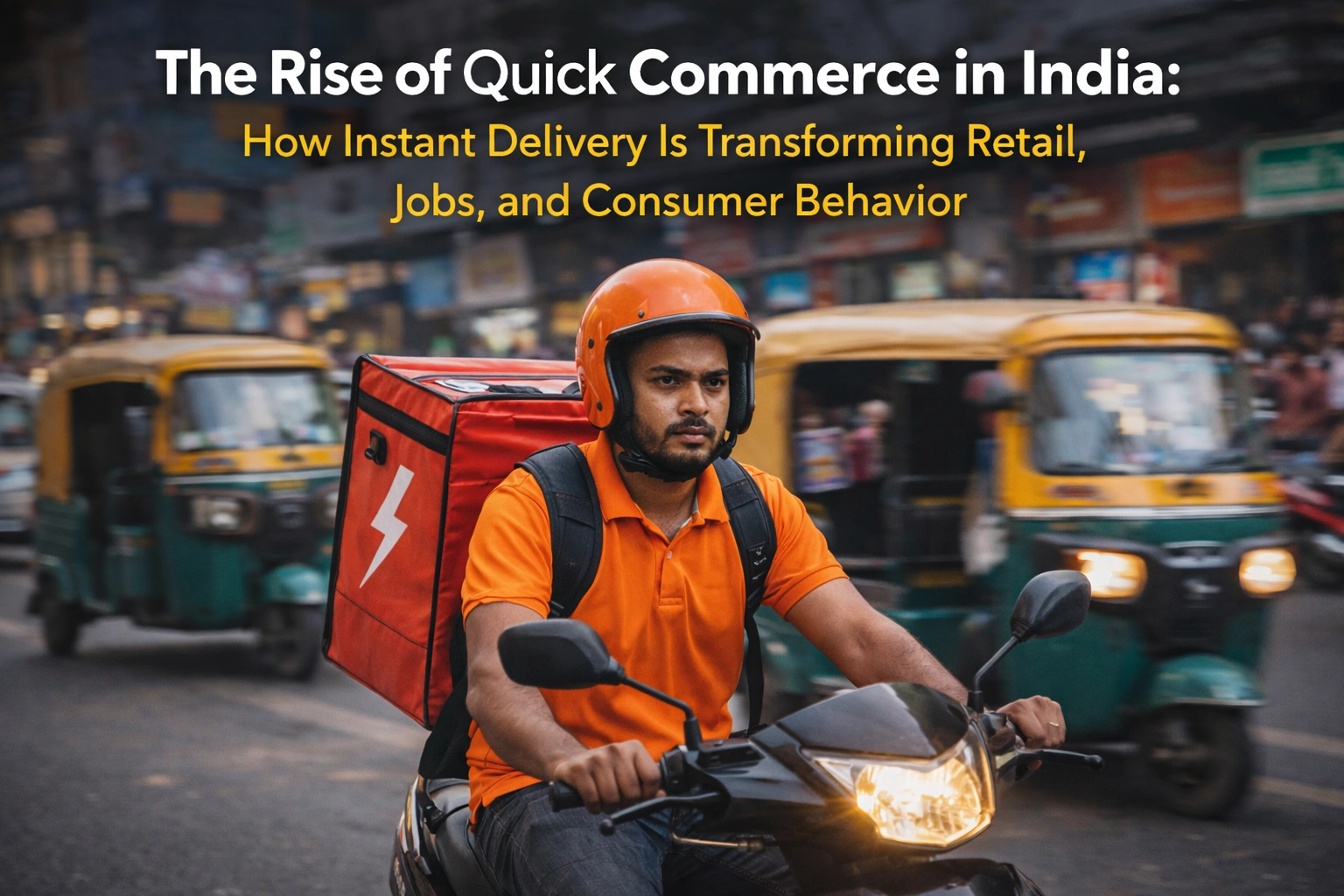
Indian retail has undergone a profound transformation in the last few years. Not long ago, grocery shopping meant weekly market visits, long checkout queues, and careful planning. Today, millions of Indian consumers can order groceries, medicines, snacks, and even electronics within minutes through mobile apps. This shift has been driven by rising smartphone penetration, affordable internet, seamless digital payments, and changing urban lifestyles.
The COVID-19 pandemic accelerated this evolution dramatically. Lockdowns and safety concerns pushed consumers to adopt online shopping at scale. According to research by the Indian Institute of Management Ahmedabad, online grocery purchases surged nearly 80% in 2020, reaching approximately ₹23,951 crore (about $2.7 billion). What began as a necessity quickly turned into a habit. Consumers discovered the convenience of doorstep delivery, and quick commerce (Q-commerce) platforms seized the opportunity.
Explosive Growth of Quick Commerce in India
Quick commerce, defined by ultra-fast delivery timelines ranging from 10 to 30 minutes, has grown at an extraordinary pace. In 2022, the segment was still emerging. Within three years, it evolved into a multi-billion-dollar industry.
Reports from India Briefing and Cornell SC Johnson indicate that India’s Q-commerce gross order value reached approximately ₹65,645 crore (around $7.4 billion) by FY25 — nearly 24 times its 2022 size. This rapid expansion highlights how deeply consumer behavior has shifted toward instant gratification and convenience-driven purchasing.
According to Bain & Company, Q-commerce accounted for nearly two-thirds of all online grocery orders in India in 2024 and approximately 10% of total e-retail spending. These numbers reflect not just a channel shift but a structural transformation in the retail ecosystem.
The expansion has also moved beyond metro cities. Tier-II and Tier-III towns are increasingly participating, supported by improving logistics infrastructure and rising internet access. Before the emergence of quick commerce, only about one-third of frequent urban shoppers preferred online channels for daily essentials. Today, that figure has climbed to nearly 87%, demonstrating a fundamental shift in consumption habits.
Incremental Consumption and Behavioral Change
Quick commerce is not simply redistributing existing retail sales — it is generating new demand. Studies by Bain and Kearney suggest that 6–8% of purchases made through Q-commerce platforms are incremental. In simple terms, consumers are buying items they may not have purchased otherwise.
Impulse purchases such as snacks, premium groceries, seasonal gifts, and convenience products are rising because availability is instant. The friction of planning or physically visiting a store has been removed. This behavioral shift is perhaps the most powerful driver of the sector’s growth.
The convenience factor has also altered expectations. E-commerce once required consumers to wait several days. Quick commerce has redefined “fast” to mean minutes. This transformation in consumer patience is reshaping supply chains, inventory planning, and last-mile logistics across the country.
Employment Generation and Economic Contribution
The quick-commerce boom has significant implications for employment and economic development. Unlike traditional e-commerce, Q-commerce is highly labor-intensive.
According to Kearney’s findings, quick commerce generates approximately 62–64 jobs for every ₹100 crore of monthly gross merchandise value. This employment intensity is comparable to traditional retail and significantly higher than modern retail or standard e-commerce operations.
Major platforms illustrate this scale. By early 2024, Zepto employed around 5,000 individuals, Blinkit about 7,000, and Swiggy Instamart roughly 5,500. These figures represent full-time equivalents, while thousands more gig-based delivery workers operate on flexible schedules.
Quick commerce has also contributed to the formalization of gig work. Delivery riders gain structured earning opportunities, and employment spreads across urban and semi-urban regions. The sector supports warehouse operations, technology development, marketing, and managerial functions, strengthening India’s service economy.
Additionally, the rapid expansion has attracted significant investment from global and domestic players. International giants such as Amazon and Walmart are accelerating ultra-fast delivery initiatives in response to India’s growth. This influx of capital strengthens technology infrastructure and boosts investor confidence in India’s digital economy.
Future Growth Projections and Market Potential
Industry forecasts suggest that India’s Q-commerce growth story is far from complete. A Cornell University analysis projects that gross merchandise value could reach approximately ₹3,10,485 crore (around $35 billion) by 2030.
This projection aligns with broader digital adoption trends. India’s internet user base has crossed 950 million and continues to expand. By 2030, online shoppers could exceed 500 million, representing a massive opportunity for instant-delivery platforms.
Demographics also favor growth. Rising incomes and an expanding middle class are driving demand for convenience services. Reports indicate that over 320 million Indians fall into middle- and high-income categories, and more than 60% of households earn over ₹10,000 per month. These structural shifts create a strong foundation for digital retail expansion.
Tier-II and Tier-III cities represent the next frontier. As broadband penetration improves through initiatives like BharatNet and platforms like ONDC integrate smaller retailers into digital ecosystems, quick commerce is likely to penetrate deeper into India’s heartland.
Technology, AI, and Innovation Driving Efficiency
Technology lies at the core of Q-commerce success. Companies are deploying advanced AI-driven demand forecasting, real-time inventory management systems, and route optimization algorithms to enhance operational efficiency.
Micro-fulfillment centers and dark stores strategically located near residential clusters enable rapid dispatch. Warehouse automation pilots are underway in major cities, and AI systems predict stock replenishment cycles to minimize out-of-stock scenarios.
India’s digital payment ecosystem, particularly UPI, has further simplified transactions. Instant payment confirmation reduces friction and supports small-ticket purchases, making quick commerce viable even for low-value orders.
As platforms refine their technology stacks, operational efficiency and profitability are expected to improve.
Product Diversification and Premiumization
Originally centered on groceries and daily essentials, Q-commerce platforms are diversifying rapidly. Electronics accessories, cosmetics, healthcare items, and small appliances are increasingly available.
Leading platforms now offer tens of thousands of SKUs. Premium brands are launching products directly on Q-commerce channels, recognizing the high engagement levels of convenience-focused shoppers.
This diversification expands average order values and introduces new revenue streams. Subscription models, advertising, delivery fees, and private-label products are also being explored to strengthen margins.
Sustainability and Regulatory Landscape
Despite rapid growth, profitability and sustainability remain critical challenges. Discount-led growth has moderated, and companies are focusing on operational scale and improved unit economics.
Environmental concerns are gaining importance. Electric delivery vehicles, sustainable packaging, and emission-reduction strategies are being piloted. Regulatory clarity around gig worker protections and consumer safeguards will also shape the industry’s long-term trajectory.
Government initiatives under Digital India have already facilitated rapid adoption. As policies evolve, a more structured and transparent regulatory environment could enhance trust and stability.
India’s Global Position in Quick Commerce
Globally, India stands out as a pioneer in rapid Q-commerce adoption. While China’s market size remains larger, India’s growth rate and innovation under infrastructure constraints have drawn international attention.
Platforms in emerging markets are studying India’s model. The ability to scale ultra-fast delivery within a price-sensitive and complex market environment showcases India’s entrepreneurial agility.
Currently, Q-commerce penetration remains relatively low compared to some countries, indicating significant headroom for expansion. As adoption spreads beyond urban centers, India could become one of the largest quick-commerce markets worldwide.
Conclusion: A Defining Moment for Indian Retail
India’s quick-commerce revolution reflects a broader shift toward digital-first living. What began as a pandemic-driven necessity has evolved into a structural change in retail behavior.
The sector is generating employment, attracting investment, driving technological innovation, and redefining supply chain models. While profitability and sustainability challenges persist, the overall momentum remains strong.
Quick commerce is unlikely to replace traditional retail entirely. Instead, it will coexist as a critical component of India’s omnichannel retail ecosystem. As connectivity deepens and consumer expectations continue to evolve, instant delivery will likely become a standard expectation rather than a premium service.
India’s journey demonstrates how a rapidly developing economy can reshape global retail trends. The coming decade will determine how sustainably and inclusively this transformation unfolds — but the direction is clear: the future of Indian retail is fast, digital, and increasingly instant.

Ruchi Kumar is the associate editor at Entrepreneur News Network and TVW News India, where she leads editorial strategy, brand storytelling, and startup ecosystem coverage. With a strong focus on innovation, business, and marketing insights, he curates impactful narratives that spotlight India’s evolving entrepreneurial landscape. She has written extensively on fintech, AI and emerging startups.