
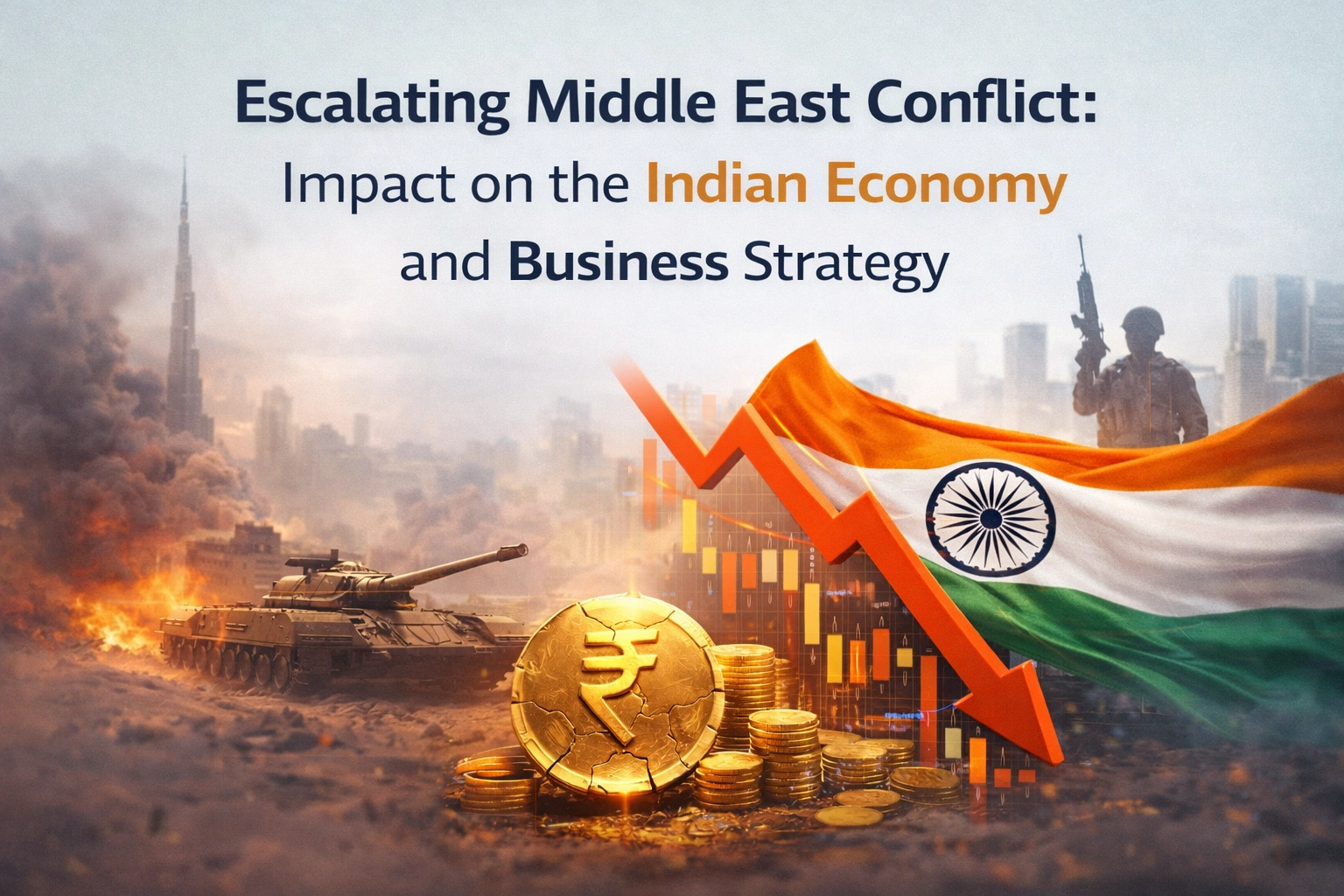
The sharp escalation of U.S.-Israeli strikes on Iran and the widening conflict across the Persian Gulf have triggered fresh volatility in global markets. For India—one of the world’s fastest-growing major economies with deep energy, trade, and diaspora links to the Middle East—the implications are significant.
As Brent crude approaches the $80-per-barrel mark, with the possibility of touching $100 if the Strait of Hormuz faces disruption, Indian policymakers and business leaders must move from passive monitoring to active risk management.
Oil Price Surge and Inflation Risks for India
Heavy Dependence on Crude Imports
India imports more than 80% of its crude oil requirements, a large share of which travels through the geopolitically sensitive Persian Gulf. Any prolonged conflict in the region directly impacts India’s energy security and macroeconomic stability.
Inflation and Fiscal Pressure
A sustained rise in global crude prices could widen India’s Current Account Deficit (CAD). Historically, every $10 increase in crude oil prices can push consumer inflation higher, particularly through transportation and logistics costs. This trickles down to essential commodities, affecting household budgets and business margins.
Higher oil prices also put pressure on government finances, especially if fuel subsidies or excise duty adjustments are used to shield consumers.
The Strait of Hormuz Risk
The Strait of Hormuz is one of the world’s most critical oil transit chokepoints, with roughly 20% of global oil flows passing through it. Any blockade or disruption could lead not only to price spikes but also to physical supply constraints for Asian economies, including India.
Impact on Aviation and Logistics
Indian airlines such as Air India and IndiGo are already adjusting routes to avoid sensitive airspace. Rising Aviation Turbine Fuel (ATF) costs, coupled with longer flight durations, may strain profitability in an already competitive aviation sector.
Logistics firms could also see higher freight and insurance costs, adding to inflationary pressures.
Cybersecurity and Physical Infrastructure Threats
Growing Cyber Risks
Modern geopolitical conflicts often extend into cyberspace. Iran has previously been associated with sophisticated cyber operations, and the current escalation raises concerns about retaliatory cyberattacks targeting financial systems, utilities, and technology infrastructure.
Indian IT hubs, financial institutions, and critical infrastructure providers must strengthen cybersecurity protocols and conduct vulnerability assessments.
Infrastructure and Utility Security
Reports of cyber disruptions affecting utilities in the Middle East highlight the importance of securing critical systems. Indian enterprises should review operational resilience plans, particularly in sectors like energy, telecom, and banking.
Indian Diaspora in the Gulf
More than 8 million Indians live and work in Gulf countries. Regional instability can disrupt employment, remittances, and economic flows. Remittances from the Middle East are a key contributor to India’s foreign exchange reserves. Any interruption would have macroeconomic implications.
Additionally, heightened tensions may require contingency planning for evacuation or mobility disruptions.
Trade, Currency, and Strategic Positioning
Export Challenges
India exports goods such as basmati rice, tea, textiles, and engineering products to Middle Eastern markets. Rising insurance premiums for ships transiting the Arabian Sea and regional instability could increase costs and delay shipments.
Such disruptions may reduce export competitiveness in an already price-sensitive global environment.
Rupee Pressure and Dollar Strength
During periods of geopolitical tension, the U.S. dollar often strengthens as a safe-haven currency. A stronger dollar typically puts downward pressure on emerging market currencies, including the Indian rupee.
A weaker rupee makes imports—especially crude oil—more expensive, complicating monetary policy decisions for the Reserve Bank of India (RBI).
Strategic Autonomy and Trade Settlement
Escalating geopolitical tensions may accelerate India’s push to diversify trade settlement mechanisms. Recent efforts to settle oil trade in local currencies such as the rupee or dirham reflect a broader strategy to reduce exposure to dollar-denominated risk.
Strategic Action Plan for Indian Business Leaders
Given the evolving risks, Indian CEOs and corporate leaders should consider the following measures:
Diversify Supply Chains
Evaluate dependencies on Gulf logistics routes and identify alternative sourcing or transit corridors where feasible.
Hedge Energy Exposure
Businesses heavily dependent on fuel should explore hedging instruments to mitigate potential price spikes in the $90–$100 per barrel range.
Upgrade Cybersecurity Frameworks
Adopt advanced security architectures, including zero-trust models, and conduct regular audits to guard against state-sponsored cyber threats.
Strengthen Stakeholder Communication
Maintain transparent engagement with investors, employees, and partners regarding the company’s exposure to Middle Eastern markets and risk mitigation strategies.
Conclusion
The unfolding U.S.-Iran-Israel conflict has evolved beyond a regional confrontation into a global economic risk factor. For India, the combination of rising oil prices, currency volatility, cybersecurity threats, and trade disruptions presents a complex challenge.
Whether this crisis results in a short-term spike or a deeper structural shift in global geopolitics remains uncertain. What is clear, however, is that Indian businesses must prepare for heightened volatility by strengthening resilience, diversifying risks, and planning strategically in an increasingly interconnected world.

Ruchi Kumar is the associate editor at Entrepreneur News Network and TVW News India, where she leads editorial strategy, brand storytelling, and startup ecosystem coverage. With a strong focus on innovation, business, and marketing insights, he curates impactful narratives that spotlight India’s evolving entrepreneurial landscape. She has written extensively on fintech, AI and emerging startups.