
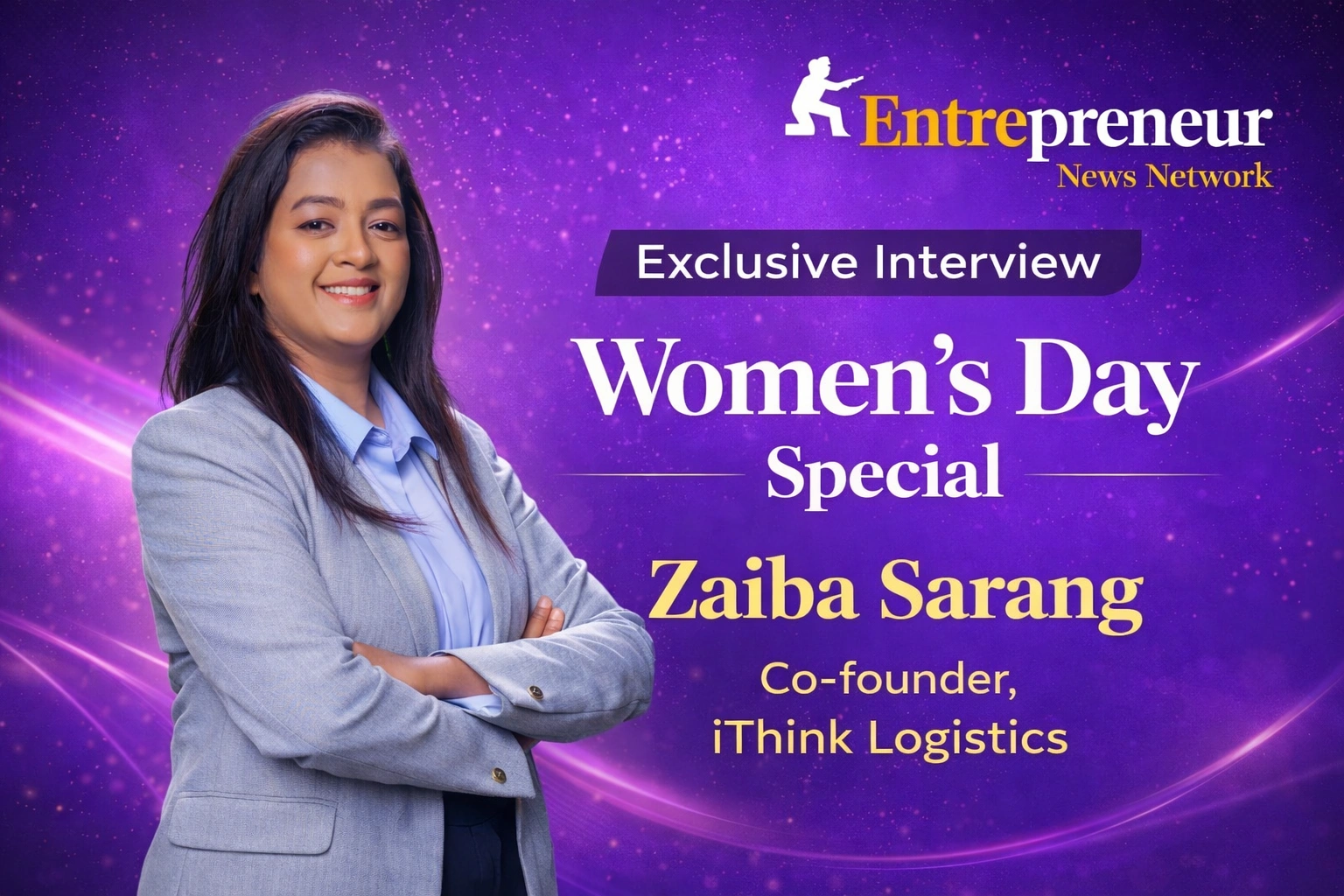
India’s logistics ecosystem has rapidly evolved alongside the explosive growth of e-commerce and quick commerce. At the centre of this transformation are platforms that make shipping smarter, faster, and more reliable for businesses across the country.
One such company is iThink Logistics, co-founded by Zaiba Sarang, which today connects brands to logistics partners across 26,000+ pin codes in India.
But behind the technology and scale lies a deeply personal entrepreneurial story — one that began in a Mumbai slum, supported by scholarships, determination, and an unwavering belief in creating opportunities for others.
In this Women’s Day special conversation, with Ankitt Y., Editor, Entrepreneur News Network, Zaiba Sarang speaks about building a logistics tech company, breaking stereotypes in a male-dominated industry, leveraging AI to solve e-commerce challenges, and why giving back to society remains central to her journey.
What inspired you to start iThink Logistics?
Although iThink Logistics was officially founded on March 6, 2017, our entrepreneurial journey actually began much earlier, around 2011.
Right after graduating with a BSc in Computer Science, I started my first company along with my co-founders Bharat and Vipul. The company focused on custom software development, where we built tailored technology solutions for brands such as Luder and DHL.
Through this experience, we developed strong expertise in technology and product development. However, we always wanted to create our own product-based business rather than only providing services.
Later, we launched another venture called GiftPunch, an online platform where we sold antique gifts sourced from markets in Mumbai, including Mohammed Ali Road and Dharavi. We built the entire platform ourselves — from the website to digital marketing — and started receiving orders from across India.
However, logistics quickly became our biggest challenge.
At that time, most e-commerce logistics companies preferred working with large brands like Amazon or Flipkart. Smaller sellers like us struggled with delayed deliveries, poor logistics coordination, and high return rates.
We realized this was not just our problem — many growing e-commerce sellers in India were facing the same logistics inefficiencies.
That insight became the core idea behind iThink Logistics.
We later onboarded two more co-founders, Paresh and Nikul, who came from logistics backgrounds. Together, we combined three founders from technology and two from logistics, which helped us build a platform focused on solving e-commerce shipping challenges.
Did you face gender bias while building a logistics startup?
To be very honest, I never felt a significant gender bias while building iThink Logistics, even though the logistics and supply chain industry is traditionally male-dominated.
Most of my co-founders are men, many of our clients are men, and even many logistics vendors are male-led organizations. But I never faced a situation where someone said that I could not succeed because I am a woman.
My background shaped my mindset very early.
I come from a lower middle-class family and grew up in a slum, where even basic needs like clean water and proper food were sometimes a challenge. When you go through such experiences, you learn that success is not defined by gender, language, or financial background.
I studied in an Urdu-medium school, and initially my English communication skills were not strong. But I focused on improving myself rather than treating these things as limitations.
In fact, being a woman entrepreneur opened many opportunities for me.
For example, I was selected for the Goldman Sachs 10,000 Women Program conducted by IIM Bangalore, which helped me understand business fundamentals at a deeper level.
I was also selected for another international program called Air SWEE, organized by TiE Global and supported by the US Embassy.
Out of 500 women applicants, only 3 entrepreneurs were selected, and I was fortunate to be one of them. This opportunity allowed me to travel to the United States for a 10-day learning program, where I observed how businesses operate in global markets.
My biggest takeaway from these experiences is simple:
Opportunities are enormous. What matters is your willingness to grab them.
How does iThink Logistics use AI to solve e-commerce shipping challenges?
The core problem we wanted to solve was high return rates and inefficient logistics partner selection in e-commerce shipping.
When we were running our earlier venture, GiftPunch, we experienced a large number of returns and failed deliveries.
India has approximately 27,000 to 29,000 serviceable pin codes, and there are 5–7 major national logistics players along with several regional logistics providers.
The challenge is that no single logistics partner performs equally well across every region.
Some logistics partners perform better in certain pin codes, while others perform better in different areas.
To solve this problem, we built an AI-based logistics recommendation engine.
This system automatically assigns the most suitable logistics partner for a shipment based on multiple parameters, including:
-
Delivery performance on specific pin codes
-
Turnaround time (TAT)
-
Expected delivery date (EDD)
-
Cash-on-delivery (COD) performance
-
Product category compatibility
-
Historical logistics performance data
For example, some logistics companies are better at delivering jewellery shipments, while others are more efficient at handling heavyweight packages.
Our AI engine analyzes these parameters and assigns the best logistics partner for every shipment.
How does your NDR technology reduce e-commerce return rates?
Another major challenge in e-commerce logistics is last-mile delivery failure.
While first-mile and middle-mile logistics usually work smoothly, the biggest issues occur during last-mile delivery, which often leads to Return to Origin (RTO) shipments.
In e-commerce logistics, delivery partners usually make three delivery attempts.
If the shipment fails after the third attempt, it is returned to the seller.
This creates multiple losses for the seller:
-
Forward shipping cost
-
Reverse shipping cost
-
Customer acquisition cost
-
Lost sales revenue
To solve this, we built a Non-Delivery Report (NDR) management system, which was initially a patented technology.
The system improves communication between the customer and delivery agents.
Our NDR process includes:
-
Automated IVR calls sent three times at different intervals
-
SMS and WhatsApp notifications to confirm delivery availability
-
A manual NDR team that directly calls customers if automated communication fails
This system ensures transparent communication with customers and significantly reduces return-to-origin shipments for e-commerce brands.
Additionally, sellers can view the entire communication history through our dashboard, including call recordings and customer responses.
What has been the biggest milestone for iThink Logistics?
One of the most important performance metrics for us is SPD (Shipments Per Day).
Currently, our platform processes around 40,000 to 50,000 shipments per day.
These shipments are not necessarily delivered directly by us but are booked and routed through our logistics platform.
Our next milestone is to reach 1 lakh shipments per day within the next financial year.
Achieving this milestone would mark a significant scale for our logistics technology platform.
How are Tier 2 and Tier 3 cities influencing India’s logistics growth?
The growth of Tier 2 and Tier 3 markets in India is extremely significant for logistics and e-commerce.
Earlier, the majority of online orders came from metro cities and Tier 1 markets.
However, today we are seeing a strong shift.
Orders from Tier 2 and Tier 3 cities are increasing rapidly, and in many cases, they are approaching a balanced distribution with metro markets.
This trend shows how digital commerce is expanding deeper into India, creating new opportunities for logistics companies and online brands.
What does leadership mean to you as a founder?
For me, leadership is not about instructing people.
Leadership is about setting an example through your own actions.
Whatever behavior a leader demonstrates is often reflected by the team.
If I expect my team to follow certain values, I must practice them first.
Organizational values should not just exist on a website or office wall — they must be actively practiced every day.
How will logistics innovation shape the future of e-commerce?
India’s logistics sector is evolving rapidly, especially with the growth of quick commerce and improved infrastructure.
Government investments in roads, logistics infrastructure, and warehousing facilities are helping the industry scale faster.
When we started, deliveries across India typically took 5 to 7 days.
Today, the industry is moving towards same-day delivery, next-day delivery, and even minutes-based delivery through quick commerce platforms.
Many brands are also adopting omnichannel strategies, combining:
-
Online commerce
-
Offline retail
-
Quick commerce platforms
This ensures that products are available to customers wherever they want to buy.
Why is continuous learning important for entrepreneurs?
Continuous learning is essential for entrepreneurs.
Even today, I make sure to pursue at least one learning program every year.
Currently, I am enrolled in the Stanford Seed Transformation Program, which is a 10-month course costing around ₹8 lakh plus GST, totaling approximately ₹10 lakh.
Learning should evolve alongside your business.
It is not just important for entrepreneurs but for anyone who wants to grow professionally or personally.
What keeps you resilient during difficult phases of entrepreneurship?
My motivation comes from my personal journey.
An NGO called MESCo (MESCO) supported my education by providing a scholarship when I was in school.
They believed in my potential and helped me complete my graduation.
That support completely changed my life.
Because of that experience, I always feel a responsibility to give back to society in the same way others supported me.
That purpose keeps me motivated even during difficult moments.
Why should founders give back to society?
Giving back does not always mean donating money.
It can also mean:
-
Creating employment opportunities
-
Sharing knowledge and mentorship
-
Helping others access opportunities
If we keep our knowledge and resources limited to ourselves, they remain restricted.
But when we share them with others, they grow and create impact.
Your message to women entrepreneurs on Women’s Day
My message is simple:
Believe in yourself.
If you do not believe in yourself, nobody else will.
It does not matter:
-
Which background you come from
-
Which language you speak
-
What financial support you have
If you truly want to achieve something, go for it with passion and dedication.
There will always be challenges — personal and professional — but those challenges should become your strength.
Keep your mindset open and growth-oriented.
If you think opportunities will not come to you because you are a woman, you will unconsciously create that barrier.
But if you believe in your skills and capabilities, opportunities will follow.

Ruchi Kumar is the associate editor at Entrepreneur News Network and TVW News India, where she leads editorial strategy, brand storytelling, and startup ecosystem coverage. With a strong focus on innovation, business, and marketing insights, he curates impactful narratives that spotlight India’s evolving entrepreneurial landscape. She has written extensively on fintech, AI and emerging startups.