
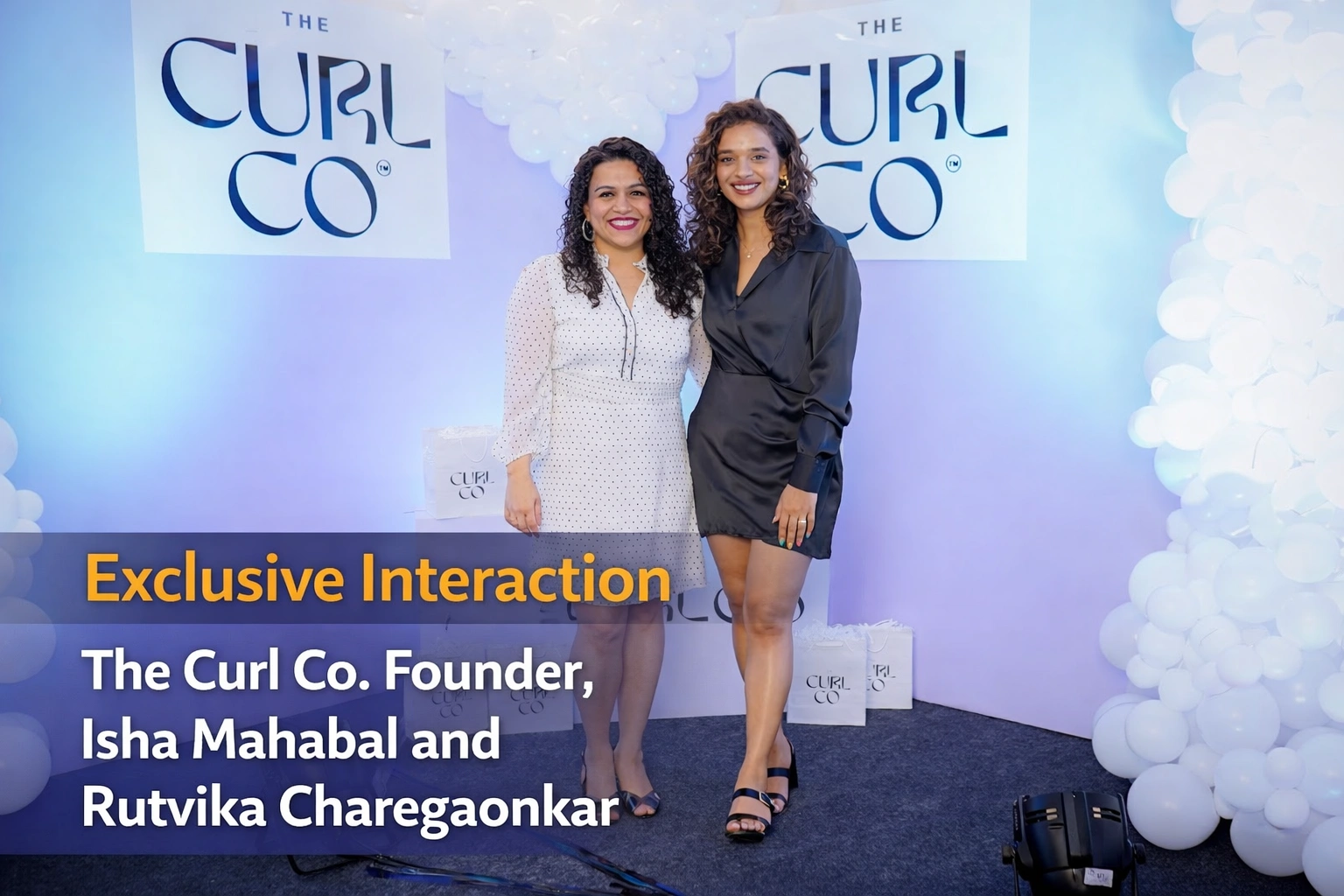
How Two Childhood Friends Built India's First Science-Backed Curly Hair Brand — With Just ₹5,000 a Month in Ads
Isha Mahabal and Rutvika Charegaonkar, co-founders of The Curl Co., share the exact numbers, the formulation science, and the philosophy behind India's fastest-growing bootstrapped curly hair brand — from 20,000+ customers to a community movement.
In a market obsessed with VC cheques and influencer blitzes, The Curl Co. did the unthinkable — it built India's most trusted curly hair brand on science, community trust, and a ₹5,000 monthly ad budget. Two years in, 20,000+ customers swear by it, and the founders aren't done yet.
Isha Mahabal is a 13-year professional hairstylist who operates four curly-hair-exclusive salons across Mumbai, Pune, Delhi, and Bangalore. Rutvika Charegaonkar is a Chartered Accountant who has spent 15 years running her family's B2B laboratory equipment business. They've been friends since childhood. In March 2023, they co-founded The Curl Co. — and within 24 months, without a single rupee of external funding and without a single paid influencer deal, they changed the conversation around curly hair in India.
This is their full story — told in their own words.
Isha Mahabal
Professional hairstylist, 13+ years. Founder of The Alchemic Beauty salon chain — 4 curly-hair-exclusive salons across India. Leads formulation, product development, marketing and community-building for The Curl Co.
Rutvika Charegaonkar
Chartered Accountant, 15 years in business operations. Manages finance, unit economics, logistics and supply chain at The Curl Co. Brings the discipline of a profitable B2B business to a consumer brand.
The $100 Billion Realisation: When India's Curly Hair Women Were Still Importing from the US
The global haircare market is valued at over $100 billion — and yet, for decades, Indian women with curly and textured hair were completely ignored by domestic brands. The choice was stark: pay thousands for imported products or resort to DIY home remedies. Isha Mahabal saw this gap every single day in her salons.
My entire education in hairdressing happened in the US. By 2016–2017, the curly hair market there was already substantial — there were established brands, communities, education. When I moved back to India, I saw something completely different. Even Rutvika, and every other girl here, used to have a list — a literal wish list for whoever was going to the US to bring back products.
People were literally boiling flaxseed or bhindi at home to make DIY curl gel. That's our traditional Indian way of solving problems. But it told me something important: the demand was enormous, the products just didn't exist here.
What I also noticed was that the few brands just starting to emerge in India were very generic. They sold products but they didn't sell education. And with curly hair, if you give someone a product without teaching them how to use it, it won't work. That was the real aha moment — not just that products were missing, but that knowledge and awareness were missing.
I started building that education individually from 2018–2019. The product line then felt like the inevitable next step, because what we needed was something India-specific: formulated for our pollution, our humidity, our culture of heavy oiling. US products simply can't survive a Mumbai monsoon with 100% humidity. Developing from scratch wasn't a choice — it was the only logical path.
The global curly hair care segment is projected to exceed $18 billion by 2030. India, home to the world's largest population with naturally wavy and textured hair, remains one of the most underpenetrated markets for science-backed, India-formulated products. The Curl Co. is betting on being first-mover in this space.
The Childhood Pact: Why a Hairstylist + CA Is the Perfect Co-Founding Pair
If two co-founders look at everything from the same angle — both left-brain or both right-brain — it becomes a tug of war over whose decision takes priority. What makes our partnership work is that we never compete for the same territory.
I'll give you a real example. When we're deciding packaging colours, I'm genuinely looking at the Pantone card number. I'm somewhat colourblind, honestly. Isha just knows which one works. So we have an unspoken rule: packaging, formula direction, community tone — that's entirely hers. Finance, unit economics, logistics, supply chain — that's entirely mine.
The only thing we need to formally align on is the big picture: where is this company going in the next 2–3 years? That's where we sit down and talk. Everything else runs on trust in each other's expertise.
Two things. First, I trust her blindly on every decision she makes in her domain. When Rutvika says we do this on the financial side, I just say, okay, you've got it. And she does the same with me on the product side. There's no second-guessing, no backseat driving. It's an unspoken rule that took no negotiating — it just emerged naturally.
Second — and this sounds simple but it's rare — we genuinely like each other as people. You can have complementary skills with someone you don't like, and it will still fall apart. With Rutvika, building a company feels like the extension of a friendship that already worked. That's the real check and balance.
"It's more or less like a marriage — and it works because we genuinely like each other as people, not just as business partners. She's very hard-working, very creative. I trust her completely in what she does."— Isha Mahabal, Co-Founder, The Curl Co.
The 30% Benchmark: How The Curl Co. Built Loyalty Without a Marketing Burn
A 30% repeat purchase rate is exceptional in any D2C vertical — in beauty, where consumers are constantly chasing the next new thing, it's rare. The Curl Co. hit this number without paid influencers, without a large ad budget, and without VC-funded discounting campaigns.
When we launched in March 2023, our entire monthly ad budget was ₹5,000. We kept it there for the first 3–4 months. And even with that, we were doing ₹50,000 a day in sales. For us, as founders coming from traditional business backgrounds, that felt normal.
What was actually doing the work was 13 years of me building an honest community of curly hair women through the salon space. When I launched the brand, people were genuinely curious — they were like, if Isha has made something, I want to at least try it. That trust was the real ad spend.
And the product had to be worthy of that trust. Our Soft Gold Curl Cream — which is still our bestseller — was the first product in India to do two jobs in a single step for curly hair. People tried it, it worked, they told their friends. No algorithm needed.
Even now, in my salons, I never try to sell our product. I tell people what works for them. If our product is the right answer, I say that. If it isn't, I say that too. That honest, neutral position is something I've maintained since day one. People can feel the difference — and they come back because of it.
Celebrities including Sanya Manotra, Mithila Palkar, Lima Barker, Tatarana Saxi and others spontaneously used and talked about The Curl Co.'s products with no paid arrangement. The brand typically found out about these endorsements a week later — through friends and family who had spotted them. Zero influencer marketing budget deployed to date.
Bootstrapping vs. Scaling: The Unit Economics of a Clean, Vegan Curly Hair Brand
Yes, it absolutely is higher. Every product we make is sulphate-free, silicone-free, paraben-free. When you replace commercially cheap chemical ingredients with premium alternatives, your raw material cost goes up significantly.
Take sulphates: they're cheap and create that satisfying lather. People in India are accustomed to that foam — it signals "clean" to them. Our shampoos don't lather the same way, so the first reaction from consumers is often, "is this working?" We have to educate them that no-foam doesn't mean no-clean.
The other challenge is with contract manufacturers. When we first started, we had to explain to them — mostly men who had never thought about curly hair routines — exactly what we needed and why. We sent them YouTube videos showing what a proper curly hair routine looks like. They were genuinely confused: "why would you not use silicone?" We had to walk them through the entire reasoning.
The unit economics reality is: better ingredients + lower volumes (because we're bootstrapped) = higher cost per unit. We offset this by keeping our price range at ₹700–₹900 — specifically because we know that anything above ₹1,000 faces significant resistance in the Indian market. Our margins are tighter than a funded brand running high volumes, but we're profitable because we don't waste on marketing that doesn't convert.
What The Curl Co. Avoids — And Why
| Ingredient | Common Use in Hair Care | Why Curl Co. Avoids / Includes It | Status |
|---|---|---|---|
| Sulphates | Creates foam/lather in shampoos | Strips all moisture from curly hair; causes brittleness, frizz and breakage long-term | Avoided |
| Silicones | Instant shine, softness, smoothness | Makes curly hair limp over time; causes curls to lose definition and bounce progressively | Avoided |
| Parabens | Preservative in personal care | Potential hormone disruptors; replaced with safer preservation systems | Avoided |
| UV Filters / SPF | UV protection | Critical for Indian climate. Intense sun exposure damages curl structure. Actively formulated in. | Included |
| Humidity Blockers | Anti-frizz in humid conditions | India's monsoon brings near-100% humidity. All Curl Co. products are India-humidity optimised. | Included |
| Chelating Agents | Removes mineral/metal build-up | Hard water is a growing Indian problem. Metals in water form a film on hair — needs targeted cleansers. | Included |
| Heavy Oiling Removers | Deep cleansing | India's oiling culture is deep-rooted. Products must effectively remove coconut/almond oil build-up. | Included |
The 20,000 Milestone: The Viral Moments That Changed Everything
Two very distinct moments stand out. The first was when we discovered that celebrities like Sanya Manotra, Mithila Palkar, and others had organically started using and talking about our products. No paid deal, no outreach from our side. We would find out a week later — when friends or family had seen a Reel and messaged us saying, "did you know this is happening?" That organic validation from people who genuinely loved the product was extraordinary.
The second was our first Curl Culture event in Chennai. We organised a paid, education-focused offline community event — and 75+ people showed up. We were not expecting that at all. That event shifted something in us: we realised we weren't just building a product company, we were building a cultural movement around curly hair. The community was hungry for this.
And sales-wise, the Soft Gold Curl Cream has been a consistent engine. It was genuinely the first product in India to do two jobs in one step for curly hair. That novelty plus quality created a loop of reviews, shares, and referrals that money couldn't have manufactured.
The Curl Co. — Growth Milestones
The "Indian Climate" Factor: Why Paris Products Fail in Mumbai
Weather is a deeply underrated variable in hair product formulation — especially for leave-in products that sit on your hair for days. Right now, I have two products in my hair. I'll keep them there for the next 2–3 days. In Indian summer heat, those products need to be lightweight, high hold, and humidity-resistant simultaneously.
Western products — particularly American and European ones — are formulated for extreme cold or dry weather. They often prioritise deep moisture. We are the exact opposite: we need to fight 100% humidity in monsoon season, not combat dryness. Their formulations create frizz in our climate instead of fighting it.
Then there's the pollution factor. Urban Indian cities have air quality that deposits particles directly onto your hair. You need a light protective film — something with UV filters — to block that. That's not something Paris formulations need to account for.
And finally, the hard water issue. A large portion of India has hard water — water loaded with metals and minerals that form a build-up film on hair over time. Your shampoo needs to specifically chelate and remove that. Standard Western shampoos don't do this.
Rutvika, do you want to add the price angle?
India is extremely price-sensitive, and I'll give you a personal example. I used to import a curly hair custard from a brand called Kinky Curly in the US. A 200g jar would land at around ₹4,000–₹5,000 by the time it reached me in India. I was hooked on it, but ₹5,000 for a jar of custard felt like a lot every single time I bought it.
That price sensitivity shaped our entire go-to-market strategy. Anything consistently priced above ₹1,000 faces real resistance in the Indian hair care market. So we built our entire product range between ₹700–₹900. It required tighter margins. But it also meant we could be accessible to the millions of women who desperately needed these products but couldn't justify import prices.
The Salon-to-Shelf Pipeline: A Living Laboratory That No Focus Group Can Replicate
The difference is enormous. On any given day in my salons, I have access to 15–20–30 real curly hair clients. I can hand them a sample, and within a week I have honest, unsolicited, real-world feedback. No one in India says no to free things — and hairdressing clients are uniquely honest. They will tell you immediately: "your product is good" or "your product is not good." There's no filter.
This accelerates everything. Instead of waiting for a 3-month focus group study, I know within days whether a formula direction is working. I also know exactly who is giving me feedback: working women, students, mothers. Different hair challenges, different lifestyles, different environments. I can design products around real human problems.
The other advantage is that my clients have become product collaborators over the years. I send them samples and WhatsApp them directly. They send back voice notes. It's the most authentic form of co-creation possible — and it's all happening in real-time, continuously. That's something a VC-funded brand spending ₹5 crore on third-party research genuinely cannot replicate.
Key Insight: The entire Southern belt — states with the highest density of naturally textured hair — remains largely untapped. Curl Culture events confirmed in Kochi and Hyderabad.
Nykaa onboarding in final stages. Zepto/Q-commerce not yet active.
From "Fixing" to "Celebrating": How Curl Culture Classes Are Building a Movement
Curly-haired girls in India have been called everything growing up — "Teri Maggi noodles jaisi baal hai", "Hagrid", "bijli ka wire." The trauma from hair shaming is real and it runs deep. So when one of our products works, the reaction from customers isn't just "great product." It's often: "The Curl Co. changed my life."
We get emails and messages from customers talking about how, before finding us, they were so self-conscious about their hair that it affected their confidence, their job performance, their relationships. Once they understood how to care for their curl type, their whole personality changed. That's not a marketing claim — those are real messages we receive.
In the Curl Culture classes, the first thing we do is normalise imperfection. We tell attendees: a little frizz is okay. You do not have to comb your hair every day. In Indian pop culture, there's this image of a woman brushing her hair 700 times before bed to make it smooth and silky — that destroys curly hair. We're actively dismantling that narrative.
The data is very clear. Right now, 50% of our sales are from Maharashtra. Karnataka adds another 10%, Gujarat 7%, Tamil Nadu 7%. The entire Southern belt — states with the highest density of naturally textured and curly hair — is almost completely untouched. That's our first priority.
We're doing Curl Culture events in Kochi and Hyderabad in the coming months specifically for this reason. Community-first, then commerce. In parallel, we're launching travel-size packs — 50g and 75g — next month. These smaller SKUs do much better on Flipkart in Tier 2 and Tier 3 cities, and they're a lower-risk entry point for first-time buyers.
International is on the table — Sri Lanka, Maldives, Dubai all have significant curly-haired populations and large Indian diaspora. But India first. We're not even on Nykaa yet — we're in the final stages. There's a massive runway within India before we look outward. We want to walk before we run.
When asked about how global tensions and tariff environments would affect expansion plans, Rutvika noted: "The war and tariffs will affect the balance sheet. Packaging tubes are up 70%, all raw materials up at least 50%, fuel surcharges have risen. But because we have reserves and operate profitably, we don't see major strategic changes needed. We stay frugal, keep our reserves intact, and keep pushing as if the whole world is ours to conquer."
Rutvika: Revenue. Top line and bottom line. Always. If the business isn't making money, nothing else matters. (laughs) She says SKU, I say revenue — see, this is exactly the complementary partnership at work.
Isha: Let each other shine in what they do best. I concentrate on understanding hair, understanding people, understanding what they want — because that's my strength. If I wanted to be a CA, I would have become one. And I think she feels the same way about what she does. When you truly let someone shine, they do their best work.
Rutvika: And just one more word — kindness. Just that. When you're building something hard, kindness is the foundation. Everything else you can figure out.
Respect Boundaries
Define territories clearly and never cross them without invitation. No micro-management. No domain wars.
Let Each Other Shine
If your co-founder is the best person to make a decision, step aside and trust them completely. That's not weakness — it's how great companies are built.
Complement, Don't Compete
Left brain + right brain. Numbers + creativity. The power comes from the gap between skill sets, not the overlap.
Lead With Kindness
Building a company is hard. The partnership that holds through the difficulty is the one built on genuine human kindness — not just complementary skills.