
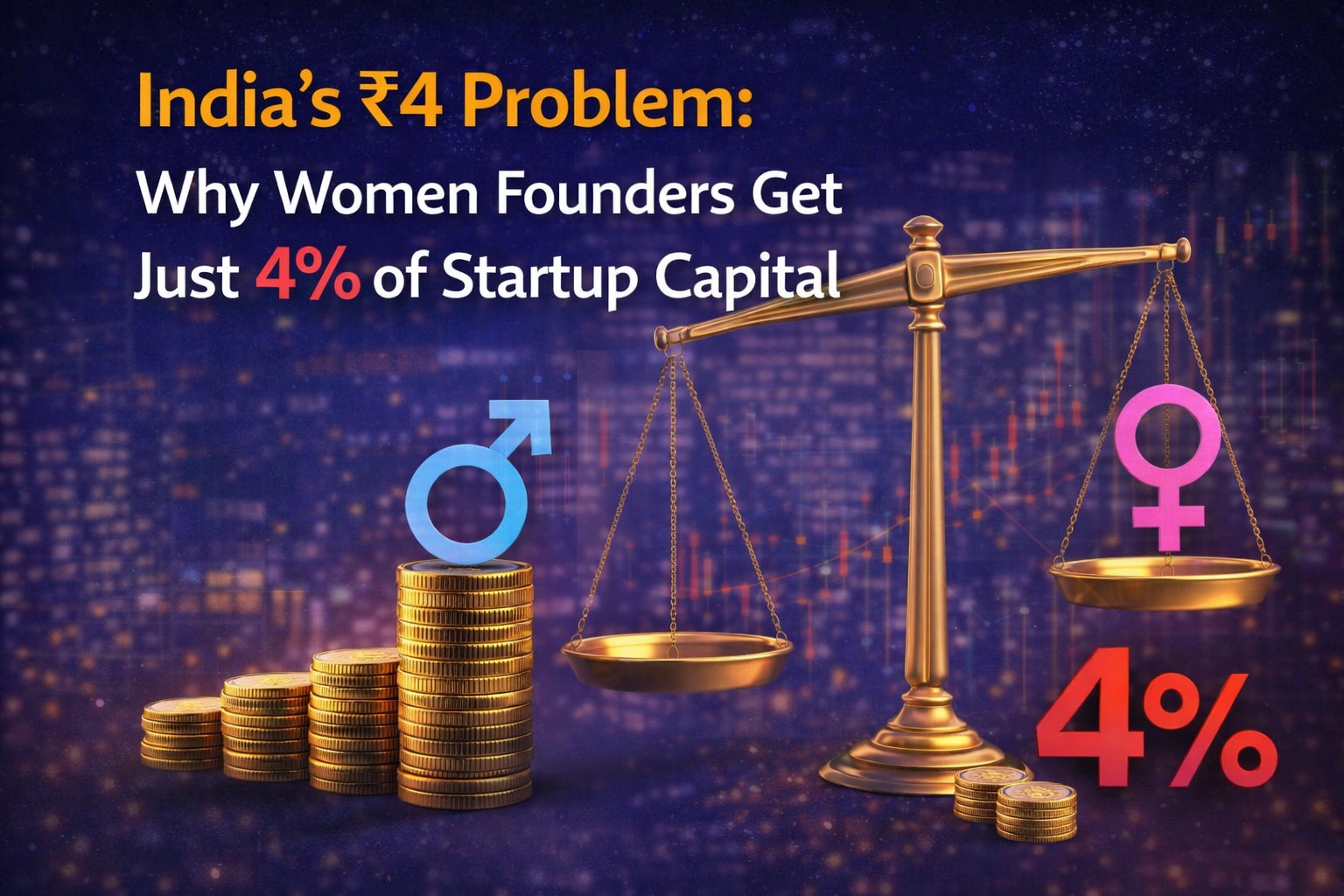
The ₹4 Problem: India's Hidden Market Crisis Is Costing Billions
How structural bias — not a talent shortage — is starving women founders of capital, and why it's India's most expensive missed opportunity.
India calls itself the world's third-largest startup ecosystem. Yet a single number — released by Kalaari Capital's CXXO initiative in March 2026 — exposes a structural rot beneath the celebration: for every ₹100 raised by founders from India's elite startup networks, women receive just ₹4.
A Market Failure, Not a Talent Gap
The industry's default explanation has long been a "weak pipeline" — too few women building fundable startups. The 2026 data decisively demolishes this narrative.
India has recorded a 1.7x increase in girls enrolling in high-school STEM subjects between 2013 and 2024. Women registering for the JEE — the nation's most competitive engineering entrance exam — doubled between 2015 and 2025. As of early 2026, over 1 lakh DPIIT-recognised startups have at least one woman director or partner. The pipeline is full. What's broken is the gate on the other side.
Despite this surge, women remain just 0.6× as likely as men to emerge as founders from elite startup-producing institutions. The talent is entering the funnel — but a set of structural filters prevents it from reaching a term sheet.
The Network Problem No One Talks About
Indian venture capital runs on "startup mafias" — tight circles of alumni from a handful of unicorns and IITs. Capital flows through referrals, warm introductions, and informal dinners. Women are structurally excluded from these loops.
Even when women share the same academic pedigree as their male peers, they are far less likely to be tapped for the informal conversations where real deal-making happens. This produces a self-reinforcing cycle: investors fund founders who resemble those they've previously backed — overwhelmingly men — which further marginalises qualified women.
The funding gap isn't just a question of equality. It's a failure of price discovery. When an entire category of founders is systematically underestimated, the market is leaving money on the table.
— Vani Kola, Managing Director, Kalaari Capital
The Decision-Maker Gap: Who Writes the Cheques?
The bias is architectural. While women represent 38% of VC analysts — a real and meaningful gain — representation collapses at the level that matters: decision-making. Only 16% of partners at Indian VC firms are women.
When 84% of capital allocators are men, homophily — the human tendency to trust and associate with people who look like us — becomes a systemic risk. It's not malice; it's pattern-matching. And it is costing the Indian economy billions.
Promotion vs. Prevention: The Pitch Room Bias
The disparity doesn't end when a woman walks into a pitch room. Research cited in the CXXO report reveals a striking questioning bias: male founders are asked promotion-oriented questions — about scale, growth, and moonshot potential. Women founders face prevention-oriented questions — about risk, domestic responsibilities, and who's "handling things at home."
Questions such as "What does your husband think?" or "Who's looking after the children?" are not merely outdated — they are economically consequential. They force women to defend their present rather than pitch their future, resulting in smaller ticket sizes and harder follow-on rounds. The bias is in the room, and it compounds at every stage.
The Macroeconomic Cost of Ignoring Women Founders
The ₹4 vs. ₹100 gap is not just a social injustice — it is a measurable economic failure with national consequences.
- $158 billion+ — the credit gap currently facing women-led MSMEs across India, representing suppressed economic output at scale.
- ₹40 lakh crore — the cumulative GDP-equivalent opportunity that could be unlocked by enabling women's full participation in financial investments, per a 2026 Lxme-EY report.
- 35% higher ROI — the return advantage data attributes to women-led startups relative to non-diverse teams, despite receiving less capital.
- 70% more new markets — diverse leadership teams capture significantly broader market footprints, underscoring the commercial case for inclusion.
The irony is sharp: the most underfunded segment of India's startup ecosystem consistently outperforms its better-funded peers. The market is mispricing an entire asset class.
What Needs to Change — Now
Panels, awards, and "Women in Tech" hashtags are not a strategy. Fixing the ₹4 problem requires structural intervention:
- Intentional Capital Platforms: Initiatives like Kalaari's CXXO — deploying conviction-led capital specifically at the earliest stages of women-founded ventures — must scale from exception to norm.
- Partner-Level Parity: Research shows that VC firms with women at 30%+ partner representation invest significantly more in female founders. This is not altruism — it is returns optimization.
- Bias Audits: Venture firms must actively track their own questioning patterns, referral flows, and portfolio diversity. What isn't measured doesn't change.
- Reframe the Narrative: Women-led startups are not a "social impact" category. They are an undervalued, high-return opportunity hiding in plain sight.
India has produced Falguni Nayar. It has produced Ghazal Alagh. These are not outliers who succeeded despite the system — they are proof of what happens when women-led businesses are permitted to scale. The ₹4 problem is a structural market flaw, but it is also the defining investment opportunity of the decade.
For the founders still building against the odds: the data is on your side, even when the capital isn't — yet. For the investors still pattern-matching: the most mispriced asset in Indian venture capital is sitting right across the table from you.

Ruchi Kumar is the associate editor at Entrepreneur News Network and TVW News India, where she leads editorial strategy, brand storytelling, and startup ecosystem coverage. With a strong focus on innovation, business, and marketing insights, he curates impactful narratives that spotlight India’s evolving entrepreneurial landscape. She has written extensively on fintech, AI and emerging startups.