
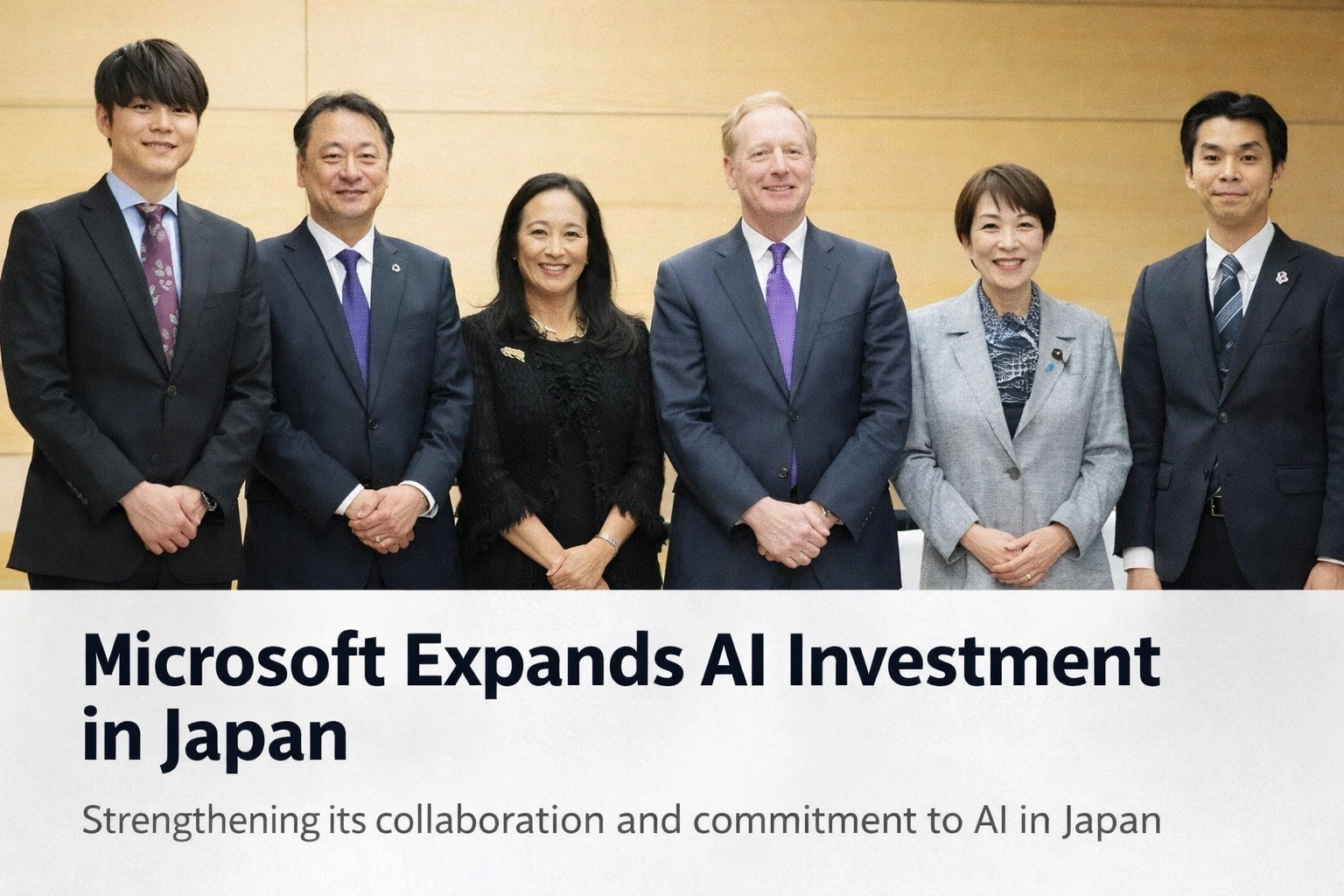
Microsoft's $10 Billion Bet on Japan's AI Future
The software giant commits 1.6 trillion yen to Japan between 2026 and 2029 — funding AI data centres, cybersecurity partnerships, and a mission to train one million technology professionals.
Published April 3, 2026 · 6 min read
A Landmark Announcement in Tokyo
On April 3, 2026, Microsoft unveiled one of the largest technology commitments ever made to Japan: a four-year, 1.6 trillion yen ($10 billion) investment designed to transform the country's artificial intelligence ecosystem. The announcement was made during a visit to Tokyo by Microsoft Vice Chair and President Brad Smith, who met with Prime Minister Sanae Takaichi to discuss the programme.
The pledge covers three interlocking priorities — AI infrastructure expansion, cybersecurity cooperation with Japanese government agencies, and large-scale workforce development. Together, they position Japan as a central pillar of Microsoft's broader strategy in Asia, where demand for cloud and AI services is accelerating rapidly.
"Demand for cloud and AI services is growing in Japan. This investment reflects our confidence in Japan's potential to lead in the next era of technology." — Brad Smith, Vice Chair & President, Microsoft
Expanding AI Infrastructure Across Japan
A substantial portion of the $10 billion will fund the construction and upgrade of data centres in both eastern and western Japan. These facilities will be equipped with advanced graphics processing units (GPUs) and next-generation hardware to support high-performance AI workloads, including the training of large language models.
Microsoft will develop this infrastructure in close collaboration with domestic firms. The company has named SoftBank and Sakura Internet as primary partners, both of which will supply GPU-based compute resources hosted entirely within Japan. This arrangement allows Japanese businesses and government agencies to use Microsoft Azure services while keeping sensitive data onshore — an increasingly important requirement given Japan's strict data governance rules.
Sakura Internet's stock surged roughly 20% on the Tokyo Stock Exchange following the announcement, reflecting market confidence in the deal's commercial significance.
Corporate Partners in the Programme
Beyond SoftBank and Sakura Internet, Microsoft is expanding its collaborations across Japan's established technology sector. Five major domestic IT companies will partner on workforce training initiatives:
Training One Million Engineers by 2030
Human capital is central to Microsoft's plan. The company has committed to training one million engineers and developers across Japan by 2030, working with the five IT partners listed above. The curriculum will focus on AI skills, cloud computing, and enterprise software — disciplines where Japan faces a widening talent gap as adoption of generative AI tools accelerates across industries.
Microsoft's own data indicates that approximately one in five working-age people in Japan already uses generative AI tools in some capacity — one of the higher adoption rates in Asia. This training initiative is designed to convert that broad awareness into deep technical expertise capable of driving economic productivity and innovation.
The programme also supports Prime Minister Takaichi's policy agenda, which targets advanced technologies — including AI — as a primary lever for national economic growth and competitiveness.
Cybersecurity: A Strategic Priority
Alongside its infrastructure and training commitments, Microsoft will deepen its cybersecurity cooperation with Japanese government authorities. The partnership involves establishing formal channels for sharing threat intelligence, coordinating responses to state-sponsored cyber intrusions, and supporting national efforts to combat cybercrime.
Japan has faced a rising volume of sophisticated cyberattacks in recent years, targeting critical infrastructure, defence supply chains, and government networks. Microsoft's involvement — given its global visibility into threat actor behaviour — is expected to meaningfully strengthen Japan's national cyber posture.
The arrangement also ensures that Japanese government agencies relying on Microsoft Azure for cloud services benefit from real-time security insights rather than depending solely on domestic capabilities.
Investment at a Glance
- ●$10 billion (¥1.6 trillion) committed across 2026–2029
- ●Data centre expansion in eastern and western Japan with advanced GPU hardware
- ●1 million engineers and developers to be trained by 2030 via NTT Data, Fujitsu, NEC, and Hitachi
- ●SoftBank and Sakura Internet to supply Japan-based AI compute (GPUs)
- ●Microsoft Azure services to be accessible with data kept onshore within Japan
- ●Formal cybersecurity intelligence-sharing programme with Japanese authorities
- ●Announced by Brad Smith during official visit to Prime Minister Sanae Takaichi
- ●~20% of Japan's working-age population already uses generative AI tools (Microsoft data)
Context: Microsoft's Broader Push in Asia
The 2026 commitment builds directly on Microsoft's earlier $2.9 billion investment in Japan announced in April 2024, which covered two years of hyperscale cloud and AI infrastructure expansion. The new pledge — nearly three-and-a-half times larger — signals a significant step up in ambition and urgency.
The move is part of a wider competitive dynamic across the Asia-Pacific region. Global technology companies including Google, Amazon Web Services, and Alibaba Cloud have all made substantial regional investments in recent years, racing to establish localised AI computing capacity ahead of what analysts expect to be a multi-decade demand surge.
Japan is a particularly attractive market: it has a sophisticated enterprise base, supportive government policy, a high existing AI adoption rate, and a pressing need for productivity gains given its ageing workforce. Microsoft's investment acknowledges all of these factors while also helping to ensure Azure's competitive position against rivals as Japanese enterprises build out their AI strategies.
Investment Timeline
What This Means for Japan's Tech Economy
The immediate market reaction — particularly Sakura Internet's 20% stock jump — suggests investors view Microsoft's partnership commitments as commercially significant, not merely symbolic. For smaller Japanese cloud providers, co-developing infrastructure alongside a global hyperscaler offers both revenue certainty and technological credibility.
For Japan's broader economy, the workforce development programme addresses a structural challenge: closing the gap between AI awareness and AI capability. As generative AI tools become embedded in workflows across manufacturing, finance, healthcare, and the public sector, having a trained base of engineers able to build, deploy, and maintain those systems becomes a critical competitive asset.
The cybersecurity dimension may prove equally consequential over time. Formal intelligence-sharing between a private technology platform with global threat visibility and a national government creates a model that other democracies — and other Microsoft markets — will be watching closely.
Altogether, Microsoft's $10 billion commitment represents one of the most comprehensive technology partnerships Japan has entered into with a foreign company — spanning infrastructure, human capital, and national security in a single, multi-year programme.

Ruchi Kumar is the associate editor at Entrepreneur News Network and TVW News India, where she leads editorial strategy, brand storytelling, and startup ecosystem coverage. With a strong focus on innovation, business, and marketing insights, he curates impactful narratives that spotlight India’s evolving entrepreneurial landscape. She has written extensively on fintech, AI and emerging startups.