
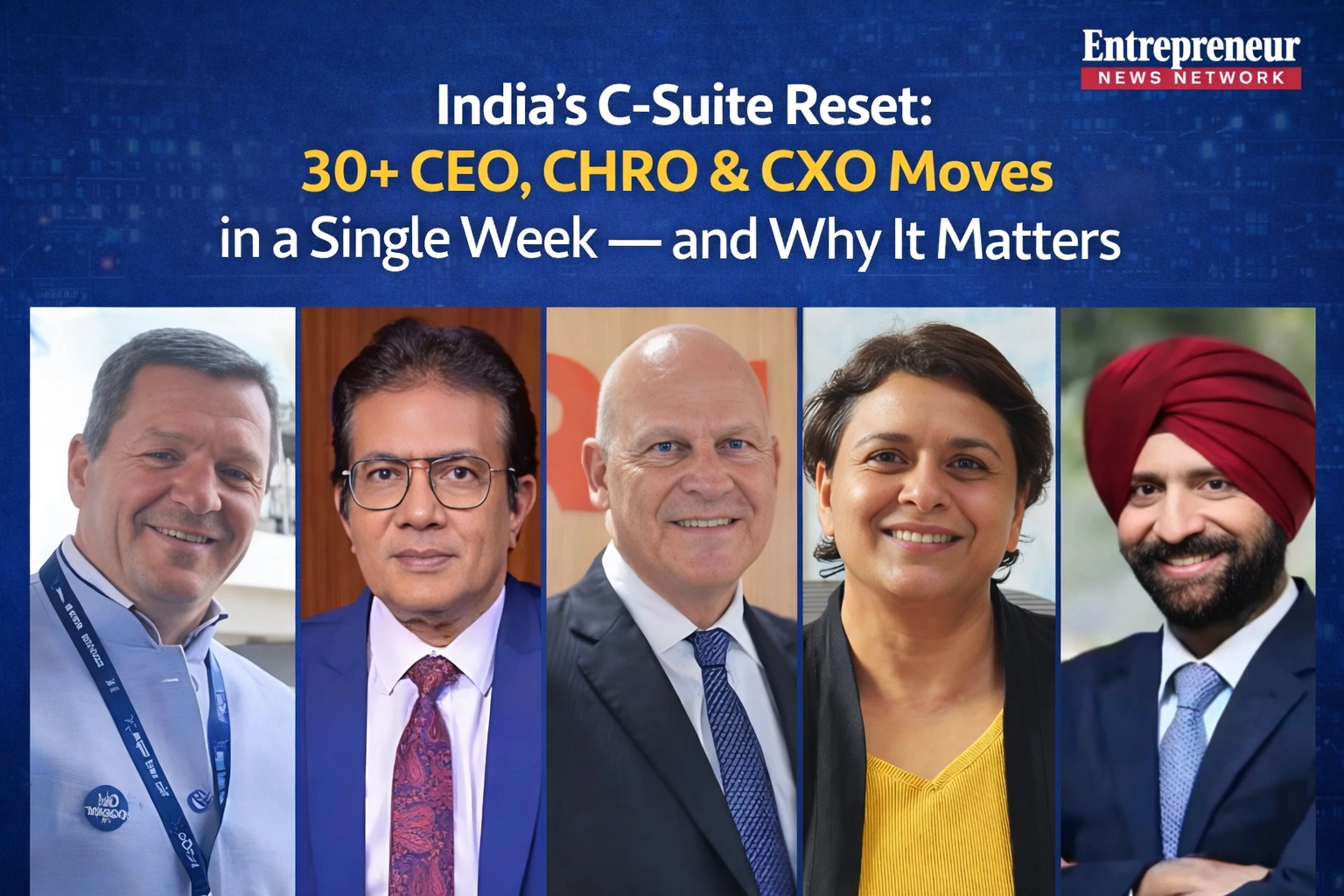

India's C-Suite Reset: 30+ CEO, CHRO & CXO Moves in a Single Week — and Why It Matters
From aviation's dual leadership shake-up to CHROs taking on business mandates across manufacturing, tech and real estate — the first week of April 2026 delivered one of India Inc's most concentrated waves of executive change in recent memory.
The first week of April 2026 has delivered an unusually concentrated wave of CEO, CHRO, and CXO changes across India Inc. In one boardroom after another, companies have appointed new chief executives, expanded regional mandates, refreshed governance benches, and accepted senior exits — all within days of each other.
"This is not random churn. It is a strategic response to a difficult operating environment: uneven demand, tighter capital, rising compliance pressure, and the urgent need to turn AI from a pilot programme into a scalable business system. In such an environment, boards do not pause leadership decisions. They accelerate them."
Aviation: Two Airlines, Two CEOs Gone in One Cycle
India's commercial aviation sector has rarely seen simultaneous leadership upheaval of this scale. In the span of a few weeks, both of the country's two largest airlines have lost their chief executives — and both have been forced to look for replacements in a demanding operational environment.
Air India: Campbell Wilson steps down
Air India CEO Campbell Wilson officially resigned on April 7, 2026 — more than a year ahead of his contracted tenure ending in July 2027. The New Zealand-born aviation executive, who brought over 26 years of Singapore Airlines experience to the role, had quietly conveyed his intention to leave to chairman N. Chandrasekaran as far back as 2024.
Wilson's tenure was defined by monumental undertakings: the acquisition and merger of four airlines, the addition of 100 aircraft to the fleet, and the full modernisation of systems under the Vihaan.AI transformation plan. Air India's standalone revenue rose 13% to ₹61,080 crore in FY25, and losses narrowed from ₹5,031 crore to ₹3,976 crore. Yet, the airline is projected to post losses of approximately ₹20,000 crore in FY26, battered by Middle East airspace closures, delayed aircraft deliveries, and the ongoing fallout from the Ahmedabad crash of June 2025, which claimed 260 lives. The airline also faces regulatory action over safety lapses — including operating an aircraft without an airworthiness certificate on 8 separate occasions.
Air India and Air India Express reported a combined FY25 loss of ₹10,859 crore on revenues of ₹78,636 crore, making them the largest loss-making entities in the Tata Group portfolio. Wilson will remain in the role until a successor is confirmed. The AAIB final report on the Ahmedabad crash is expected by June 2026, and major strategic decisions — including CEO selection — are likely tied to it.
IndiGo: Willie Walsh named as next CEO
IndiGo, India's largest carrier by market share, had already navigated its own departure when Pieter Elbers resigned on March 10, 2026, following a turbulent December that saw mass flight cancellations and estimated losses of ₹2,000 crore. On March 31, IndiGo confirmed that Willie Walsh — the former CEO of British Airways and Director General of IATA — would succeed Elbers. Walsh's IATA tenure closes July 31, 2026; he is expected to formally join IndiGo on August 3, 2026, subject to regulatory clearances.
Key Appointments at a Glance
Across banking, technology, FMCG, life sciences, manufacturing, and infrastructure, here is a curated view of the most significant moves:
Vinay Muralidhar Tonse
Appointed MD & CEO alongside S. Anantharaman as Chief Risk Officer. One role sets direction; the other hardens controls at a bank rebuilding institutional credibility.
Sam Mathew
Elevated from President to CEO after 18 months leading global markets. The move is explicitly tied to the company's AI-first, automation-led platform strategy.
Vikas Chawla
Appointed to a newly created President role — a structural redesign giving one leader direct ownership of growth and brand expansion across a larger geography.
Kulmeet Bawa
Effective April 6, 2026. Role sits at the intersection of enterprise software growth, AI workflow adoption, and market expansion across India and SAARC.
Santhosh Viswanathan
Mandate expanded from India to the full Asia Pacific and Japan region — a consolidation designed to align commercial priorities and customer engagement under one leader.
Sumir Bhatia
Named Lenovo's first-ever Chief Commercial Officer for APAC, combining enterprise sales, channel and alliances to tighten revenue alignment across markets.
Arun Rao
Brings over 3 decades of HR leadership. Appointed alongside new COO Vikram Puranik — a dual hire aimed at resetting execution rhythm after three simultaneous senior exits.
Maninder Kapoor Puri
Moved from Biocon to lead HR for Syngene's workforce of over 5,500 scientists. Brings 30+ years of experience in organisational transformation and talent strategy.
Neha Saxena Shenoy
In a scale-heavy real estate business, the CHRO role now carries direct accountability for capability building and organisational design.
Aditya Kohli
Hired for organisational effectiveness, not just policy and engagement — reflecting a sector-wide shift in manufacturing HR mandates.
Ritika Chopra (elevated)
JSW Paints
Elevated as CHRO as integration and scale become central priorities. The role now carries direct business relevance beyond traditional HR functions.
Mark Paulek
Promoted to CHRO effective April 1 — underlining how global tech firms are prioritising continuity in people leadership during transformation at scale.
Ravi Kumar Chirugudu
Semiconductor veteran appointed as President & COO following a major funding round and acquisition. The company transitions from growth mode to operating discipline.
Bikram Mazumdar
Responsible for AI-enabled CX and enterprise expansion across India, Southeast Asia, North Asia, and Korea — a classic market-expansion mandate in digital commerce.
Pankaj Rathi
Appointed to strengthen funding, capital adequacy, and compliance as the company scales in a tighter capital environment.
Vijay Sampathkumar
Appointed Chief Business Officer to lead global go-to-market for AI data-centre infrastructure — a sector experiencing explosive demand growth.
Notable Exits
Kavita Singh, CHRO — United Breweries: Stepped down after a five-year tenure. In large, distributed manufacturing organisations, senior CHRO exits typically mark the close of a strategic phase rather than a performance issue.
Navin Chandani, CBO — Pine Labs: Resignation adds to an emerging pattern of tighter expectations in fintech and digital commerce, where profitability and governance now carry equal weight to growth metrics.
Campbell Wilson, CEO — Air India: After four years leading the ₹18,000 crore Tata takeover turnaround. Wilson added 100 aircraft, merged four airlines, and modernised operations — yet the airline faces projected FY26 losses of ₹20,000 crore.
Pieter Elbers, CEO — IndiGo: Resigned March 10, 2026, after a turbulent December quarter involving mass flight disruptions and estimated losses of ₹2,000 crore.
Why Is This Happening Now?
The market is cautious, but leadership is moving fast. That is not a contradiction — it is a defining characteristic of 2026's operating environment. When growth is uneven and capital is selective, boards converge on three things:
Boards are appointing leaders who can deliver in difficult conditions — not just communicate vision. Track record across economic cycles now outweighs charisma.
Wider mandates and reduced reporting layers are being used to remove decision delay. Several new roles — Intel APJ, Lenovo APAC CCO, Hyatt India President — reflect this consolidation.
Finance, risk, and governance appointments are accelerating. YES Bank's dual hire — CEO plus CRO on the same day — is the clearest signal of this intent.
AI Is Reshaping How Leadership Is Designed
What is emerging from this wave of moves is hard to miss. Artificial intelligence is not a side conversation — it is actively restructuring how companies organise themselves, and therefore how they hire.
Microland explicitly tied its CEO elevation to an AI-first, autonomous operations strategy. Scaler has split its leadership structure around AI-driven skilling demand. ServiceNow and Zendesk are building their India and Asia-Pacific leadership roles around AI-enabled enterprise workflows. Intel and Lenovo are consolidating regional mandates to better align commercial and technical execution in increasingly AI-intensive markets. Meanwhile, Refroid and U-Flex are hiring directly into data-centre and AI infrastructure roles — sectors experiencing structural, not cyclical, demand growth.
The shift runs deeper than technology adoption. AI is not just changing what companies build — it is changing how they are organised. It forces closer alignment between product, sales, operations, customer success, and workforce planning. That is why many of the new roles in this cycle are broader, more integrated, and explicitly cross-functional.
The CHRO Role Has Become a Business Role
Perhaps the most consequential structural shift visible in this cycle is the evolution of the CHRO mandate. Appointments at Birlasoft, Emaar India, Syngene, Tenneco India, JSW Paints, Kyndryl, and others share a common thread: HR leaders are being hired with hard, operational briefs — not traditional people-and-culture mandates.
India's labour code reforms — covering wages, social security, industrial relations, and occupational safety — have added a new layer of complexity to workforce management. Classifying workers, managing contractors, structuring teams across states, and running compliant payroll at scale is no longer legal work. It is organisational design work. Boards are staffing accordingly.
The Macro Context: A Reshaping C-Suite Economy
Across India Inc, boards are no longer extending runway for leaders without visible operating results. The combination of tighter capital, AI-driven transformation pressure, post-pandemic structural corrections, and new compliance obligations is compressing the timeline for results — and shortening CEO and CXO tenures with it.
With over 2 lakh registered startups in India and enterprise organisations undergoing parallel transformation, the demand for leaders capable of balancing growth, risk, AI and people — not in silos, but as a single integrated agenda — has never been higher.
What This Cycle Tells Us: 5 Key Takeaways
- The CHRO role has been permanently upgraded. Seven CHRO appointments in one week, all with operational and business mandates, mark a structural — not cyclical — shift in the role's scope.
- Regional roles are becoming mini-CEO roles. From Intel APJ to ServiceNow India & SAARC and Lenovo APAC, regional leaders are now given full P&L accountability and wider commercial authority.
- Aviation leadership is in a genuine crisis. Two of India's top three airlines are searching for new CEOs simultaneously — against a backdrop of geopolitical disruption, safety scrutiny, and mounting losses.
- Boards are choosing operating experience over vision statements. Most appointments in this cycle favour leaders with multi-cycle exposure and the ability to execute through uncertainty.
- Succession is now strategy. If the leadership bench lacks depth, boards will not wait — as Birlasoft's triple exit and Tessolve's post-funding COO hire both demonstrate.
Related topics

Ruchi Kumar is the associate editor at Entrepreneur News Network and TVW News India, where she leads editorial strategy, brand storytelling, and startup ecosystem coverage. With a strong focus on innovation, business, and marketing insights, he curates impactful narratives that spotlight India’s evolving entrepreneurial landscape. She has written extensively on fintech, AI and emerging startups.