
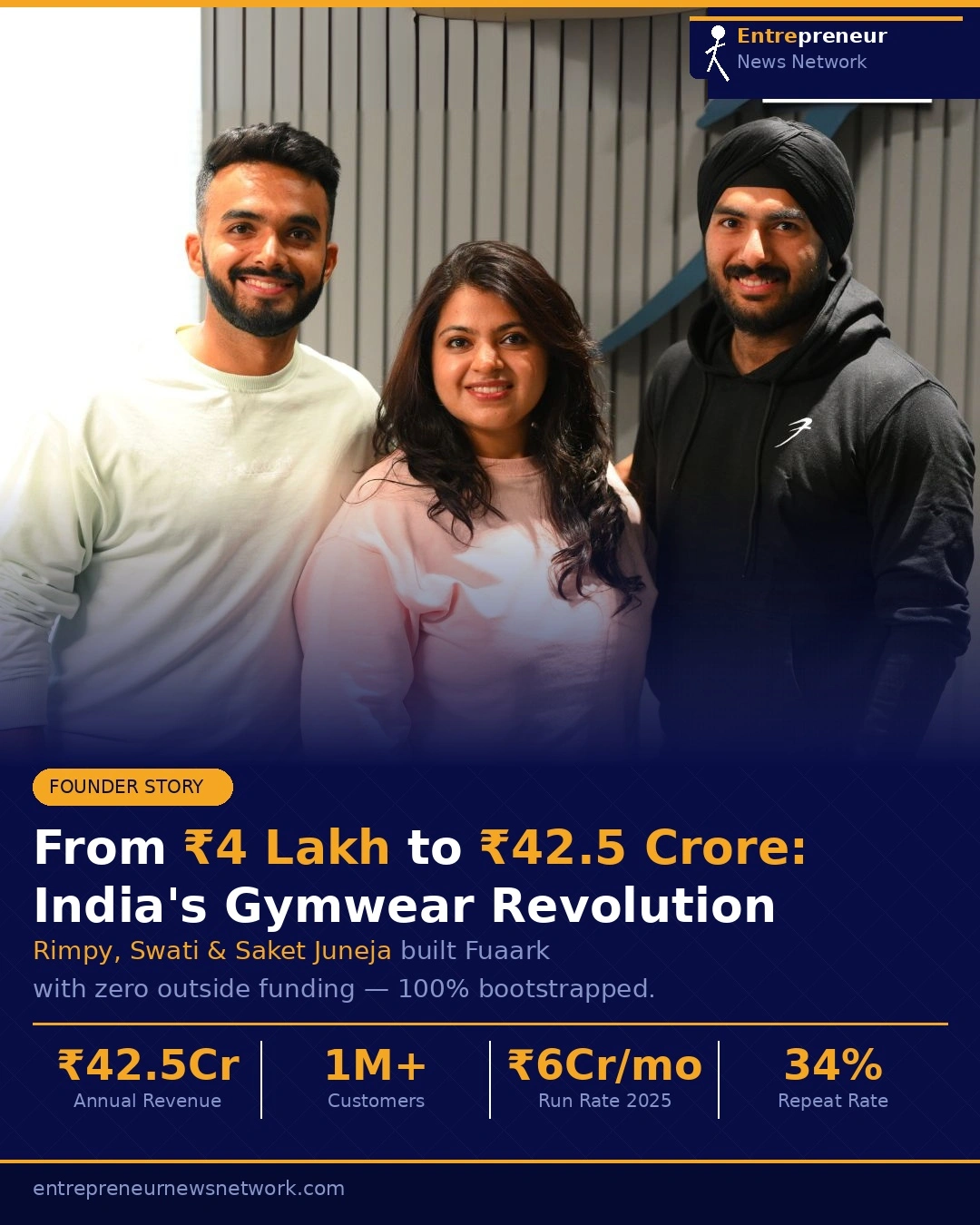
How a Family Trio from Surat Built India's Gymwear Revolution
Rimpy, Swati, and Saket Juneja spotted a gap between Decathlon and Nike — and turned a simple family loan into Fuaark, a 100% bootstrapped gymwear brand with over 1 million customers and no outside funding.
When Rimpy Juneja walked into a gym in Surat sometime around 2016, he wasn't thinking about building a business. He was just frustrated. The T-shirts he owned either looked terrible under a barbell or cost more than his monthly gym membership. The affordable brands were shapeless. The premium ones were priced for a different income bracket altogether. That frustration turned into a question — and the question turned into Fuaark.
Founded in January 2017 by Rimpy Juneja, his wife Swati Juneja, and later his brother Saket Juneja, Fuaark has become one of India's most compelling bootstrapped startup success stories. With zero external funding, a starting capital of just ₹10 lakh — of which ₹4 lakh was borrowed from Rimpy's father — the Surat-based family trio has built a gymwear brand that now generates ₹42.5 crore in annual revenue, serves over 1 million customers, and runs out of a 25,000 sq. ft. office-warehouse complex.
Meet the founders
The three together form a rare combination — a marketer, a product specialist with luxury fashion experience, and an operator with an entrepreneur's instinct. Swati handles brand and community, Saket drives product innovation, and Rimpy coordinates strategy and growth. Their complementary strengths, combined with the trust that only a family team brings, have been central to Fuaark's ascent.
Spotting the gap: between Decathlon and Nike
India's fitness apparel market in 2017 was polarised. On one end sat Decathlon — affordable but generic, designed for the casual exerciser rather than the dedicated lifter. On the other end were Nike and Adidas — aspirational, premium, and priced well beyond the average Indian gym-goer's budget. Between those two poles, there was a conspicuous void.
What Rimpy and Swati identified was not just a price gap — it was a purpose gap. Existing brands were designing clothes for people who occasionally exercised. Nobody was designing for the person who trains six days a week, tracks progressive overload, and takes their lifting seriously. Fuaark was built from day one for that person.
Starting with ₹10 lakh — and six months of fabric research
Fuaark's first product was born not in a design studio but in a factory search. Before a single item went on sale, Rimpy and Swati spent six full months testing fabrics across India. Their goal was specific: find the same quality of material that Nike and Adidas sourced their performance apparel from.
They eventually tracked down the factory that supplied fabrics to global giants — a supplier most Indian brands had never approached because the material cost was higher. Fuaark chose it anyway. The sweat-wicking, four-way stretch fabric became the brand's foundational differentiator, baked into the product before the brand had a single rupee of marketing spend.
The total founding capital was ₹10 lakh: Rimpy borrowed ₹4 lakh from his father and invested ₹6 lakh from personal savings. No angels, no venture capitalists, no accelerators. The brand launched initially at Greywolf before being rebranded to Fuaark in October 2017 — a name chosen to resonate with the energy and defiance of India's hardcore gym culture.
The product edge: engineering clothes for real lifters
Saket Juneja's Tommy Hilfiger background proved crucial here. He brought a structured understanding of garment construction — how seam placement affects movement, how fabric weight changes performance, and how fit variations affect the perception of a physique. These details set Fuaark apart from competitors that treated gym apparel as casual fashion.
Revenue journey: from ₹5.85 crore to ₹42.5 crore in four years
Fuaark's growth trajectory is a textbook case of organic, community-driven scaling. In May 2018 — roughly a year after launch — the brand listed its products on Amazon, Flipkart, and Myntra, opening up national distribution without a single retail store.
| Financial Year | Annual Revenue | Growth | Scale |
|---|---|---|---|
| FY21 | ₹5.85 crore | — | |
| FY22 | ₹12 crore | +105% | |
| FY23 | ₹23 crore | +92% | |
| FY24 | ₹40 crore | +74% | |
| FY25 | ₹42.5 crore | +6% |
By January 2025, Fuaark had reached a monthly revenue run-rate of ₹6 crore. Critically, around 42% of all sales come through the brand's own website — a high direct-to-consumer ratio that gives Fuaark significantly better margins than brands that are almost entirely marketplace-dependent. The remaining 58% is split across Amazon, Myntra, Zepto, and other platforms. The brand maintains a 34% repeat purchase rate — a strong signal of product quality and customer loyalty.
Marketing without a celebrity budget: the influencer playbook
With no venture capital to burn on celebrity endorsements or billboard campaigns, Fuaark built its brand the grassroots way — through fitness influencers and genuine community. By 2020, the brand was working with 75+ fitness influencers simultaneously, many on barter arrangements where the influencer received product in exchange for authentic content.
This approach worked because Fuaark was operating in white space — no other Indian brand was laser-focused on the dedicated gym audience. The influencers were genuine customers who trained hard, and their audiences trusted their product recommendations. Over time, the brand extended into celebrity partnerships with Asim Riaz and Kunal Khemu, adding mainstream visibility while retaining its hardcore fitness credibility.
By 2024, Fuaark had built a network of 80+ active athletes and 60+ brand ambassadors, with a social media following that crossed 1 lakh followers. The community-building extended to physical events — FUAARKOS — held in Gurugram (2023), Mumbai (2024), and other cities, each drawing hundreds of attendees without significant marketing spend.
Key milestones
In 2023, Fuaark was selected to pitch on Shark Tank India Season 2 — chosen from a pool of 8 lakh startup applicants. The team prepared their pitch, appeared on set, and presented their case to the Sharks. The episode was filmed. It was never broadcast — cut from the final release due to scheduling constraints.
Rather than treating it as a setback, Rimpy turned it into a brand identity moment. The line he coined has since become one of the brand's most-quoted taglines:
The quote captures something essential about Fuaark's founder mindset — the ability to reframe every obstacle as a statement of identity. In a D2C landscape dominated by venture-backed brands and media-amplified launches, Fuaark's quiet, community-built growth has become its most powerful differentiator.
Going offline: the Bengaluru store moment
In 2025, Fuaark opened its first offline Exclusive Brand Outlet — on 100 Feet Road, Indiranagar, Bengaluru. The launch was handled entirely in-house. No PR agency. No celebrity appearance. No advertising budget. The only communication was a message to existing Bengaluru customers: "Fuaark is opening its first store."
What happened on opening day left Rimpy visibly moved. Customers gathered outside before the shutters went up. The energy, he later wrote, did not feel like a store opening — it felt like a community gathering. And the detail that struck him most: nearly every person who walked in was already wearing Fuaark.
Vision: ₹100 crore and building the fitness movement
Fuaark's stated ambition is to cross ₹100 crore in annual revenue within three years. The roadmap to get there involves three parallel tracks: expanding the offline store network across Indian metros, scaling distribution into national retail chains, and launching new product categories — including formal and casual wear extensions under the Fuaark umbrella.
But behind the revenue targets, the founders speak about something larger — a fitness culture movement. Fuaark's brand values are deliberately inclusive: no idealised body type, no pressure to conform to celebrity-standard aesthetics. The product is designed to make any gym-goer feel stronger, more confident, and better prepared — regardless of where they are on their fitness journey.
5 lessons from Fuaark's bootstrapped journey
Frequently asked questions

Ruchi Kumar is the associate editor at Entrepreneur News Network and TVW News India, where she leads editorial strategy, brand storytelling, and startup ecosystem coverage. With a strong focus on innovation, business, and marketing insights, he curates impactful narratives that spotlight India’s evolving entrepreneurial landscape. She has written extensively on fintech, AI and emerging startups.