
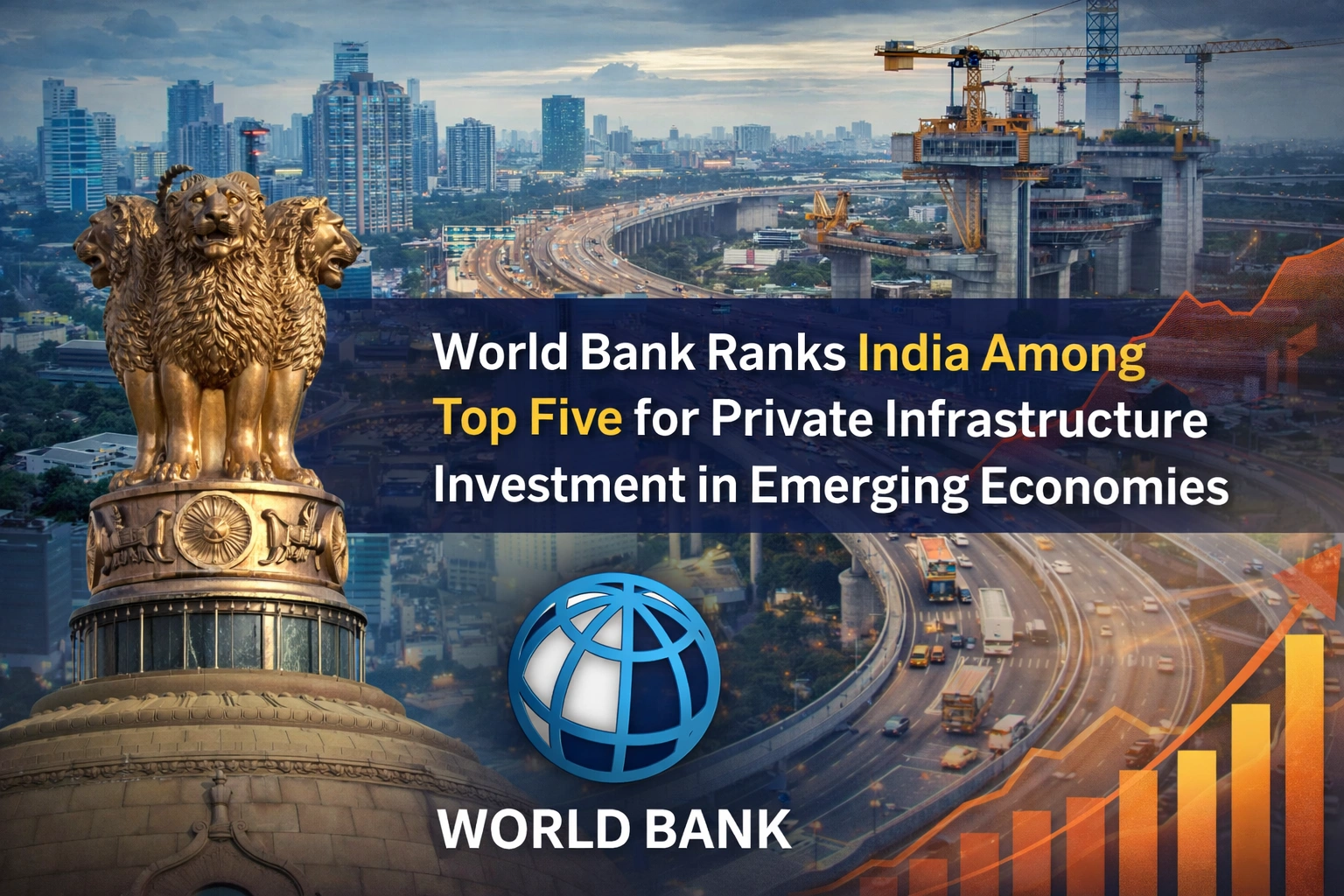
New Delhi, January 30, 2026: India has emerged as one of the top five countries globally for private investment in infrastructure among low- and middle-income economies, according to the World Bank. The ranking was highlighted in the Economic Survey 2025–26, tabled in Parliament on Thursday, underscoring India’s accelerating infrastructure-led growth story.
The Economic Survey noted that India is now the largest recipient of private infrastructure investment in South Asia, accounting for over 90% of total private infrastructure investment in the region—a significant indicator of investor confidence in the country’s long-term economic fundamentals.
Rapid Expansion of Physical Infrastructure
India’s infrastructure base has expanded sharply over the past decade. According to the Survey, the national highway network has grown by nearly 60%, reaching 1,46,572 km as of FY26 (up to December). High-speed corridors have seen even more dramatic growth, increasing almost tenfold from 550 km in FY14 to 5,364 km in FY26.
The Survey also highlighted India’s growing global presence in aviation and maritime infrastructure. India is now the third-largest domestic aviation market in the world, while several Indian ports—benefiting from reduced turnaround times—have entered the top 100 ports globally on the World Bank’s port performance rankings.
Public Capital Expenditure Driving Momentum
A key driver of this transformation has been sustained public capital expenditure. Government capital spending rose from ₹2.63 lakh crore in FY18 to ₹11.21 lakh crore in FY26, with actual capital expenditure reaching ₹15.48 lakh crore. This consistent investment has helped crowd in private capital across sectors such as roads, railways, ports, aviation, and renewable energy.
The Survey emphasised that public capex has acted as a catalyst, improving project viability, reducing execution risk, and enhancing long-term returns for private investors.
Diversifying Infrastructure Financing
India’s infrastructure financing ecosystem is also becoming more diversified. The Economic Survey noted a growing role for NBFC credit, alongside institutional instruments such as Infrastructure Investment Trusts (InvITs) and Real Estate Investment Trusts (REITs), which are increasingly being used to raise long-term capital and recycle operational assets.
This shift is helping unlock fresh private investment while improving balance-sheet efficiency for developers and public-sector entities.
Integrated Planning Under PM GatiShakti
The expansion across transport, logistics, and energy is being driven by an integrated, multi-modal approach under flagship initiatives such as PM GatiShakti and the National Logistics Policy. These frameworks aim to synchronise infrastructure development across ministries and states, reducing transaction costs and execution bottlenecks.
The Survey highlighted that renewable energy capacity is nearing half of India’s total installed power capacity, reflecting a parallel push toward sustainability alongside physical connectivity.
Strengthening India’s Investment Appeal
According to the Economic Survey, the combination of policy certainty, large-scale public investment, diversified financing channels, and integrated planning has significantly strengthened India’s appeal as an infrastructure investment destination.
As global investors look for stable, long-term opportunities in emerging markets, India’s infrastructure push—backed by rising private participation—positions the country as a key growth engine among low- and middle-income economies.

Ruchi Kumar is the associate editor at Entrepreneur News Network and TVW News India, where she leads editorial strategy, brand storytelling, and startup ecosystem coverage. With a strong focus on innovation, business, and marketing insights, he curates impactful narratives that spotlight India’s evolving entrepreneurial landscape. She has written extensively on fintech, AI and emerging startups.