

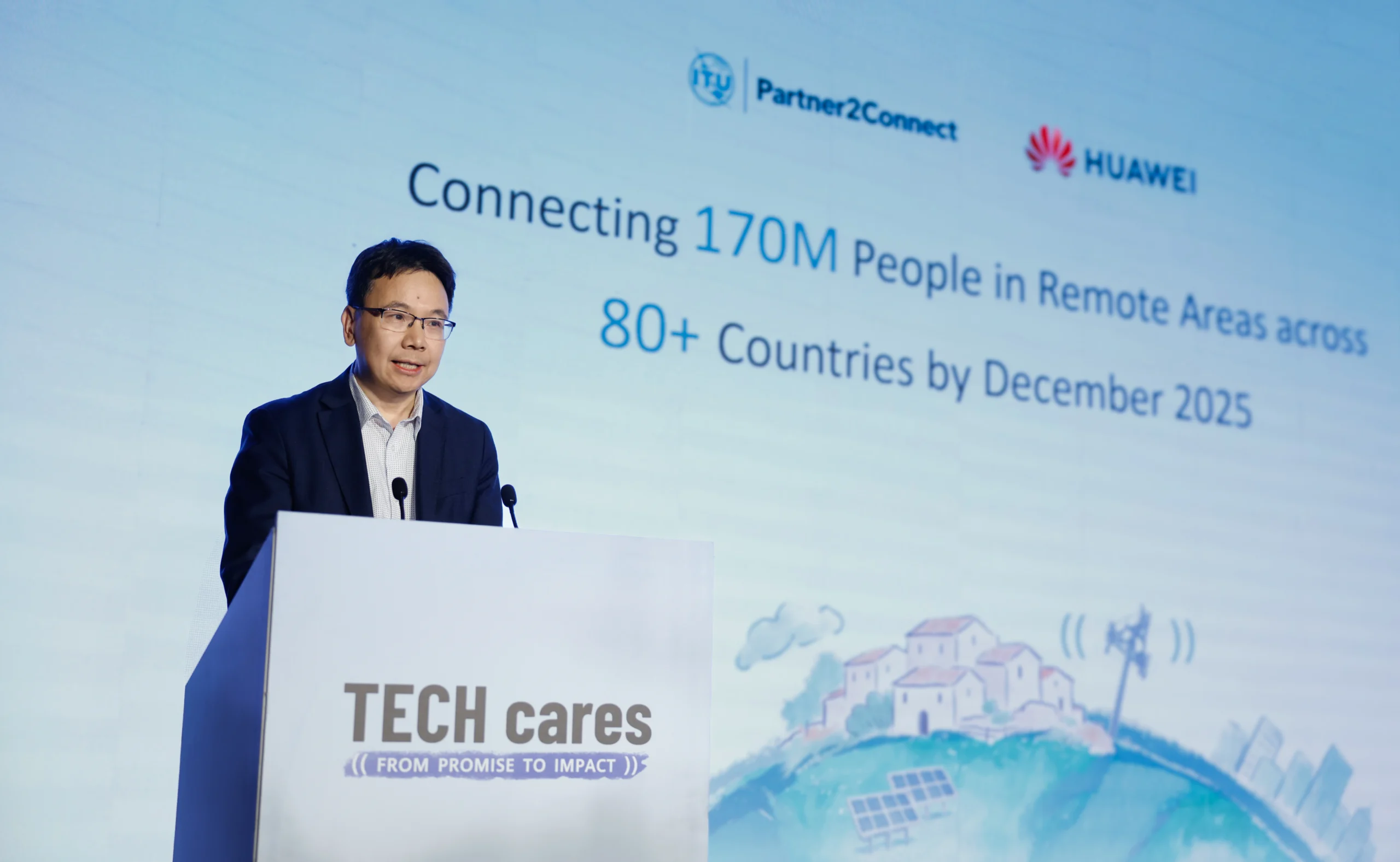
Ahead of Mobile World Congress (MWC) 2026, Huawei brought together policymakers, technology partners, and global media in Barcelona to address a critical challenge shaping the future of artificial intelligence: the widening digital divide.
During a two-day forum held on March 1–2 at the Leonardo Royal Hotel Barcelona Fira, Huawei leaders and global organizations discussed the urgent need to expand connectivity and digital skills as AI technologies rapidly transform sectors such as healthcare, finance, education, and public services.
AI Growth Is Exposing the Global Connectivity Gap
According to the International Telecommunication Union (ITU), around 2.2 billion people remained offline in 2025, highlighting the scale of the global digital divide.
Speaking at the forum, Yang Chaobin, CEO of Huawei ICT Business Group, warned that the gap could widen further if infrastructure and digital capabilities are not expanded alongside AI development.
“The digital divide seems to be widening further,” Yang said. “High-speed networks and robust computing facilities are essential foundations for an inclusive and sustainable AI era.”
As AI adoption accelerates globally, access to reliable internet infrastructure, computing power, and digital education is becoming essential for ensuring that technological progress benefits everyone.
Inclusion Must Be Central to the AI Era
Global institutions also emphasized that connectivity alone is not enough. Building an inclusive digital ecosystem requires skills training, responsible AI governance, and investments in local communities.
Dr. Cosmas Zavazava, Director of the ITU Telecommunication Development Bureau, highlighted the importance of ensuring that digital transformation includes underrepresented groups.
“AI must strengthen meaningful connectivity and support inclusive digital transformation,” Zavazava said. “This requires responsible AI governance, investment in local talent and content, and capacity building, particularly for young girls, women, indigenous communities, and marginalized groups.”
The conversation reflects a growing global consensus that digital inclusion is becoming a prerequisite for the AI-driven economy.
Huawei Expands Global Connectivity Initiatives
Huawei also shared updates on its participation in the ITU Partner2Connect Digital Coalition, an initiative aimed at expanding digital infrastructure in underserved regions.
The company said its programs have helped bring digital connectivity to 170 million people in rural and remote areas across more than 80 countries by the end of 2025.
According to Jeff Wang, President of Huawei Public Affairs and Communications, bridging the digital skills gap remains a priority.
“To bridge the digital skills gap, Huawei works closely with governments and partners to enhance digital access, deliver skills training, and advance STEM education for underserved communities,” Wang said.
These efforts focus particularly on expanding access to STEM education and technology training in developing regions.
Technology and Conservation: The Tech4Nature Initiative
The second day of the event shifted focus from connectivity to technology-enabled environmental protection.
Participants visited Spain’s Natural Park of Sant Llorenç del Munt i l’Obac, where digital monitoring tools are being used to support biodiversity conservation. The project is part of Tech4Nature, an initiative developed in partnership with the International Union for Conservation of Nature (IUCN).
The program uses advanced technologies to monitor wildlife and manage environmental risks. One of its goals is protecting the endangered Bonelli’s eagle, while also minimizing the impact of tourism activities such as rock climbing and cave exploration on sensitive ecosystems.
Sònia Llobet, Director of the natural park, said digital monitoring is helping park authorities balance conservation with visitor access.
“Our challenge as park managers is making visitor access compatible with the conservation of this natural space,” she said. “This project is helping us answer key questions about balancing tourism and environmental protection.”
AI, Connectivity, and the Road Ahead
As AI continues to reshape global industries, discussions at the Barcelona forum highlighted a key reality: technological progress cannot be truly transformative unless access is universal.
Expanding connectivity, strengthening digital education, and ensuring responsible AI governance are likely to remain central topics at MWC 2026 and beyond, as governments and technology companies work to build a more inclusive digital future.

Ruchi Kumar is the associate editor at Entrepreneur News Network and TVW News India, where she leads editorial strategy, brand storytelling, and startup ecosystem coverage. With a strong focus on innovation, business, and marketing insights, he curates impactful narratives that spotlight India’s evolving entrepreneurial landscape. She has written extensively on fintech, AI and emerging startups.