

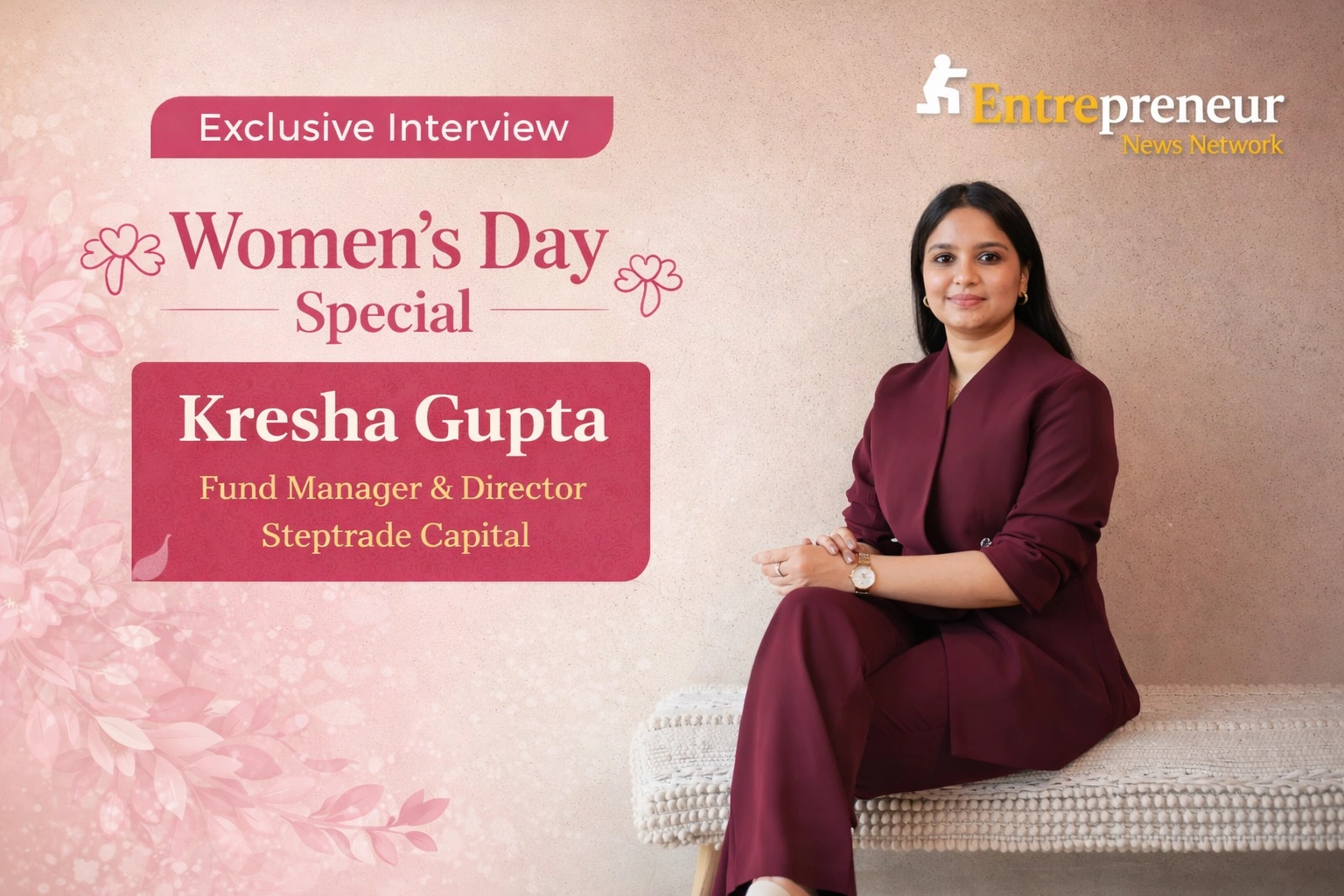
At 24, Kresha Gupta was doing something most finance professionals spend decades preparing for — managing investor money.
But the journey to that moment didn’t begin with a fund launch. It started much earlier — in conversations around capital markets at home, long hours during her articleship working on SME IPOs, and later in the high-pressure corridors of Vodafone Idea’s treasury division, where she interacted directly with investors, bankers, and CXOs.
By the time she launched Steptrade Share Services, Gupta had already seen the capital markets ecosystem from multiple angles: auditing companies preparing for IPOs, analysing balance sheets in a corporate treasury role, and managing her family’s investment portfolio.
Today, as one of the youngest fund managers in India, she is building a platform focused on SME investments, an area she believes holds enormous untapped potential in India’s capital markets.
In an exclusive conversation with Ankitt Y., Editor at Entrepreneur News Network, Kresha Gupta, Fund Manager and Director at Steptrade Capital, shares insights on capital markets, SME investing, and building an asset management company at a young age.
Full Interview
Achieving Big Milestones Early
You became a Chartered Accountant at 20 and launched an Alternative Investment Fund at just 24. What mindset helped you reach these milestones so early?
If you look at my profile today, it might appear very glamorous — a young fund manager managing investor money at an early age. But what people don’t see are the struggles and the long process behind it.
My journey actually started much earlier. I come from a business family and my father has been a long-time equity investor. Growing up, I was always exposed to conversations around capital markets and listed companies. That environment shaped my interest very early.
When I started my CA journey, I deliberately chose to do my articleship with a smaller firm because I wanted exposure to every aspect of finance. During that time, our firm handled an SME IPO project, and I got the opportunity to work closely with merchant bankers, promoters, and legal advisors.
That experience changed everything for me. I realised that capital markets were where I wanted to build my career.
From Vodafone Idea to Entrepreneurship
Your career moved from corporate finance at Vodafone Idea to building your own asset management company. What inspired that leap?
At Vodafone Idea, I was part of a management training program where only a small group of professionals were selected across India. The training exposed me to every part of business — sales, operations, finance, and marketing.
For example, I even worked on selling SIM cards and handling B2B sales. That gave me a very strong understanding of how businesses operate at the ground level.
Later, I moved into investor relations and treasury, where I interacted with investors and bankers during a difficult time for the company. Vodafone was facing serious financial challenges, and our share prices were under pressure.
Handling those conversations taught me a lot about capital preservation, communication with investors, and decision-making under uncertainty.
That experience eventually encouraged me to start managing my family’s investment corpus, which gradually evolved into the idea of launching an Alternative Investment Fund (AIF).
Why SMEs Became Her Investment Focus
Steptrade has carved a niche in SME investments. What convinced you SMEs represent a major opportunity in India?
SMEs are often labelled as risky, but in reality, the key difference is the level of analysis required.
My first IPO project during articleship was actually an SME IPO, so I had the chance to study the business deeply. I sat with promoters, understood how the company generated revenue, and analysed its entire operational structure.
What I realised is that SMEs require ground-level research. Once you understand their business model and risks, they can become excellent investment opportunities.
Capital markets themselves are risky — whether you invest in SME companies or large-cap companies. The difference is simply the level of participation and visibility.
Lessons from Corporate Treasury
How did working in treasury at Vodafone shape your investment philosophy?
Working at Vodafone gave me a deep understanding of how complex corporate balance sheets work.
When you analyse a telecom company, you realise that each business vertical can operate under different entities — network infrastructure, broadband, towers, and SIM services.
Understanding those structures helped me develop a strong focus on financial fundamentals and balance sheet analysis.
Today, when we evaluate companies for investment, that background helps us assess risks more accurately.
Moving from Family Office to Managing External Capital
What was the biggest mindset shift when you moved from managing family money to managing external investor funds?
Honestly, the mindset shift is still ongoing.
When you’re young and managing large funds, people naturally question your experience. Many investors prefer working with someone who has decades of experience.
To address that, we built a team structure that balances youth and experience. My co-founder, Ankush, has 15–20 years of experience, and together we present our investment strategies to investors.
In many cases, investors may trust the experience of the team more than the founder’s age — and that’s perfectly fine. Building trust takes time.
The Biggest Pre-IPO Mistake Founders Make
Having worked on IPO projects and now investing as a QIB or anchor investor, what mistakes do you see founders making before going public?
The most common mistake is overcommitting on revenue projections.
Founders sometimes assume that if they made ₹10 crore this year, they will definitely make ₹18 crore next year. But they don’t always factor in external risks or market conditions.
Another issue is that once the projections are published in the DRHP, they influence market expectations. Investors should always study the risk factors section carefully, because companies disclose most of their risks there.
The Role of AI in Financial Analysis
Do you see AI becoming a major tool for investors and financial analysis?
AI can definitely help in analysing large documents like DRHPs.
Earlier, analysts had to manually read hundreds of pages. Today, you can upload the document into an AI system and ask it to identify negative factors or risks.
However, for our investment strategy — which focuses on active and research-driven investing — human judgement and detailed analysis are still extremely important.
Advice for Women Entering Finance
On Women’s Day, what message would you give to young women who want to build careers in finance or entrepreneurship?
My biggest advice is simple — don’t be hesitant.
I was hesitant many times, and sometimes I still am. But if you have the knowledge and the capability to build something, don’t let fear stop you.
People may question your age, experience, or background. But ultimately, knowledge and hard work always earn respect.
Work Ethic Behind the Success
You’ve achieved a lot at a young age. What does your work routine look like?
For almost 10 years, from the age of 16 to 26, I worked almost every single day — including weekends.
Even when travelling, I always carried my laptop. Markets operate on their own timelines, and sometimes that meant working at odd hours in different time zones.
Entrepreneurship requires that level of dedication.
The Vision for Steptrade
Looking ahead, is your goal to scale assets under management or change how SMEs are valued in India?
Both.
In the long run, I want Steptrade to become a full-scale asset management company, similar to large institutions like Edelweiss.
We started with alternative investments, but the vision is to expand into portfolio management services, mutual funds, and other financial strategies.
Ultimately, the goal is to build an institution that contributes meaningfully to India’s capital markets.
Closing Thought
For Kresha Gupta, the journey from a teenage articleship student to a young fund manager has been anything but easy. Yet her story highlights a larger shift taking place in India’s financial ecosystem — one where youth, research-driven investing, and entrepreneurial ambition are reshaping traditional finance.
And if her advice to young women is anything to go by, the next generation of financial leaders may arrive much sooner than expected.

Ruchi Kumar is the associate editor at Entrepreneur News Network and TVW News India, where she leads editorial strategy, brand storytelling, and startup ecosystem coverage. With a strong focus on innovation, business, and marketing insights, he curates impactful narratives that spotlight India’s evolving entrepreneurial landscape. She has written extensively on fintech, AI and emerging startups.