


Meta Platforms, the parent company of Facebook, Instagram, and WhatsApp, may be preparing for one of the largest workforce reductions in its history as it ramps up spending on artificial intelligence infrastructure.
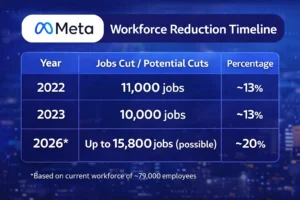
According to people familiar with the matter, the company is considering layoffs that could impact 20% or more of its employees, as it seeks to balance rising AI investments with operational efficiency. While the exact scale and timeline of the job cuts have not been finalised, senior leadership has reportedly begun asking teams across the organisation to identify areas where headcount reductions may be possible.
If implemented at the proposed scale, the layoffs would mark Meta’s most significant restructuring move since the company’s major cost-cutting drive in 2022 and 2023, when chief executive Mark Zuckerberg declared the period the “year of efficiency.”
Potential Layoffs Could Surpass Previous Cuts
Meta’s workforce stood at nearly 79,000 employees as of December 31, according to the company’s latest regulatory filings.
During the previous restructuring cycle, Meta eliminated thousands of jobs as part of efforts to streamline operations and reduce costs.
The company announced its first major round of layoffs in November 2022, cutting around 11,000 jobs, which represented approximately 13% of its workforce at the time.
Just four months later, the company launched another restructuring initiative that resulted in an additional 10,000 job cuts in 2023.
If the proposed layoffs affecting roughly one-fifth of Meta’s workforce move forward, the number of impacted employees could exceed both previous rounds combined, making it the largest workforce reduction in Meta’s history.
Read more: Travel Tech Startup Atlys Raises $36 Million, MakeMyTrip Joins as Strategic Investor
Meta Layoff History
AI Investments Driving Corporate Restructuring
The potential layoffs come at a time when Meta is significantly increasing its investment in artificial intelligence technologies.
CEO Mark Zuckerberg has made AI development a central pillar of Meta’s long-term strategy, positioning the company to compete with leading AI players such as OpenAI, Google, and Microsoft.
In order to accelerate its progress in generative AI, Meta has been offering large compensation packages to top researchers and engineers. Reports suggest that some recruitment offers for elite AI talent have reached hundreds of millions of dollars in long-term compensation.
At the same time, Meta is planning massive infrastructure investments to support its AI ambitions.
The company has outlined plans to invest approximately $600 billion in data centre infrastructure by 2028, which will power large-scale AI model training and computing workloads.
Such investments are necessary to remain competitive in the global AI race, but they also significantly increase operational costs—creating pressure to streamline other parts of the business.
Expanding Through AI Acquisitions
Meta has also been actively pursuing acquisitions to strengthen its artificial intelligence ecosystem.
Recently, the company acquired Moltbook, a social networking platform designed specifically for AI agents.
Earlier reports also suggested that Meta was exploring a deal worth at least $2 billion to acquire Chinese AI startup Manus, further highlighting the company’s aggressive expansion strategy in the AI sector.
These moves signal Meta’s ambition to build a comprehensive AI ecosystem spanning infrastructure, research, and applications.
AI Productivity and Smaller Teams
Zuckerberg has previously indicated that advances in artificial intelligence could fundamentally reshape how companies operate.
Earlier this year, he suggested that AI-driven tools could dramatically increase productivity across organisations.
According to Zuckerberg, tasks that once required large teams of engineers may now be completed by a single highly skilled individual using advanced AI tools.
This shift could allow technology companies to operate with smaller and more specialised teams, reducing the need for large workforces.
Such thinking is increasingly influencing hiring and workforce strategies across the technology industry.
A Broader Trend Across the Tech Sector
Meta’s potential layoffs are not happening in isolation. Several major technology companies have begun restructuring their workforces as artificial intelligence becomes central to their business models.
Earlier this year, Amazon announced plans to eliminate around 16,000 jobs, representing roughly 10% of its workforce, as part of broader cost optimisation efforts.
Meanwhile, fintech company Block, led by Jack Dorsey, recently cut nearly half of its workforce. Dorsey attributed the move to the growing capabilities of AI tools that enable companies to achieve more with smaller teams.
Across the technology sector, automation and AI are increasingly replacing repetitive tasks and reshaping corporate workforce structures.
Challenges in Meta’s AI Strategy
Despite its ambitious AI plans, Meta’s journey in the artificial intelligence race has not been without setbacks.
The company faced criticism last year regarding the performance claims of its Llama 4 AI models, after reports suggested that benchmark results used in promotional materials may have been misleading.
Meta later cancelled the release of the largest version of the model, internally known as Behemoth, which had been expected to launch during the summer.
In response, the company has formed a new superintelligence team tasked with building next-generation AI models.
The group is currently working on a new internal project reportedly called “Avocado.” However, early reports indicate that the model’s performance has not yet met internal expectations.
A Defining Moment for the Tech Workforce
If Meta proceeds with layoffs affecting as much as 20% of its workforce, it will signal a major shift in how technology companies structure their teams in the AI era.
The company faces the difficult challenge of balancing:
-
Massive investments in AI infrastructure
-
Rapid innovation in generative AI technologies
-
Operational efficiency across its global workforce
For Meta employees—and for workers across the broader technology sector—the message is increasingly clear.
Artificial intelligence is not only transforming the products companies build but also reshaping how organisations operate and how many people they employ.
As AI continues to evolve, the tech industry may move toward leaner, highly specialised teams supported by advanced automation, marking a new phase in the global technology workforce.

Ruchi Kumar is the associate editor at Entrepreneur News Network and TVW News India, where she leads editorial strategy, brand storytelling, and startup ecosystem coverage. With a strong focus on innovation, business, and marketing insights, he curates impactful narratives that spotlight India’s evolving entrepreneurial landscape. She has written extensively on fintech, AI and emerging startups.