

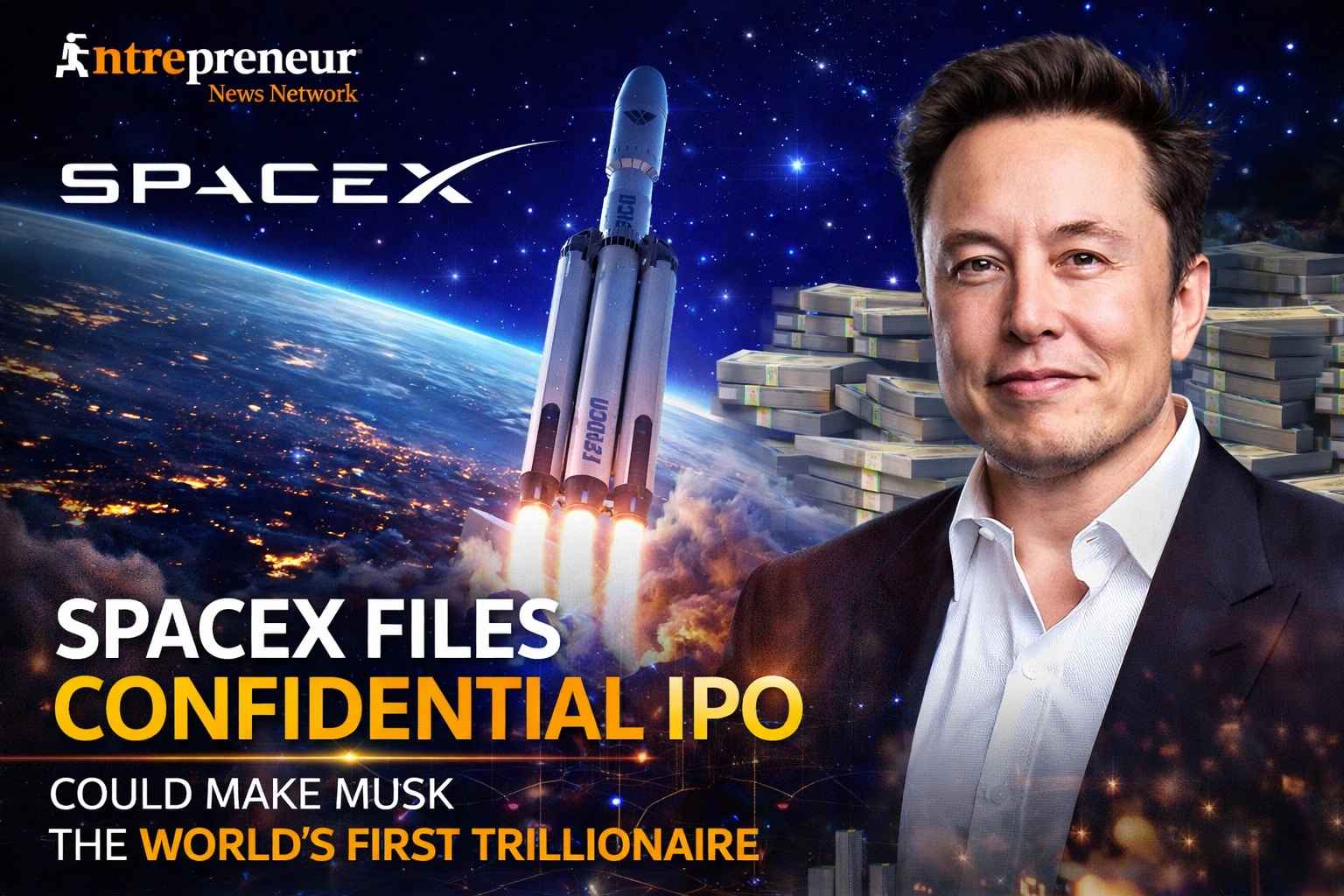
SpaceX Files Confidential IPO — Could Make Musk the World's First Trillionaire
The aerospace giant's $1.75 trillion valuation and $75 billion fundraise target would shatter every IPO record ever set — and reshape the boundaries of a single person's wealth.
Elon Musk may soon cross a financial frontier no human has ever reached — a personal net worth exceeding $1 trillion — as SpaceX prepares to make its long-anticipated debut on public markets. The aerospace firm submitted a confidential IPO registration to the Securities and Exchange Commission (SEC), a filing currently accessible only to regulators.
Wall Street's most powerful institutions are leading the offering. According to the Wall Street Journal, citing sources familiar with the matter, Bank of America, Citigroup, Goldman Sachs, JP Morgan Chase, and Morgan Stanley have been tapped as underwriters.
Lead Underwriters
A Record-Shattering Debut
With a listing expected in June, the public offering is estimated to value SpaceX at $1.75 trillion and raise approximately $75 billion. That sum would more than double Saudi Aramco's record $29 billion debut in 2019 — widely considered the largest IPO in history — setting an entirely new benchmark for capital markets.
"Once SpaceX's listing debuts, Musk will likely become the first CEO to simultaneously lead two companies each valued at over $1 trillion."
His electric vehicle company Tesla currently carries a market capitalization of $1.44 trillion. If SpaceX lists at its anticipated valuation, Musk will hold a position unprecedented in corporate history: chief executive of two separate trillion-dollar enterprises at the same time.
The xAI Consolidation
SpaceX's ambitions extend well beyond rockets. In February, the company acquired Musk's artificial intelligence startup xAI, consolidating two of his ventures in a deal that valued the combined entity at an estimated $1.25 trillion. The merger signals a deliberate move to position SpaceX not just as the world's leading private aerospace company, but as a vertically integrated force in AI infrastructure.
The move puts Musk in direct competition with OpenAI and Anthropic — two of the most well-funded AI labs in the world. While both rivals are racing to build next-generation models and data center capacity on Earth, Musk has set his sights on something far more audacious: the first data centers in space, a concept that OpenAI's Sam Altman has also reportedly explored, potentially through partnering with or acquiring a rocket company.
From Reluctant Founder to IPO Architect
The contrast with Musk's earlier stance is striking. In 2013, he was reportedly hesitant to take SpaceX public, telling employees that Tesla had only gone public because he felt he had no choice. Over a decade later, the calculus has shifted dramatically — the need to fund xAI's infrastructure ambitions and remain competitive in a fast-moving AI arms race appears to have resolved his hesitation.
The upcoming SEC filing will also pull back the curtain on SpaceX's financials and operations for the first time — information the company has carefully guarded through years of developing technology for NASA and other government agencies. Investors, analysts, and competitors alike will be watching closely.
Key Numbers at a Glance
| Metric | Value | Context |
|---|---|---|
| SpaceX IPO Valuation | $1.75 trillion | Projected |
| Capital to Be Raised | $75 billion | Largest IPO ever if achieved |
| Previous IPO Record — Saudi Aramco (2019) | $29 billion | Would be surpassed by ~2.6× |
| Tesla Market Capitalization | $1.44 trillion | As of IPO filing week |
| SpaceX + xAI Combined Valuation | $1.25 trillion | Post-acquisition deal value |
| Expected Listing Date | June 2026 | Subject to SEC review |

Ruchi Kumar is the associate editor at Entrepreneur News Network and TVW News India, where she leads editorial strategy, brand storytelling, and startup ecosystem coverage. With a strong focus on innovation, business, and marketing insights, he curates impactful narratives that spotlight India’s evolving entrepreneurial landscape. She has written extensively on fintech, AI and emerging startups.