

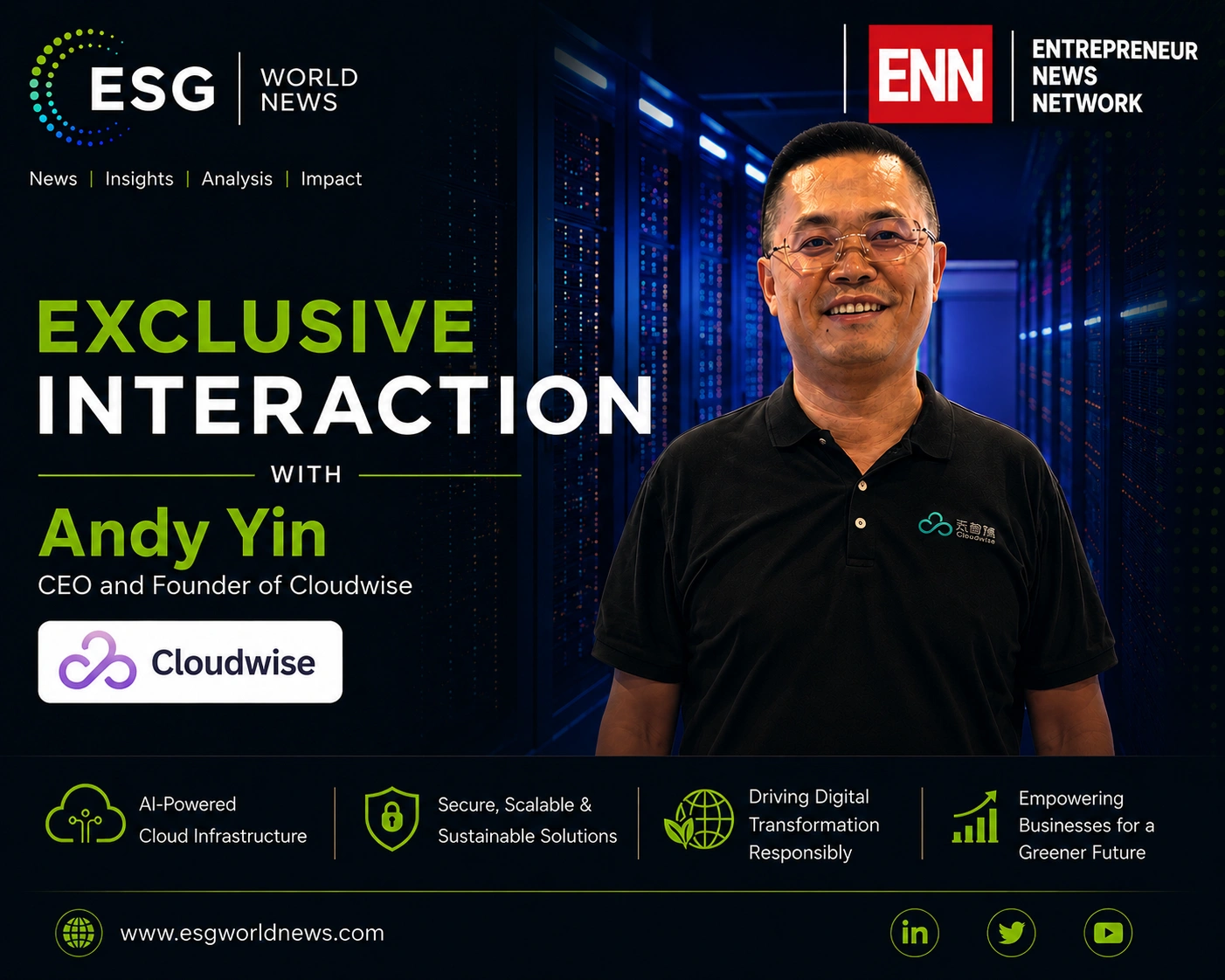
Exclusive Interview | Beyond Expo 2026 | Macao – In a world racing to deploy artificial intelligence, one question is rising above the noise: can we trust it? For Andy, CEO of CloudWise, the answer lies not in building more AI — but in making AI reliable, observable, and always on. At Beyond Expo 2026 in Macao, ENN sat down exclusively with Andy to unpack how CloudWise is solving one of the most underrated challenges in the AI era — ensuring that the power infrastructure, AI data centres, and intelligent agents that the world increasingly depends on never fail, never go undetected, and never slow down. From smart substations in China to AI data centres in Singapore and a growing footprint across the Middle East, CloudWise is quietly building the reliability layer that the AI economy desperately needs.
Q: Andy, let’s start with you and CloudWise. Tell our readers who you are and what problem you’re solving.
Andy: Right now, everyone is starting to use AI. That’s exciting. But I believe the reliability of AI will become more important than anything else going forward. CloudWise is focused on helping our customers resolve the issue of AI variability — making sure their AI systems are not just powerful, but dependable.
We work across three core areas. First, power — ensuring reliable energy supply for AI factories and AI data centres. Second, helping customers improve the availability of their AI data centre infrastructure. And third, the reliability of AI agents themselves. So we offer an end-to-end solution — from agent observability all the way to AI factory power management — ensuring our customers’ AI capability is always high-performance, always available, and always trustworthy.
Q: Your solution seems deeply connected to power infrastructure — substations, transmission, distribution. How does CloudWise track and manage all of this?
Andy: We deploy a large number of sensors across the entire power chain — from generation and transmission through to substations. We collect data in real time and run AI algorithms to predict the status of power infrastructure at any given moment.
If there are any warning signals — any anomalies in the system — we send instant alerts and simultaneously identify the root cause. We don’t just tell our customers something is wrong. We help them understand why it’s happening and support them in resolving it in real time. The goal is to get ahead of failures before they become outages.
Q: Is CloudWise a cloud-based platform, an app, or something else entirely?
Andy: In this agentic AI era, we deploy real-time AI agents directly inside our customers’ cloud infrastructure. These agents continuously collect metrics, process real-time logs, and perform end-to-end observability of the AI agent environment. When an issue is detected, our system identifies the root cause and — through automated tools — helps fix it in real time. So it is cloud-native, agent-powered, and fully automated.
Q: Can your solution track the full cycle — from power distribution and transmission all the way through to consumption?
Andy: Yes, absolutely. We use a wide network of sensors to connect and monitor metrics across the entire energy chain. A substation using our technology can track everything — the energy it generates, the power it distributes, and the consumption patterns downstream. It gives operators a complete real-time picture of their infrastructure health.
Q: Where is CloudWise operating today, and where are you expanding?
Andy: We currently have customers in mainland China, Singapore, and Jakarta, Indonesia. And right now, we are actively expanding into the Middle East. We already have a team on the ground in Abu Dhabi with local engineers who support our customers there directly. Having local presence is important — it means our customers get real, on-the-ground support, not just remote management.
Q: How long does deployment typically take?
Andy: It varies depending on the use case. For power generation — whether solar or traditional — deployment typically takes anywhere from four to eight weeks. This is because we need to install sensors, integrate them with existing systems, collect baseline data, and validate that everything is working correctly before going live. We take that validation process seriously because we are dealing with mission-critical infrastructure.
Q: Power infrastructure runs 24/7. Does your team operate around the clock too?
Andy: Our system operates 24/7 — that is non-negotiable for the industry we serve. But our people do not need to sit in front of screens around the clock. If the system detects any alert, it will automatically notify the relevant engineer — via message or phone call. So our customers get the benefit of constant monitoring without the burden of constant staffing. The AI does the watching. The humans respond when it matters.
Q: You mentioned the Middle East expansion. Does climate and temperature variation affect your product’s performance?
Andy: That is a great question. Different environments — extreme heat, desert conditions, high humidity — present unique challenges. But we have built our systems and sensors to operate across a wide range of environments. In China alone, we manage infrastructure running in vastly different climates across different regions. That real-world experience has prepared us well. Different environment, same reliability — that is the standard we hold ourselves to.
Q: Compatibility is often a challenge when entering new markets with existing infrastructure. How do you handle that?
Andy: It does vary by country. In markets where Chinese companies have previously built the power infrastructure, integration is straightforward — we can deploy our solutions directly with minimal modification. In other markets with different technical standards, we go through a migration process to align our solution with local requirements. We do not take a one-size-fits-all approach. We adapt to the market, not the other way around.
Q: AI data centres are the hottest topic in infrastructure right now. How does CloudWise support them?
Andy: Our focus in AI data centres is improving availability — ensuring these facilities never go down. One of our most innovative solutions here is the use of robots for patrol work inside data centres. Traditionally, human operators walk the floor checking for issues. But humans can miss signals or make mistakes. Robots do not. They patrol continuously, capture data consistently, and flag anomalies without error.
And when you consider the scale of AI data centres being built by companies like Google and Microsoft — the stakes of downtime are enormous. A single failure event can result in massive losses. That is why AI-powered, robotic-assisted monitoring is not a luxury in these facilities. It is a necessity.
Q: Final thought — what is your message to the global business community?
Andy: Everyone will use AI. That is already happening. But in my opinion, reliable AI will be the most important thing for every company and every person going forward. It is not enough to deploy AI. You need to trust it. And trust is built through reliability.
This exclusive interview was conducted at Beyond Expo 2026, where Entrepreneur News Network (ENN) served as the Official Media Partner.

Ruchi Kumar is the associate editor at Entrepreneur News Network and TVW News India, where she leads editorial strategy, brand storytelling, and startup ecosystem coverage. With a strong focus on innovation, business, and marketing insights, he curates impactful narratives that spotlight India’s evolving entrepreneurial landscape. She has written extensively on fintech, AI and emerging startups.