

Venture Capital · Innovation · Asia
The Inner Engine:
What It Really Takes
to Earn Antler's Bet
Magnus Grimeland — CEO of the world's most active early-stage VC — doesn't want your pitch deck. He wants to know who you are when the money runs out.
"We don't try to predict the future. We find the people who are going to build it — and then we get out of their way."
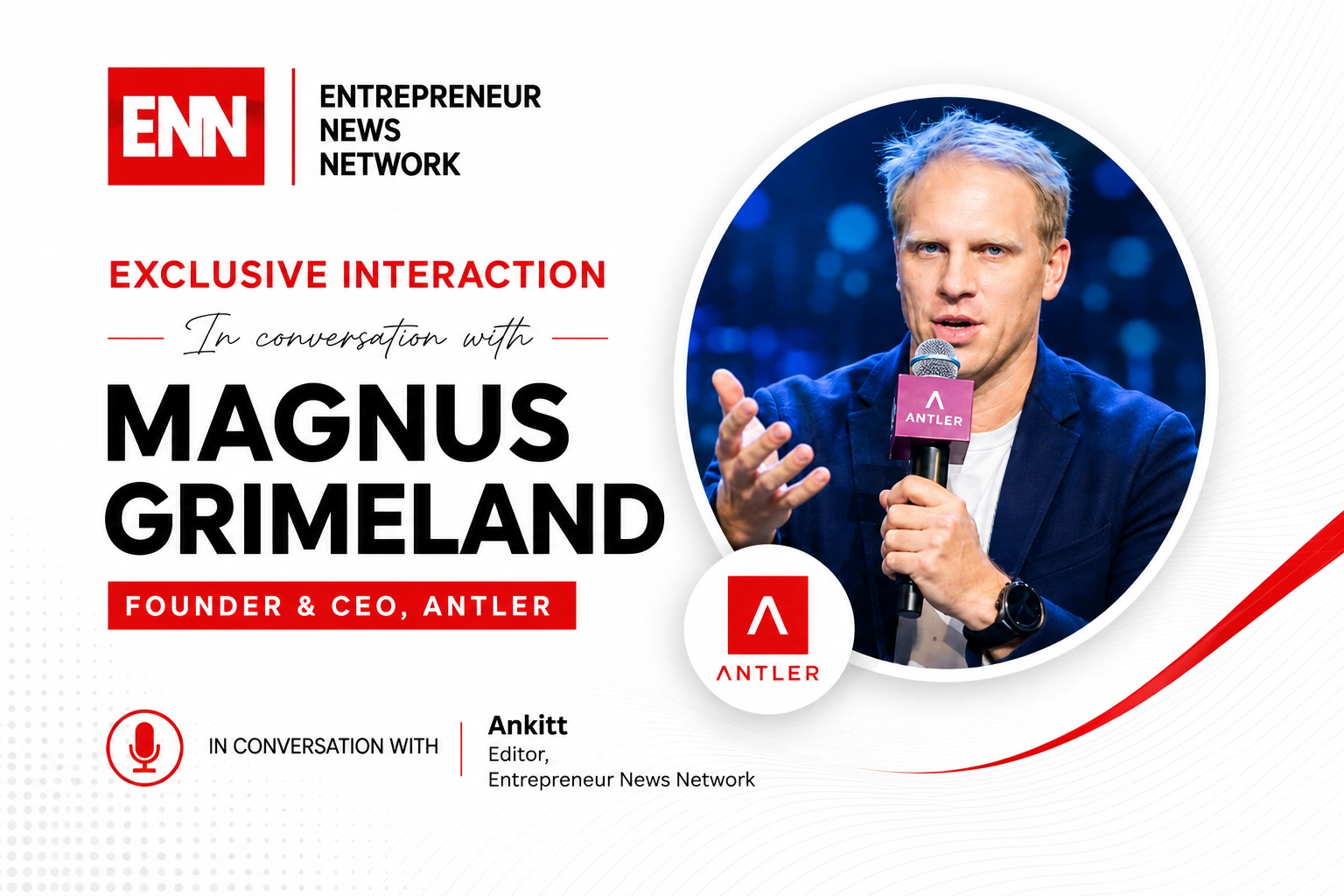
Magnus Grimeland · Founder & CEO, Antler
Magnus Grimeland moves like a man who has somewhere else to be — because he usually does. The week before BEYOND Expo, he was in Shanghai touring twenty hardware startups back-to-back. The week ahead: another city, another flight, another founder who might just change the world.
But for now, he's here, leaning forward, talking with the directness of someone who once served in Norway's Naval Special Forces — and the warmth of someone who has spent a decade believing in people before they believe in themselves.
Antler — the firm he founded in 2017 — is now the world's most active early-stage venture capital firm, operating across 30 cities on six continents, with a portfolio valued at over $3.7 billion. Its model is unusual: Antler backs founders at day zero, often before a company even exists. That means the entire investment thesis collapses into a single, defining question: Is this the right person?
Asia Isn't Catching Up. It's Pulling Away.
You've been in Shanghai all week, now Macau. What's your honest read on Asia's startup ecosystem versus the West right now?
Some things are universal — the best founders have the same energy everywhere. But Asia right now has structural advantages that I genuinely don't see the rest of the world competing against. The most obvious is hardware. Being close to the supply chain means you can almost build hardware companies the way you used to build software companies. Fast.
In Shanghai last week, I toured twenty companies. Several had gone from prototype to market-ready product in nine months. That used to be the timeline for a software MVP. Nine months. That's a different game entirely.
Beyond supply chains — what else drives Asia's edge?
Work culture. I went to see ByteDance in its early days — a thousand engineers, some of them partially sleeping in the office, working out of an old rocket hangar. A thousand people. There's a lot of Elon Musk tweeting about 120-hour weeks. In China, you have entire companies of people operating like that. When you have that density of driven people working at that intensity, you compress timelines in ways that are almost hard to believe from the outside.
And then there's the tailwind. Around 60% of global GDP growth — not total GDP, growth — is coming out of Asia. You're building into that current. That matters enormously when you're trying to find product-market fit.
"Start a great business in China and by the next day there are 200 well-funded competitors working just as hard. It's ultimately good for markets — but genuinely punishing for anyone who doesn't make it through."
996 Is Not an Ideology. It's Physics.
The 996 debate sparked enormous controversy in Europe. Is that level of intensity sustainable — and would you encourage your portfolio companies to operate that way?
In the early days? I think it's almost required. Look at the origin stories — Google, Facebook, Tesla, SpaceX. It wasn't just founders sleeping in the office. It was everyone around them. You're eating glass. You're in the tent. It doesn't feel glorious when you're in it. But that's what it takes.
The US tech giants got comfortable during the COVID years. Free lunches, massages, work from anywhere — and they were still printing record profits. There was a cultural amnesia about what got them there. Then ChatGPT landed. The competition from China became impossible to ignore. Suddenly Meta and others are reversing hard back to founder-mode intensity.
My advice to founders: tell your family upfront. Tell your friends. This is what I'm doing now. The 99% of startups that fail mostly fail because founders went in with the wrong expectations about what it actually takes.
Two Industries About to Be Unrecognisable
Which industries look stable right now but are most ripe for disruption?
Mobility and logistics, without question. The solution already exists — the only thing genuinely holding it back is government regulation. Think about every physical product in the world. Nearly all of it has at some point been on a truck or a boat, operated by a human being. That entire system is going to be transformed — in cost, routing efficiency, and safety. Have you tried a Waymo? Once you use one, you just don't want to be driven by a human anymore. It feels like going from the future back to the Stone Age.
And second?
Healthcare — at both ends of the spectrum. I genuinely believe most diseases we currently can't treat will be treatable within ten years. And on the access side: I worked in Africa after university, before McKinsey. People were dying of simple infections because they didn't have soap. Bar soap. We've come a long way — but the distribution gap hasn't been closed. Technology, particularly mobile, can do that in ways that feel almost miraculous if you zoom out far enough.
Forget the Deck. Show Me Who You Are.
Every VC says they invest in people. Magnus is specific about what that actually means. At Antler, it comes down to three things — and he names them in the same order every time.
Spike
Something the founder is genuinely better at than almost anyone else. It doesn't have to be technical. It could be an almost supernatural ability to form relationships in minutes, obsessive domain knowledge, or world-class pattern recognition in a specific market. We want to see a real, demonstrable edge.
Drive
Not passion — drive. Passion without execution is just a hobby. I know people who have been passionate about starting a company for thirty years. They're still at Goldman Sachs, still talking about the thing. Drive is raw ambition fused with the demonstrated ability to actually do something about it.
Grit
The history. Have you taken something genuinely hard all the way to its limit — whether you succeeded or failed? Have you been in the tent, eating glass, and kept going? That's the evidence we look for. Not intentions. Track record.
"Passion without execution is just a hobby. I know people who've been passionate about building a company for thirty years — and they're still at the same place, still talking about the thing."
The Founder Who Held a Funeral Instead of a Pitch
The Airmay story — now a unicorn
The founder of Airmay came up to Magnus after a talk at Singapore Management University. He'd spent years selling scratch cards to sailors on cargo ships — prepaid calling cards that let crew call home cheaply. WhatsApp and Skype were killing the business.
He'd tried multiple companies before this moment. He was living in a collective apartment with his wife and five others, nearly got kicked out of Singapore. He had zero technical background.
What he had was a spike — one of the most compelling salespeople Magnus had ever encountered — and grit written across every line of his biography.
At the Antler demo day, instead of a conventional pitch, he organised a funeral for the SIM card. Magnus still talks about it. That founder went on to build the largest eSIM marketplace in the world.
You've said 70% of US unicorns have at least one immigrant co-founder. Is there something specific about that profile?
There's something about moving to a new place — having something to prove, fewer fallbacks, a hunger to establish yourself. It produces intensity. Harry Stebbings, the British podcaster, talks about looking for founders with "a little bit of trauma." I think he's onto something.
But I'd frame it differently. What I'm really looking for is an inner engine that doesn't switch off. Whatever lit that engine — honestly, I don't care. It could be difficulty, movement, a chip on your shoulder. Some people just have it intrinsically, regardless of where they came from. That's what we're finding and backing.
Magnus Grimeland is the founder and CEO of Antler, the world's most active early-stage venture capital firm, with a portfolio valued at over $3.7 billion across 30 cities on six continents. This interview took place at Beyond Expo 2026 in Macau.

Ruchi Kumar is the associate editor at Entrepreneur News Network and TVW News India, where she leads editorial strategy, brand storytelling, and startup ecosystem coverage. With a strong focus on innovation, business, and marketing insights, he curates impactful narratives that spotlight India’s evolving entrepreneurial landscape. She has written extensively on fintech, AI and emerging startups.