
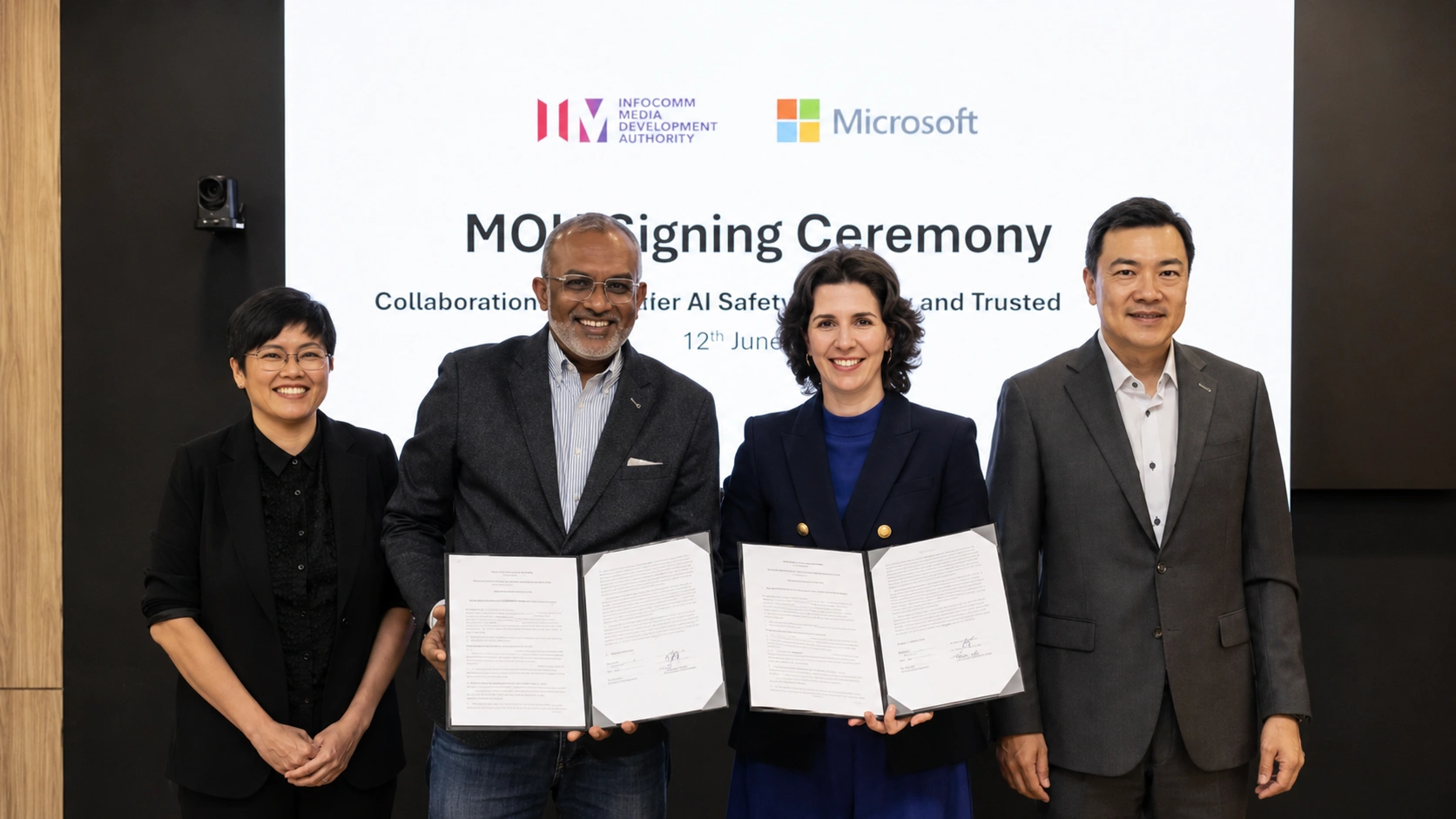
The Infocomm Media Development Authority (IMDA) and Microsoft have signed a strategic agreement to deepen collaboration on artificial intelligence (AI) safety, security, and responsible AI development, reinforcing Singapore’s position as a global leader in trusted AI governance.
The partnership aims to support the safe, secure, and ethical deployment of advanced AI technologies through joint research, policy development, and knowledge sharing initiatives.
The agreement was signed by Kiren Kumar, Deputy Chief Executive of IMDA, and Natasha Crampton, Chief Responsible AI Officer at Microsoft.
Strengthening AI Safety and Governance
As AI adoption accelerates across industries and governments worldwide, ensuring that advanced AI systems remain safe, reliable, and trustworthy has become a growing priority.
Through this partnership, IMDA and Microsoft will collaborate on technical research, information exchange, and the development of frameworks that promote responsible access to advanced AI models.
The initiative will focus on creating practical approaches that help organizations deploy AI technologies while maintaining high standards of safety, transparency, and accountability.
Research Focus on Agentic AI Systems
A key area of collaboration will be agentic AI, a rapidly evolving category of artificial intelligence systems capable of making decisions and performing tasks with greater autonomy.
As these AI systems become more sophisticated, governments and technology companies are increasingly exploring ways to evaluate and manage associated risks.
Under the agreement, IMDA and Microsoft will jointly develop:
- AI safety evaluation methods
- Performance measurement tools
- Reliability benchmarks
- Risk assessment frameworks
- Testing methodologies for advanced AI models
The goal is to improve the ability of organizations to assess how AI systems behave across different scenarios and ensure they operate safely and predictably.
Enhancing AI Safety Across Languages and Regions
Another important focus area will involve improving AI safety and trustworthiness across multiple languages and cultural contexts.
As AI systems become more widely used globally, ensuring that models perform reliably across diverse languages remains a significant challenge.
The collaboration will explore ways to reduce potential trust and safety risks while promoting fair and responsible AI deployment across different user groups and regions.
By addressing multilingual AI challenges, the partnership seeks to contribute to the development of more inclusive and globally applicable AI safety standards.
Sharing Knowledge and Best Practices
As part of the agreement, IMDA and Microsoft will exchange:
- Research findings
- AI governance frameworks
- Safety and security best practices
- Policy recommendations
- Technical insights
The organizations may also share selected knowledge and research outcomes with industry stakeholders, ecosystem partners, and the broader AI community to support responsible innovation.
This collaborative approach is expected to help accelerate the development of industry-wide standards for AI governance and risk management.
Supporting Governments and Critical Infrastructure Operators
The partnership extends beyond research and will also explore how governments and operators of critical infrastructure can responsibly access advanced AI systems for safety testing and evaluation.
Working alongside the Singapore AI Safety Institute and other government agencies, IMDA and Microsoft will examine mechanisms that enable secure access to frontier AI models while maintaining appropriate safeguards.
This effort reflects growing recognition that public sector organizations require specialized frameworks and tools to assess the capabilities, risks, and potential impacts of advanced AI technologies.
White Paper to Guide Future AI Policy
As part of the collaboration, the organizations plan to develop a comprehensive white paper focused on the needs of government agencies and critical infrastructure operators using advanced AI systems.
The document will examine:
- Responsible AI access models
- Safety testing requirements
- Governance frameworks
- Policy considerations for AI developers
- Security requirements for critical sectors
The findings are expected to contribute to future discussions around AI regulation, governance, and responsible deployment strategies.
Growing Global Focus on AI Safety
The announcement comes amid increasing global efforts to establish robust AI governance frameworks as generative AI and autonomous systems continue to evolve.
Governments, regulators, and technology companies are investing heavily in AI safety research to address concerns related to:
- Model reliability
- Security vulnerabilities
- Misinformation risks
- Ethical AI deployment
- Transparency and accountability
- Critical infrastructure protection
Singapore has emerged as one of the leading nations promoting responsible AI adoption through initiatives focused on governance, trust, and innovation.
Outlook
The collaboration between IMDA and Microsoft represents a significant step toward strengthening AI safety and governance frameworks in Singapore and beyond.
By combining technical expertise, policy development, and research capabilities, the partnership aims to advance the responsible development and deployment of AI technologies while supporting innovation and public trust.
As AI becomes increasingly integrated into governments, businesses, and critical infrastructure systems, initiatives such as this will play an important role in shaping the future of secure, transparent, and trustworthy artificial intelligence.
CREST Raises $3.1 Million Pre-Seed Funding to Build AI-Powered Wealth Management Platform

Ruchi Kumar is the associate editor at Entrepreneur News Network and TVW News India, where she leads editorial strategy, brand storytelling, and startup ecosystem coverage. With a strong focus on innovation, business, and marketing insights, he curates impactful narratives that spotlight India’s evolving entrepreneurial landscape. She has written extensively on fintech, AI and emerging startups.