


As artificial intelligence workloads continue to drive unprecedented demand for data center capacity, NVIDIA has unveiled a breakthrough cooling architecture that could dramatically reduce energy consumption, lower operating costs, and nearly eliminate water usage in hyperscale facilities.
The company’s next-generation Rubin AI platform is the world’s first AI infrastructure designed with 100% liquid cooling, where every processor, networking component, and system element is cooled entirely by liquid in a closed-loop system without the use of fans.
What makes the technology particularly significant is its ability to operate cooling liquid at temperatures as high as 45°C (113°F) — hotter than the temperature of most hot tubs. While this may sound counterintuitive, the higher operating temperature actually improves energy efficiency and reduces dependence on traditional cooling systems.
Why Data Center Cooling Has Become a Critical Challenge
Data centers are among the world’s most energy-intensive facilities, and cooling remains one of their largest operational expenses.
Industry estimates indicate that cooling systems can account for up to 40% of a data center’s total electricity consumption. As AI infrastructure scales rapidly, reducing cooling requirements has become one of the most important levers for improving sustainability and profitability.
According to industry benchmarks:
- A 1°C increase in chiller operating temperature can reduce cooling energy consumption by approximately 4%
- A 50 MW hyperscale data center can save more than $4 million annually in cooling-related energy and water costs through liquid-cooling technologies
- Traditional cooling-tower-based systems consume approximately 2.6 million gallons of water per megawatt annually
- NVIDIA’s architecture can reduce water consumption by up to 100% in suitable climates

How NVIDIA’s 45°C Cooling Architecture Works
Traditional data centers rely on chilled air circulated through hot and cold aisles to remove heat from servers. This process requires large fans, chillers, cooling towers, and significant electricity consumption.
NVIDIA’s Rubin platform takes a fundamentally different approach.
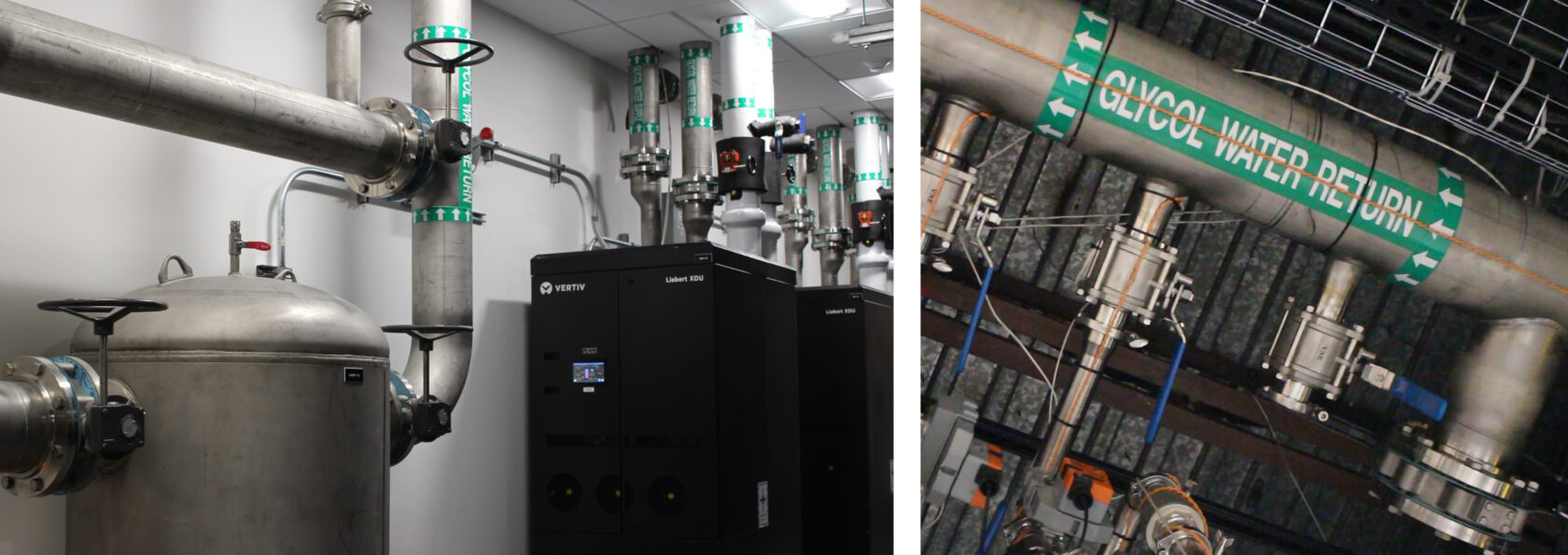
Instead of using air, a liquid coolant mixture consisting of:
- 75% water
- 25% propylene glycol
flows directly through cooling plates attached to processors and networking equipment.
The coolant enters the system at temperatures of up to 45°C and exits at approximately 55°C, carrying heat away from the chips without impacting performance.
Because heat is captured directly at the source, facilities can use outdoor dry coolers instead of traditional refrigeration equipment for much of the year.
Near-Zero Water Consumption Becomes Possible
One of the most significant sustainability benefits of NVIDIA’s new architecture is the potential to virtually eliminate water consumption in AI data centers.
Unlike traditional cooling towers that continuously consume water through evaporation, NVIDIA’s design uses a sealed, closed-loop liquid system.
Ali Heydari, Director of Data Center Cooling and Infrastructure at NVIDIA, said:
“The NVIDIA DSX reference design for AI factories has zero water consumption — we have eliminated massive amounts of power usage and pretty much all water usage. With dry-cooler-based designs, it’s a closed-loop system with no evaporative water cooling — outside of maybe 1% of the year when we might need chillers in some climates.”
For hyperscale operators facing increasing pressure to reduce environmental impact, the potential reduction in water consumption represents a major breakthrough.
AI Factories Could Operate Without Chillers
In favorable climates, NVIDIA’s high-temperature cooling system enables data centers to operate without traditional chillers for most of the year.
Instead, heat can be rejected through large outdoor dry coolers that function similarly to giant radiators.
This approach reduces:
Electricity consumption
Water usage
Equipment footprint
Noise levels
Maintenance requirements
Richard Whitmore, President and CEO of Motivair, Schneider Electric’s advanced cooling division, noted:
“Once the watts per chip crossed a certain level, liquid cooling became mandatory.”
No Fans, No Cold Aisles, Less Noise
Traditional data centers are known for their loud environments, with cooling fans often generating noise levels exceeding 85 decibels, requiring hearing protection for workers.
NVIDIA’s fully liquid-cooled architecture eliminates this challenge.
Because no component depends on air cooling:
- Cooling fans are eliminated
- Cold and hot aisle configurations become unnecessary
- Rack densities increase significantly
- Server footprints shrink dramatically
The company reports that systems previously requiring six rack units can now fit into just two rack units, allowing more computing power in less space.
Higher Rack Density Supports Growing AI Demand
AI workloads continue to expand across industries, driving record investments in data center infrastructure worldwide.
Without major improvements in cooling efficiency, energy consumption would increase alongside computing power.
NVIDIA’s liquid-cooled architecture addresses this challenge by enabling:
- Higher-density AI deployments
- Reduced cooling energy requirements
- Lower operational costs
- Increased facility efficiency
The architecture also opens new opportunities for waste heat recovery, where excess heat generated by AI facilities can be reused to warm residential, commercial, or industrial buildings nearby.
Building the Future of Sustainable AI Infrastructure
The Rubin platform forms part of NVIDIA’s broader DSX AI Factory Reference Design, which provides a blueprint for designing, building, and operating next-generation AI factories.
As cloud providers, hyperscalers, and enterprise organizations race to deploy advanced AI infrastructure, liquid cooling is increasingly becoming a necessity rather than an option.
By combining 100% liquid cooling, near-zero water consumption, reduced energy usage, and higher compute density, NVIDIA’s latest AI infrastructure could set a new industry standard for sustainable data center operations.
With AI demand continuing to surge globally, innovations such as NVIDIA’s 45°C liquid-cooling technology may prove critical in balancing computational growth with energy efficiency and environmental responsibility.
Key Numbers at a Glance
📌 Coolant Operating Temperature: 45°C (113°F)
📌 Cooling Energy in Traditional Data Centers: Up to 40% of total power consumption
📌 Potential Cooling Cost Savings: $4+ million annually per 50 MW facility
📌 Water Consumption Reduction: Up to 100%
📌 Coolant Composition: 75% Water, 25% Propylene Glycol
📌 Chiller Usage: Near Zero in Favorable Climates
📌 Noise Reduction: Eliminates high-speed cooling fans
📌 Rack Density Improvement: Up to 3x more efficient space utilization

Ruchi Kumar is the associate editor at Entrepreneur News Network and TVW News India, where she leads editorial strategy, brand storytelling, and startup ecosystem coverage. With a strong focus on innovation, business, and marketing insights, he curates impactful narratives that spotlight India’s evolving entrepreneurial landscape. She has written extensively on fintech, AI and emerging startups.