

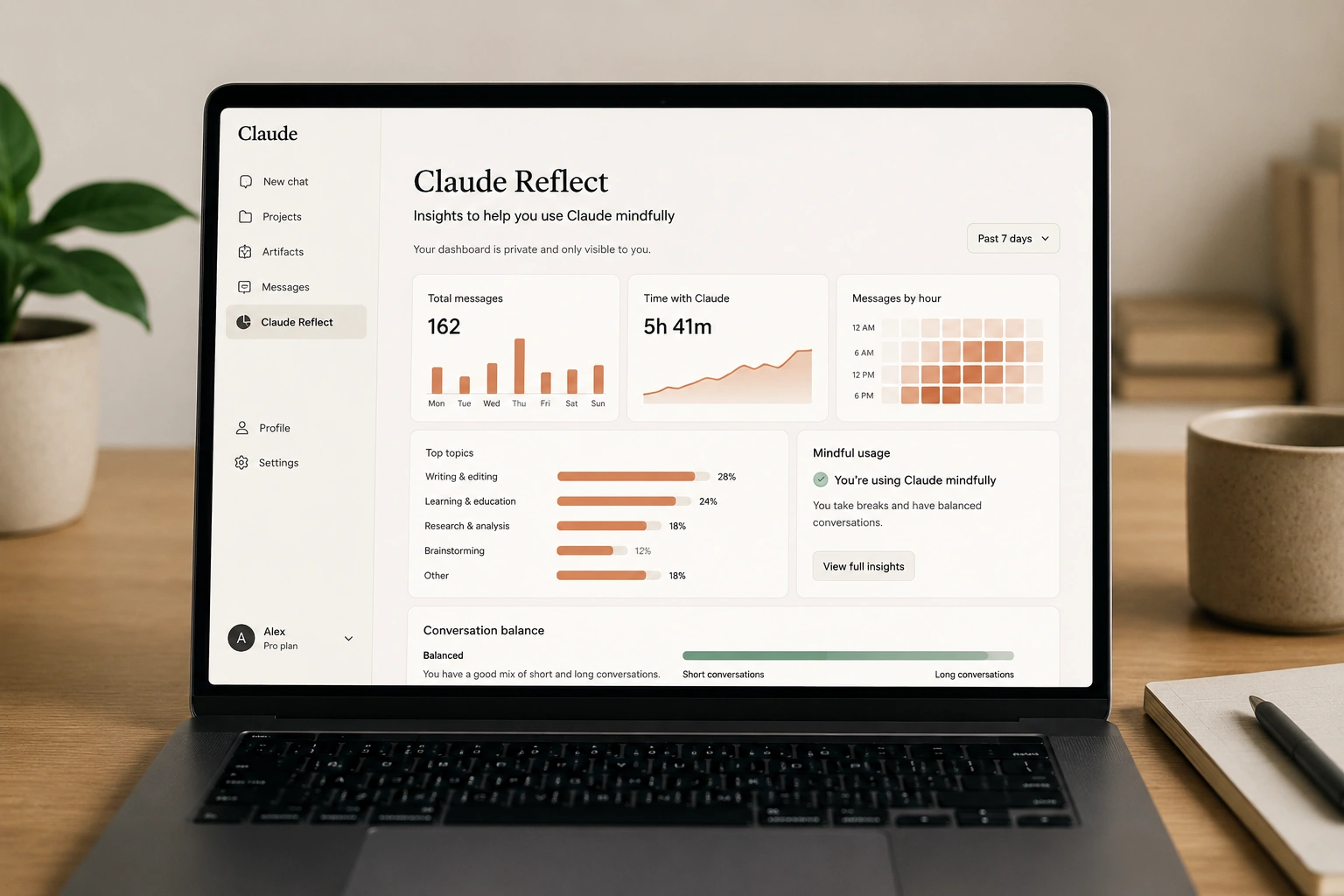
AI criticism is everywhere right now. Data center protests are making headlines, and public unease about how much of daily life now runs through chatbots keeps growing. Against that backdrop, Anthropic has picked an unusual moment to launch a feature that puts a mirror up to your own AI habits — and, in doing so, quietly reminds you how essential its chatbot has become to your routine.
The feature is called Reflect, a new dashboard built into Claude that lets people track and visualize their usage patterns over time. On its face, it’s a simple analytics tool. Underneath, it’s a carefully designed piece of product strategy that reframes Claude as an everyday companion — one that’s woven into your workflow, but that you’re also being encouraged to use “mindfully.”
What Is Claude Reflect?
Reflect is a self-service reporting dashboard that summarizes how a person has been using Claude: which topics come up most often, what kinds of tasks they lean on the assistant for, and when they tend to be most active. Users can pull up snapshots covering the past month, three months, six months, or a full year.
The dashboard highlights a person’s busiest day and peak usage hour, along with a visual breakdown of total conversations over the selected period. Anthropic has also said a future update will add a running total of time spent actually chatting with Claude — a metric that isn’t part of the initial rollout.

The 4D AI Fluency Framework
Rather than just tallying chat counts, Reflect sorts a user’s activity into four categories that make up what Anthropic calls its “4D AI Fluency Framework”: delegation (deciding when and how to hand a task to AI), description (how clearly goals get communicated), discernment (how critically outputs get evaluated), and diligence (how much ownership a person takes for the results).
In practice, that means the dashboard might point out a pattern — say, that someone consistently rewrites Claude’s email drafts in their own voice before sending them, or that they tend to lock in a strategy themselves before looping the AI in on execution.
The dashboard doesn’t stop at description. It also nudges people toward specific product features based on what it notices. If someone keeps re-explaining the same background information across separate chats, for instance, Reflect might suggest switching to Claude’s Projects feature to keep that context in one place — a suggestion that happens to deepen a user’s reliance on Anthropic’s ecosystem rather than a rival’s.
Built-In Guardrails: Quiet Hours and Break Nudges
The dashboard isn’t purely about engagement, though. It also ships with tools aimed at self-regulation. People can set “quiet hours” during which they don’t want to be prompted to use Claude, or schedule reminders to step away after a certain amount of use. Both are optional and can be dismissed at any time.
Reflect also occasionally surfaces reflective prompts, such as asking users what’s one task they’d rather keep doing themselves even if the AI could technically do it faster. It’s a small design choice, but a telling one — an acknowledgment of just how easy it is for AI-chatbot use to become habitual, given that these tools are always available and always ready to keep a conversation going.
Privacy: What Reflect Does and Doesn’t See
Anthropic has been explicit about the boundaries of what feeds into a person’s reflection report. Conversations held in Incognito mode are excluded entirely, as is any underlying file content pulled in through connected tools — if Claude summarized someone’s inbox, for example, that summary might show up in Reflect, but the source emails won’t. Conversations tied to health-related integrations are also left out completely.
More sensitive topics may still be reflected in a user’s summary, but only in an aggregated, high-level way rather than in granular detail. Anthropic says none of the information generated inside Reflect is repurposed for any other use. The company also notes it consulted outside researchers — including groups from MIT Media Lab, Boston Children’s Hospital’s Digital Wellness Lab, and the Family Online Safety Institute — while building the feature.
Not a New Playbook, Just a New Application
Using an analytics feature to shape how people feel about a product isn’t a novel idea. Back in 2012, Google rolled out Gmail Meter, a tool that broke a person’s inbox down into charts and stats — traffic patterns, message categories, storage use, and more. It was a fun rabbit hole for data-curious users, but it also worked as a subtle reminder of exactly how central Gmail had become to their digital lives.
Reflect follows a similar playbook, but goes a step further: instead of just visualizing behavior, it actively coaches people on how to get more out of the product — which, for Anthropic, has the side benefit of making Claude harder to walk away from.
Availability
Claude Reflect is live now in beta, available in Settings on the Claude web client and desktop app for Free, Pro, and Max users who have memory enabled. It isn’t yet available on mobile, and the time-spent metric is still on the roadmap. Anthropic says both are coming in future updates.
The Bigger Picture
Reflect lands at a pointed moment — one where skepticism about AI’s costs, from energy-hungry data centers to concerns about overdependence, is becoming harder to ignore. By pairing usage analytics with gentle prompts toward mindful use, Anthropic isn’t just shipping a new settings page. It’s making a bet that giving users more visibility and more control over their own habits will build trust — while, almost as a side effect, cementing Claude even more firmly into their daily routine.
Whether that combination reads as genuine user empowerment or a more polished form of engagement design likely depends on who you ask. Either way, it’s a notable move from an AI company choosing to hand users the brakes, even as it keeps the engine running.
Thailand to invest $1.99B in AI, electronics, aviation, clean energy amid supply chain updates

Ruchi Kumar is the associate editor at Entrepreneur News Network and TVW News India, where she leads editorial strategy, brand storytelling, and startup ecosystem coverage. With a strong focus on innovation, business, and marketing insights, he curates impactful narratives that spotlight India’s evolving entrepreneurial landscape. She has written extensively on fintech, AI and emerging startups.