
From your first angel cheque to Series C and beyond — real data, proven frameworks, and the government schemes most founders leave on the table.
India’s startup ecosystem has crossed a quiet but important threshold. It is no longer a market where a handful of headline-grabbing rounds define the year — it is a deep, multi-layered capital system with its own government-backed funds, a maturing base of domestic investors, and a public-market exit route that finally works. For a founder deciding when and how to raise, that changes the playbook.
This guide walks through exactly how funding works in India in 2025–26: the stages, the investors, the government schemes almost nobody applies for, and the process top founders actually follow to close a round in three to nine months instead of twelve.
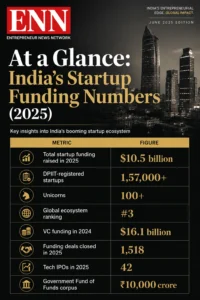
A structural shift sits underneath these numbers: domestic venture capital funds now account for roughly 45% of all startup funding in India, up from just 28% in 2020. Five years ago, an Indian founder’s path to a serious cheque ran almost exclusively through Silicon Valley. That is no longer true.
Why 2025–26 Is a Pivotal Time to Raise
India raised $10.5 billion in startup funding in 2025, holding its position as the world’s third-largest startup ecosystem behind only the United States and China. The headline deal count fell by roughly 39% year-on-year — but that number hides the part that actually matters to a founder raising today: early-stage funding rose 7% to $3.9 billion. Investors pulled back from speculative, growth-at-all-costs bets and leaned further into quality seed and Series A companies. Capital didn’t leave the market; it got more selective about where it goes.
The exit environment tells a similar story. Forty-two Indian tech companies went public in 2025, up 17% from 36 the year before. A working IPO route changes how growth-stage investors underwrite a deal — it gives them a realistic path to liquidity, which in turn makes them more willing to write bigger cheques earlier.
As Prayank Swaroop, Partner at Accel India, put it:
“We don’t yet have an AI-first company in India at $40–$50 million of revenue in a year’s time frame, and that is globally happening.”
That gap is precisely why AI-native founders are commanding premium valuations right now — investors are actively hunting for the company that closes it.
Funding Stages Explained: From Idea to IPO
Every funding round serves a different purpose and attracts a different type of investor. Knowing exactly which stage you’re at — and what that stage’s investors actually expect to see — is the single biggest factor in whether a pitch converts into a term sheet.
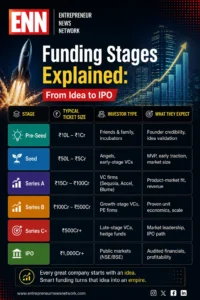
A pattern worth internalising: at every stage, the ask an investor makes of you gets more specific and less forgiving. A pre-seed investor is underwriting you. By Series B, they’re underwriting a spreadsheet. Raise too early against the wrong expectation — pitching a Series A VC on “idea validation” instead of product-market fit, for instance — and you will burn the relationship before you’ve even opened a real conversation.
Types of Funding Sources in India
Equity from a traditional VC fund is only one of at least six distinct capital pools active in India today. Most founders raise from more than one of these across the life of their company.
Angel Investors — Networks like IAN (Indian Angel Network), Mumbai Angels, Lead Angels and platforms like LetsVenture write typical cheques of ₹25 lakh to ₹2 crore. This is the best fit at seed stage, particularly when the founding team’s credibility is doing most of the persuading.
Venture Capital — Domestic funds such as Blume Ventures, Kalaari Capital and Chiratae Ventures, alongside global firms like Peak XV Partners, Accel and Lightspeed, dominate Series A and beyond. This is the capital pool most founders picture when they think “fundraising,” but it’s actually the narrowest of the six.
Government Schemes — SIDBI’s Fund of Funds, the Startup India Seed Fund Scheme, the Credit Guarantee Scheme for Startups and the Atal Innovation Mission offer non-dilutive or founder-friendly capital that a surprising number of eligible founders never apply for. More on this below.
Venture Debt — Firms like Trifecta Capital, InnoVen Capital and Stride Ventures let founders extend runway without heavy additional dilution, typically once at least one priced equity round is already on the cap table.
Accelerators — Y Combinator, 100X.VC, Nasscom’s various programmes, and IIT/IIM-affiliated incubators trade a small equity stake for capital, structured mentorship and — often the most valuable part — a warm introduction into their investor network.
Corporate Venture Capital (CVC) — Tata Digital, Reliance Jio Platforms, Kotak and HDFC are among the corporates now writing startup cheques directly. This isn’t a niche source anymore: corporate VCs participated in roughly 40% of all global funding rounds of $50 million or more in 2024, and they often bring a distribution or enterprise-customer relationship that a financial investor simply can’t.
Government Schemes Every Founder Must Know
This is the section most fundraising guides skip — and the one with the highest founder ROI, because almost none of this capital requires giving up a board seat. The Government of India has committed ₹6,886 crore of a planned ₹10,000 crore corpus to SIDBI under the Fund of Funds for Startups, which has already catalysed ₹21,276 crore into 1,173 startups as of December 2024. That’s roughly a 3x multiplier on every rupee of government capital deployed — and the majority of eligible startups still haven’t applied.
Fund of Funds for Startups (FFS) — A ₹10,000 crore corpus managed by SIDBI that doesn’t invest in startups directly. Instead, it capitalises SEBI-registered Alternative Investment Funds (AIFs), who then invest in startups on commercial terms. As of December 2024, ₹21,276 crore had been catalysed into 1,173 startups.
Startup India Seed Fund Scheme (SISFS) — A ₹945 crore scheme built specifically for the earliest, riskiest stage: proof-of-concept, prototype development and market entry. Capital is disbursed through a network of 300+ incubators. ₹467.75 crore had reached 2,622 startups as of December 2024.
Credit Guarantee Scheme for Startups (CGSS) — Rather than lending directly, CGSS lets banks and NBFCs extend collateral-free credit to DPIIT-recognised startups, covering loans of up to ₹10 crore per startup. This is the scheme to know about if you need working capital without giving up equity.
Atal Innovation Mission (AIM) — Run by NITI Aayog, AIM funds deep-tech and hardware innovation through a national network of Atal Incubation Centres, each eligible for grants of up to ₹10 crore. More than 68 AICs are now operating across the country.
DPIIT Startup India Recognition — Not a fund, but the gateway to almost everything above. DPIIT recognition unlocks a three-year income tax exemption under Section 80-IAC, fast-tracked IP filing, and self-certification on nine labour laws. Registration is free at startupindia.gov.in, and it is a prerequisite for accessing most of the government schemes on this list — apply for it before you do anything else.
Step-by-Step: How to Raise a Funding Round in India
The typical Indian fundraising timeline runs three to nine months from first outreach to money in the bank. The founders who land at the shorter end of that range tend to follow roughly the same sequence:
- Get DPIIT recognition first. It’s free, takes days rather than months, and unlocks tax benefits, government scheme eligibility and access to many accelerator programmes.
- Know your numbers cold. Burn rate, runway, CAC, LTV, month-on-month revenue growth, gross margin. Every serious investor will ask; hesitating on the answer is one of the fastest ways to lose credibility in a first meeting.
- Build a real investor target list. Aim for 50–80 investors matched to your specific stage, sector and typical ticket size — not a generic list of “top Indian VCs.” Warm introductions convert five to ten times better than cold outreach, so build the list around who can actually get you a warm intro.
- Build a 10–14 slide pitch deck. Problem, solution, market, traction, business model, team, financials, ask. The deck’s only job is to get you into the room — the round is closed in the conversation, not the slides.
- Run a tight six-to-eight-week process. Send introductions in batches rather than one at a time, run multiple investor conversations in parallel, and set a soft close deadline. A process that drags past three months loses momentum and, often, the round.
- Nail the first meeting. Open with a sharp, specific market insight rather than a generic elevator pitch. Spend the first five minutes on the problem, not the solution — investors back founders who are missionaries about the problem, not just enthusiastic about their product.
- Prepare your data room before you need it. Cap table, financial model, audited accounts, material contracts, employee agreements and IP filings, organised and ready to share. A clean data room is one of the most underrated speed levers in due diligence.
- Negotiate the term sheet properly. Valuation gets the headlines, but dilution, board composition, anti-dilution provisions and liquidation preferences will matter far more over the life of your company. Hire a lawyer who specialises in startup financings, not a generalist.
Hot Sectors Getting Funded in 2024–25
Fintech, enterprise tech and consumer services led Indian startup funding in 2024 by total dollars raised, but the sharpest momentum is in two narrower categories. AI startups raised $643 million across roughly 100 deals in 2025, and defence tech had a breakout half-year, pulling in $311 million in H1 2025 alone as India’s push toward indigenous defence manufacturing opened a new category of venture-backable companies.
The valuation effect is now measurable: startups with a genuine AI layer in their product are commanding valuations two to three times higher than otherwise-comparable non-AI peers at the same stage. That premium is a real signal to founders deciding how to position their company for a raise — not a reason to bolt “AI” onto a pitch deck that doesn’t have the product to back it up.
Key Investors Active in the Indian Market
| Investor | Stage Focus | Sector Focus | Notable Bets |
|---|---|---|---|
| Peak XV Partners (formerly Sequoia India) | Seed to late-stage | Consumer, SaaS, fintech | Zomato, Freshworks |
| Accel India | Seed to Series B | SaaS, consumer, AI | Flipkart, Swiggy |
| Blume Ventures | Pre-seed to Series A | India-first, tech-first startups | — |
| Lightspeed India | Early to growth stage | Consumer, SaaS, deep tech | OYO, ShareChat |
| Kalaari Capital | Early to Series B | Healthcare, gaming, fintech | — |
| 100X.VC | Pre-seed | Sector-agnostic, ~100 startups/year | Cheque size ~₹25L for 1–2% equity |
| Elevation Capital | Seed to growth stage | Consumer, marketplaces | Meesho, Urban Company |
| Chiratae Ventures | Seed to Series B | Consumer, B2B, healthtech | — |
| Indian Angel Network | Seed | Sector-agnostic, 500+ angels | Cheque size ₹25L–₹2Cr |
Match your outreach to this table before you send a single email. A seed-stage consumer app pitching Chiratae’s healthtech partner, or a Series C company cold-emailing 100X.VC, wastes everyone’s time and burns a relationship you may want later at the right stage.
How to Build a Pitch Deck That Actually Converts
A pitch deck has one job: get you a second meeting. Ten to fourteen slides is the right length — long enough to be credible, short enough that an investor reads the whole thing on their phone between meetings.
- Hook. One sentence carrying an insight the investor hasn’t already heard from three other founders this month.
- Problem. Make the pain visceral with real data and real customer quotes, not a hypothetical.
- Solution. Show the actual product — screenshots or a short GIF. Investors back what they can see working, not a description of what it will eventually do.
- Market size. TAM/SAM/SOM built on sourced, defensible data (IBEF, NASSCOM, or a relevant government report) — not a top-down “if we capture just 1% of India” calculation.
- Traction. This is the slide investors linger on longest. Revenue, users, retention, month-on-month growth — whatever proves the market wants this now.
- Business model. How the company makes money, current margins, and specifically why those margins improve as the company scales.
- Competition. Show the landscape honestly and specifically. “We have no competitors” is read as either naivety or a market too small to matter.
- Team. Answer one question directly: why is this specific group of people the right team to build this specific company?
- Financials. A three-year projection with clearly stated assumptions, showing a credible path to profitability.
- The ask. The amount, exactly what it funds, and the specific milestones that capital unlocks.
Common Fundraising Mistakes to Avoid
Do this:
- Build real traction before your first VC conversation
- Prioritise warm introductions over cold outreach every time
- Run parallel conversations with eight to twelve investors at once
- Be direct about risks and open challenges — investors diligence harder when a founder oversells
- Get DPIIT recognition in place before you start fundraising
- Bring in a startup-savvy lawyer before you sign a term sheet
Avoid this:
- Approaching VCs before you have an MVP or any real traction
- Cold-emailing investors with no research into their stage or sector focus
- Running a process with only one investor in active conversation
- Inflating your TAM or leaning on vanity metrics that don’t hold up in diligence
- Giving up more than 20–25% of the company in early rounds
- Starting a raise in the middle of a growth slump, when leverage is at its lowest
Frequently Asked Questions
How much equity should I give up at the seed stage? The typical range is 10–25%. Protect your early dilution deliberately — founders who end up owning less than 15–20% by the time of an IPO often find themselves under-incentivised relative to the effort the journey still requires.
Do I need a Private Limited company before approaching investors? Yes. Institutional and angel investors in India invest in equity, which means you need to be registered as a Private Limited Company under the Companies Act, 2013, before serious conversations begin — a sole proprietorship or partnership cannot receive equity investment. Get your DPIIT recognition active at the same time.
What’s the realistic timeline from first meeting to funds in the bank? Angel rounds typically close in four to eight weeks, seed rounds in six to twelve weeks, and Series A and beyond in three to six months. Clean, ready-to-share documentation is the single biggest lever for compressing that timeline.
Can a startup outside a metro city realistically raise VC funding? Yes — this is one of the more significant shifts of the last five years. Over 51% of DPIIT-recognised startups are now based in Tier II or Tier III cities, and funds including Blume Ventures and 100X.VC actively source deals from these geographies. Video-first investor meetings have removed most of the geographic disadvantage that used to exist.
When does it make sense to use venture debt instead of raising more equity? Venture debt from firms like Trifecta Capital, InnoVen Capital or Stride Ventures is best used to extend runway between two equity rounds without taking on additional dilution. It’s typically only available once you’ve closed at least one priced VC round, and works well for bridging to your next raise or financing a specific, identifiable asset rather than general operating burn.
Data sources: Tracxn, Inc42 Annual Funding Report, TechCrunch, Bloomberg, SIDBI, DPIIT/Startup India, NITI Aayog. Figures reflect calendar year and financial year data as published through late 2025; founders should verify current scheme corpus and disbursal figures at startupindia.gov.in before applying, as government allocations are updated periodically.
HCLTech Is Building Its First AI Data Center — and It’s Betting ₹14,257 Crore on Odisha

Ruchi Kumar is the associate editor at Entrepreneur News Network and TVW News India, where she leads editorial strategy, brand storytelling, and startup ecosystem coverage. With a strong focus on innovation, business, and marketing insights, he curates impactful narratives that spotlight India’s evolving entrepreneurial landscape. She has written extensively on fintech, AI and emerging startups.