

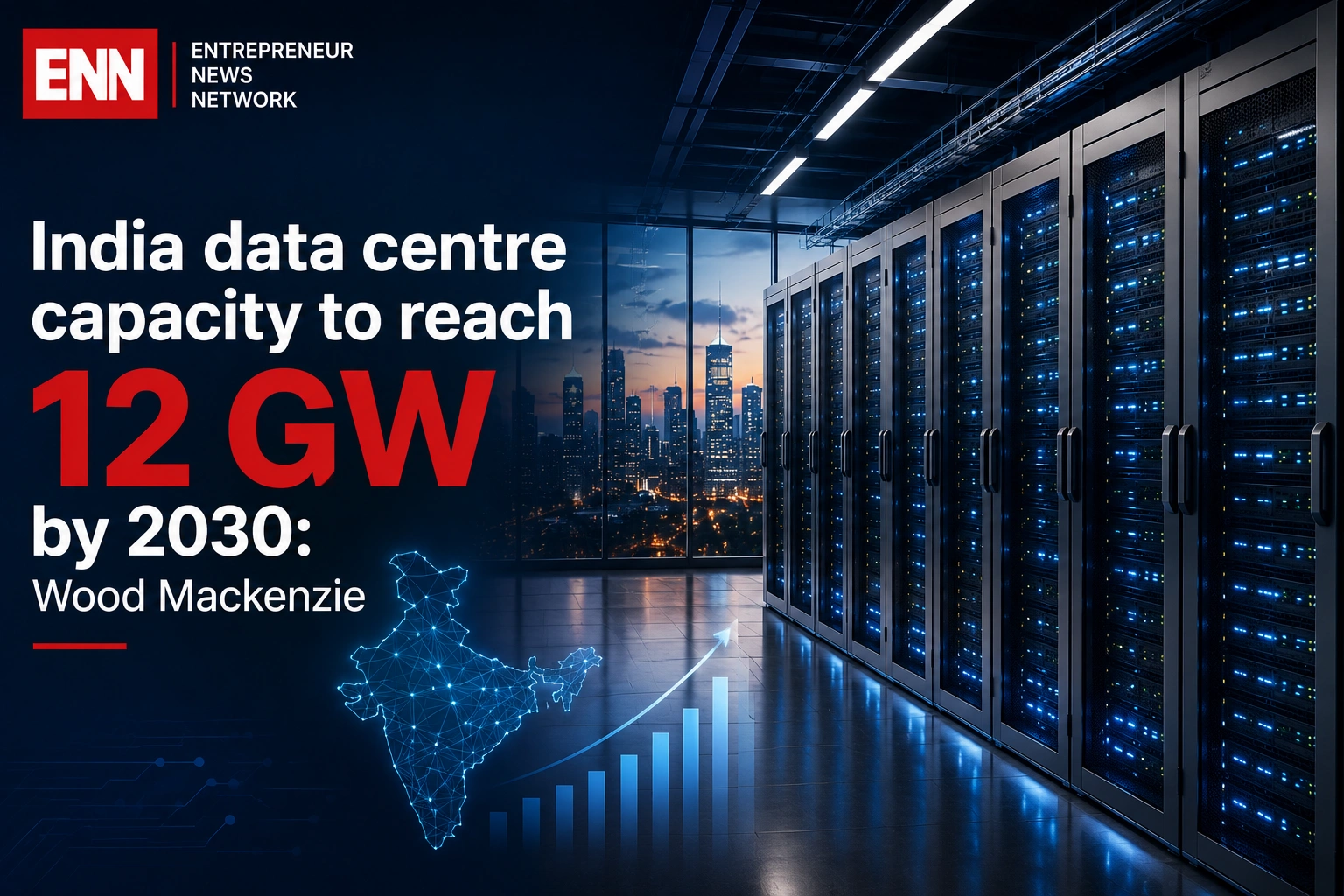
Somewhere between a UPI payment cleared in Bengaluru and a chatbot query answered in Mumbai sits a server rack, humming inside a data centre that likely didn’t exist five years ago. Multiply that rack by thousands, spread it across six states, and you have the outline of what Wood Mackenzie now calls one of Asia-Pacific’s most attractive infrastructure investment opportunities: India’s data centre market.
According to the energy research firm’s latest report, “India’s Data Centre Landscape: Powering the Digital Economy,” the country’s operational data centre capacity is set to rocket from 2.2 GW in 2025 to 12 GW by 2030 — a compound annual growth rate of roughly 40 percent. It is the kind of growth curve more often associated with a hot consumer app than a category of physical infrastructure that takes years to permit, power and build.
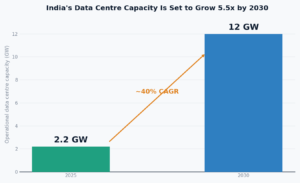
Fig. 1: India’s operational data centre capacity is forecast to grow 5.5x this decade. Source: Wood Mackenzie, “India’s Data Centre Landscape: Powering the Digital Economy.”
“India’s data centre market becomes a structural investment thesis. The convergence of hyperscale capital, AI workload growth and a decade of policy support have created the conditions for India to rival any market in Asia-Pacific. The question for developers and investors is no longer whether to enter India, but where and how.”
— Souhardya Pal, Research Associate, Wood Mackenzie
A Digital Economy Too Big to Ignore
The scale of the buildout starts to make sense once you look at what’s actually running on top of it. India’s digital economy was valued at INR 32 trillion in 2025, contributing roughly 12 percent of GDP, and it now serves more than 1.03 billion active internet users. Every month, the country’s Unified Payments Interface (UPI) rail alone processes around 22 billion transactions — a volume that would have sounded implausible a decade ago and now barely raises an eyebrow.
INR 32 trillion value of India’s digital economy in 2025 (~12% of GDP)
1.03 billion+ active internet users
22 billion UPI transactions processed monthly
INR 11.7 trillion projected size of India’s domestic AI market by 2032
Layer artificial intelligence on top of that base, and the compute math gets even steeper. Wood Mackenzie projects India’s domestic AI market will reach INR 11.7 trillion by 2032, and every increment of that growth translates directly into demand for high-performance, power-hungry computing infrastructure.
AI Is the Fastest-Growing Slice of the Market
Nowhere is that more visible than in AI-dedicated capacity — the racks built specifically to train and run large models rather than host conventional enterprise workloads. Wood Mackenzie expects this segment to expand nearly 24-fold by 2030, climbing from 275 MW today to 6,546 MW. Total capacity is growing fast; the AI slice of it is growing faster still, and it is reshaping what a “typical” data centre in India even looks like — denser racks, heavier cooling loads, and a very different power profile than the enterprise colocation facilities that dominated the market a decade ago.
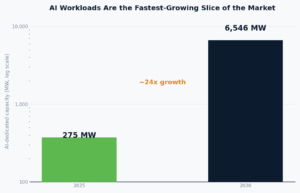
Fig. 2: AI-dedicated capacity is forecast to grow nearly 24x by 2030, far outpacing the broader market. Source: Wood Mackenzie.
Power Becomes the New Gatekeeper
For years, the two biggest constraints on data centre development in India were finding enough land and raising enough capital. Wood Mackenzie’s report argues that era is over. The new bottleneck is power — specifically, firm, round-the-clock electricity delivered at the substation level, at a competitive price, without the volatility of grid curtailment.
Electricity demand from data centres is forecast to grow 20-fold by 2040, from 10 TWh in 2025, and will account for around 7 percent of India’s total electricity demand by then — a striking share for a single category of commercial infrastructure.
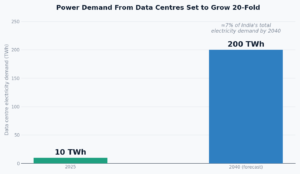
Fig. 3: Data centre electricity demand is set to grow 20-fold by 2040, reaching roughly 7% of India’s total power demand. Source: Wood Mackenzie.
In response, developers are increasingly turning to captive power generation and long-term renewable power purchase agreements (PPAs) — deals that lock in supply and price for the life of an asset while supporting corporate decarbonisation commitments at the same time. States that offer liberalised open-access electricity frameworks and competitive intra-state transmission charges are emerging as the preferred landing spots for new capacity, because in this market, power procurement strategy has become the single biggest determinant of where a data centre actually gets built.
“Land and capital are no longer the limiting factors for data centre developers in India. What determines site selection and delivery timelines now is access to firm, round-the-clock power at the node level. Developers who secure their power strategy early through captive generation or long-term renewable PPAs will lock in a structural cost and sustainability advantage for the life of their assets.”
— Dr. Rashika Gupta, Vice President of Research, Wood Mackenzie
Six States, One Race
Today, the map is lopsided. Maharashtra and Tamil Nadu together account for around 65 percent of India’s installed IT load, the legacy of being early movers with strong connectivity and established enterprise demand. But Wood Mackenzie expects the next wave of investment to fan out considerably further, into Andhra Pradesh, Telangana, Uttar Pradesh and Karnataka.
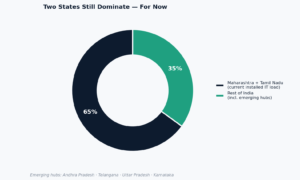
Fig. 4: Maharashtra and Tamil Nadu still dominate installed IT load, but four emerging states are drawing major new commitments. Source: Wood Mackenzie.
The commitments already on the table are substantial. Global hyperscalers including Amazon Web Services and Google have made significant moves into these emerging hubs, while domestic operator AdaniConnex has announced a development pipeline of 2.6 GW — a single company’s ambitions that would, on their own, more than account for India’s entire current installed base.
To make sense of where the next dollar of investment is most likely to land, Wood Mackenzie built a Hub Attractiveness Index that benchmarks India’s data centre markets across power economics, sustainability considerations, infrastructure ecosystem and policy support — giving developers and investors a data-driven view of a landscape that, until recently, was assessed largely on gut instinct and anecdote.
The Water Question
If power is the headline risk, water is the one still flying under the radar. As AI workloads push rack densities and cooling requirements higher, water availability is becoming a more important site-selection criterion — particularly in already water-stressed states such as Tamil Nadu and Karnataka, where competition for water resources extends well beyond the data centre sector.
The report notes that developers who move early on closed-loop cooling systems and zero liquid discharge technology are already cutting their freshwater consumption — and, in the process, getting ahead of regulation that has not yet arrived but looks increasingly likely to.
What It Means for Investors
Put together, the pieces describe a market with real momentum behind it: a INR 32 trillion digital economy still expanding, an AI sector heading toward INR 11.7 trillion, more than a decade of supportive policy, and a renewable energy market growing fast enough to underwrite long-term power contracts at scale. Wood Mackenzie’s headline forecast — 2.2 GW to 12 GW by 2030 — is as much a statement about India’s broader digital trajectory as it is about server racks and substations.
But the report is equally clear that scale alone won’t determine who wins. The developers and investors who come out ahead will be the ones who treat power procurement as a first-order decision rather than an afterthought, take water risk seriously before it becomes a regulatory constraint, and choose locations that balance growth potential against genuine infrastructure resilience — rather than simply chasing the states with the biggest headlines today.
As Pal put it, the question for the industry has already shifted. It is no longer whether to enter India. It is where, and how.
Source: Wood Mackenzie, “India’s Data Centre Landscape: Powering the Digital Economy”. All figures, forecasts and quotations in this article are drawn from that report.
Salil Parekh to step down as Infosys CEO in March 2027 after nine-year tenure

Ruchi Kumar is the associate editor at Entrepreneur News Network and TVW News India, where she leads editorial strategy, brand storytelling, and startup ecosystem coverage. With a strong focus on innovation, business, and marketing insights, he curates impactful narratives that spotlight India’s evolving entrepreneurial landscape. She has written extensively on fintech, AI and emerging startups.