
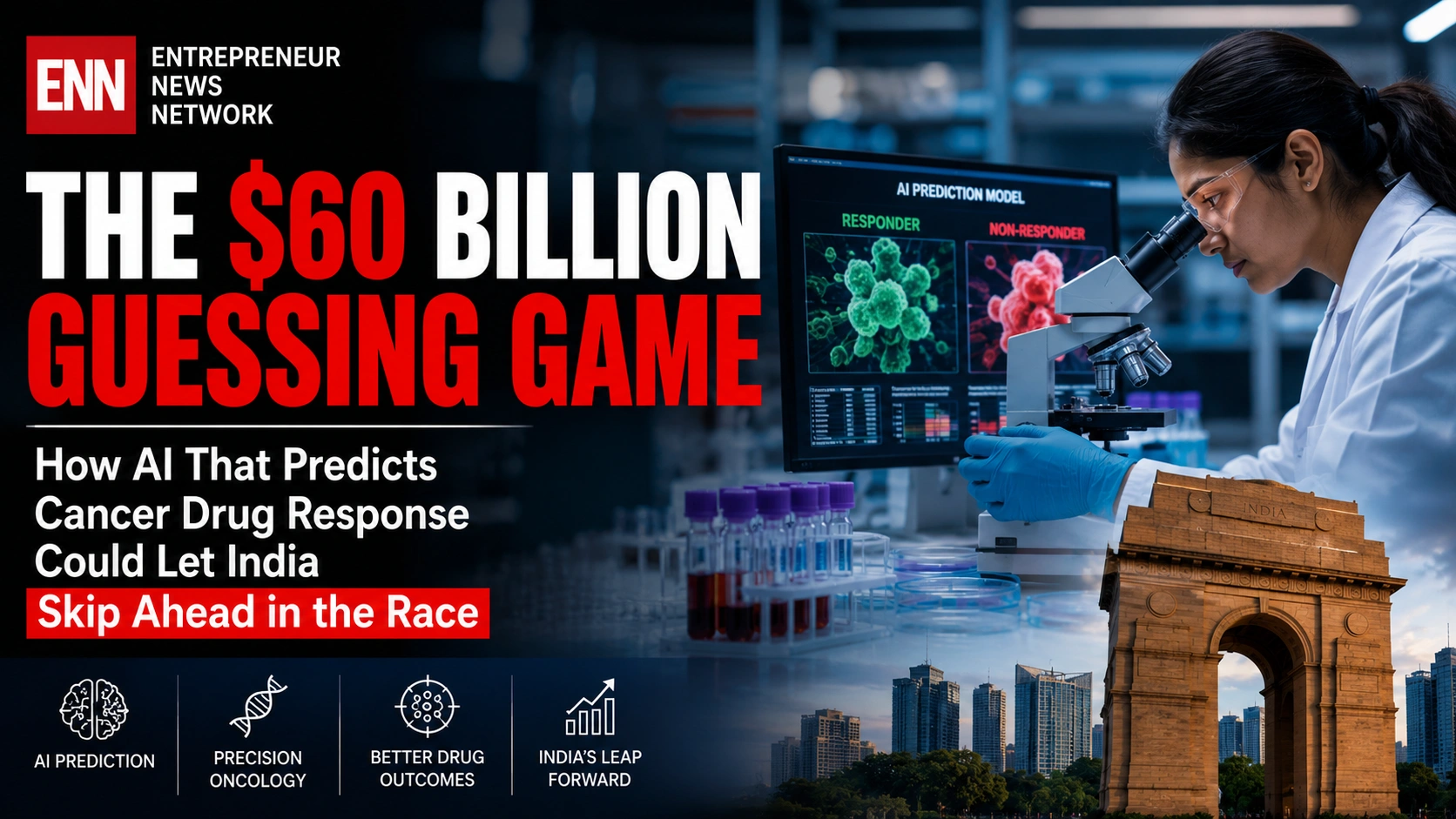
THE $60 BILLION GUESSING GAME
How AI That Predicts Cancer Drug Response Could Let India Skip Ahead in the Race
A data-driven look at why the world’s most genetically diverse, fastest-growing cancer population may also be its smartest testing ground
Every oncology drug that enters a clinical trial is, in a very real sense, a bet placed on a patient before anyone knows if their tumor will listen. Roughly seven times out of ten, in Phase II, that bet doesn’t pay off — not because the drug is bad, but because it was given to someone whose cancer was never going to respond to it. The industry has a name for this expensive blind spot, and for the first time, it has the beginnings of a fix.
A field built on educated guesses
Cancer drug development runs on trial and error at a scale that would be unacceptable in almost any other industry. More than 70% of Phase II oncology trials fail, and when researchers dig into why, roughly half of those failures trace back to a lack of efficacy rather than safety problems or business decisions. The drug worked in the lab, worked in animal models, and then simply didn’t work in the patients it was tested on. Zoom out further and the numbers get harder to look away from: only around 3% of oncology drugs that enter clinical development ever reach approval, by far the lowest hit rate of any major disease area, and industry estimates put the annual cost of failed oncology trials at $50 billion to $60 billion. That is not the cost of one bad drug. It is the recurring, yearly price of an entire field testing therapies on patients whose tumor biology was mismatched to the drug from day one.
The tragedy of that number is that it is largely avoidable. A tumor’s response to a drug is written into its biology — the mutations driving it, the genes it expresses, the pathways it depends on to survive. That information exists before a single dose is given. The problem has never been a lack of data; it has been the inability to read that data quickly and cheaply enough to act on it at the scale a clinical trial requires.
Teaching a model to read a tumor before treatment begins
That is starting to change. In April 2024, researchers at the US National Cancer Institute published a computational pipeline called PERCEPTION in the journal Nature Cancer, built to do exactly this: read the single-cell transcriptomic profile of a patient’s tumor — essentially a snapshot of which genes are switched on inside each individual cancer cell — and predict, before treatment, whether that specific tumor will respond to a specific drug. Tested retrospectively against real trial data in multiple myeloma, breast cancer, and lung cancer, the model correctly separated patients who went on to respond from those who didn’t, and in lung cancer, it even captured how resistance developed over the course of treatment.
The tool is a US government research project, not an Indian one. But its lead author, Sanju Sinha, trained as a bioengineer at IIT Guwahati before building PERCEPTION during his PhD and postdoctoral work at the NCI — one small but telling sign that Indian-trained scientists are already sitting at the center of this shift, even when the labs and the funding are elsewhere.
The broader case for this approach is best made not by any single tool but by a simple comparison the industry has increasingly documented: what happens to a trial’s odds when patients are selected using a biomarker versus when they are not.
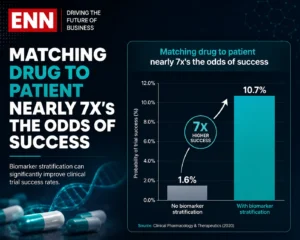
Oncology programs that use a biomarker to select patients see roughly seven times the probability of success of programs that don’t.
That gap — 1.6% versus 10.7% — is the entire argument in one chart. It means the single highest-leverage change a drug developer can make isn’t a better molecule; it’s a better filter for who receives it. Every trial run without that filter is, statistically, closer to a coin flip stacked against the sponsor, the regulator, and above all the patient who enrolled hoping for a chance at remission.
Why this problem has India written all over it
Predictive, biomarker-driven trial design is a global shift, but three things converge in India in a way they don’t quite converge anywhere else: a cancer burden large and diverse enough to train and validate these models properly, a cost structure that makes running smarter trials commercially attractive rather than just scientifically nice-to-have, and an early, if uneven, diagnostic and digital-health backbone already being built to support it.
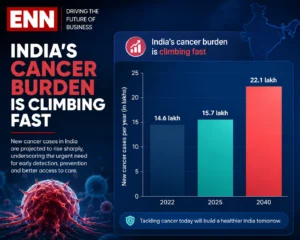
Start with scale. India’s cancer incidence is not just large, it is accelerating. The National Cancer Registry Programme, run under the Indian Council of Medical Research, projected cases rising from 14.6 lakh in 2022 to 15.7 lakh in 2025, on a trajectory toward an estimated 22.1 lakh new cases annually by 2040. ICMR’s own analysis now puts the lifetime cancer risk for an average Indian at roughly one in nine. That is a sobering human cost — but from a pure data-science standpoint, a population this large, this genetically diverse, and growing this fast is precisely the kind of varied, high-volume dataset that trains a drug-response model far more robustly than a narrower, more homogenous Western trial population ever could. Every AI system of this kind is only as good as the diversity of tumors it has learned from, and India’s patient population is one of the most underrepresented — and most needed — inputs missing from today’s models.
Then there is cost, which is where the case moves from scientific to commercial. Running a Phase III oncology trial in India costs an estimated $3,000 to $5,000 per patient, compared with $10,000 to $15,000 in the United States — a 40 to 60% saving that has already made India a preferred outsourcing destination for global pharmaceutical sponsors, helped along by a pool of roughly one million new cancer cases and three million prevalent patients to recruit from each year.
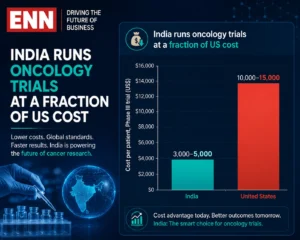
Lower per-patient costs mean India can absorb the added expense of biomarker testing and AI-driven stratification while still coming out cheaper than a conventional US trial.
Put those two forces together and the economics compound in a useful way. A biomarker-stratified trial costs a little more upfront — you have to sequence and screen patients before you enroll them — but it fails far less often, and it fails faster when it does. Layer that discipline onto India’s cost base, and a sponsor gets the best of both: trials that are already cheaper to run, made dramatically more likely to succeed.
The scaffolding is already being built
None of this requires India to invent its precision-oncology infrastructure from scratch; a fair amount of it already exists, in pieces. The National Cancer Grid, a network that has grown to more than 360 cancer centres and roughly 270 actively partnered hospitals, has been working with IndiaAI to pilot and validate AI tools in real cancer-care settings — the 2026 IndiaAI–NCG CATCH Compendium alone documents 28 AI solutions spanning screening, diagnostics, and clinical decision support that are ready, or close to ready, for deployment. Separately, ICMR has signed a formal agreement with the National Cancer Grid specifically to develop affordable clinical trials for cancers that are common in India, which is exactly the kind of institutional plumbing a biomarker-driven trial model needs to run at national scale.
On the diagnostics side, Bengaluru-based Strand Life Sciences and MedGenome already run much of the genomic and biomarker testing infrastructure that any drug-response model depends on, and both have partnered with global pharmaceutical companies to deliver subsidized cancer biomarker testing inside India. Karkinos Healthcare has partnered with the US firm C2i Genomics to bring AI-powered cancer detection and monitoring into Indian hospital networks, and in January 2024, Apollo Cancer Centres opened what it describes as India’s first dedicated AI Precision Oncology Centre. None of these organizations has yet built a PERCEPTION-style drug-response predictor of their own. But each of them is quietly assembling a piece of the foundation — sequencing capacity, biomarker testing, hospital-network reach, digital infrastructure — that such a tool would eventually need to plug into.
The market has already started pricing this in
Investors and analysts appear to be reaching similar conclusions. India’s precision oncology market — diagnostics and biomarker-driven therapeutics together — is projected to reach roughly $8.9 billion by 2030, growing at a 12.6% annual rate from 2025, with diagnostics identified as the fastest-growing segment even though therapeutics still command about 80% of current revenue. Narrower still, the AI-in-oncology segment specifically is projected to reach $1.38 billion in India by 2033, expanding at a striking 27.3% a year from 2026. Globally, AI-based clinical trial solutions as a category were valued at $2.51 billion in 2025 and are expected to grow at a 14.3% annual rate through 2036, with India already flagged as one of the fastest-growing individual markets in that category and oncology alone expected to account for close to a third of all AI-driven clinical trial spending by 2026.
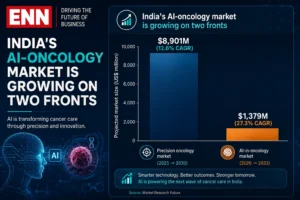
Two related but distinct India markets — precision oncology broadly, and AI-in-oncology specifically — are both compounding faster than the wider healthcare sector.
Growth at 27% a year, off a small base, is easy to dismiss as a rounding error today and just as easy to underestimate tomorrow. The pattern is a familiar one from India’s software and generics industries: a cost advantage draws the work in first, and the deeper capability follows once enough of it has landed.
Where the optimism needs a caveat
None of this is guaranteed, and it would be dishonest to frame it as inevitable. Genetic diversity is a strength for training a model, but it is also a challenge for validating one — a tool trained mostly on Western or East Asian tumor datasets, as most existing models still are, may simply perform worse on Indian patients until it is retrained on Indian tissue and sequencing data at meaningful scale, which is expensive and slow to collect. Single-cell sequencing, the technique PERCEPTION and similar tools depend on, remains costly and is concentrated in a handful of well-funded urban hospitals; extending it to the tier-two and tier-three cities where much of India’s rising cancer burden actually lives will take years of infrastructure investment, not just software. And any system built on individual tumor genomics raises real questions about data privacy and consent that India’s regulators are still working through.
None of that erases the underlying opportunity — it defines the actual work ahead of it. The $50-60 billion wasted globally each year on mismatched trials is not a problem India caused, but it is one India is unusually well positioned to help solve, by turning what has historically been treated as its biggest liability in drug development — sheer scale and diversity — into the training ground for the tools that finally start matching the right drug to the right patient before the guessing begins.
Sources
- Failed Oncology Trials May Cost Up to $60 Billion Per Year — Cancer Therapy Advisor
- PERCEPTION predicts patient response and resistance to treatment using single-cell transcriptomics of their tumors — Nature Cancer, April 2024
- AI That Predicts Targeted Cancer Drug Response with Single-Cell Precision — Inside Precision Medicine
- Sanju Sinha, PhD — Sanford Burnham Prebys Medical Discovery Institute
- Cancer incidence estimates for 2022 & projection for 2025 — Indian Journal of Medical Research / National Cancer Registry Programme
- Cancer Risk India: ICMR Study Highlights Lifetime Threat & Prevention
- Oncology Clinical Trials in India — Clinical Research Society
- Phase-by-Phase Clinical Trial Costs Guide for Sponsors — ProRelix Research
- Biomarker-driven patient stratification: How AI is improving clinical trial enrollment — Drug Discovery News
- AI-based Clinical Trials Solution Provider Market — Future Market Insights
- National Cancer Grid and IndiaAI spotlight trusted AI solutions for cancer care at the India AI Summit 2026 — PIB
- ICMR inks MoA with National Cancer Grid to revolutionise cancer care — BioSpectrum India
- India Precision Oncology Market Size & Outlook, 2025-2030 — Grand View Research
- India AI In Oncology Market Size & Outlook, 2033 — Grand View Research
- C2i Genomics and Karkinos Healthcare Partner to Bring AI-Powered Cancer Detection and Monitoring to India

Ruchi Kumar is the associate editor at Entrepreneur News Network and TVW News India, where she leads editorial strategy, brand storytelling, and startup ecosystem coverage. With a strong focus on innovation, business, and marketing insights, he curates impactful narratives that spotlight India’s evolving entrepreneurial landscape. She has written extensively on fintech, AI and emerging startups.