

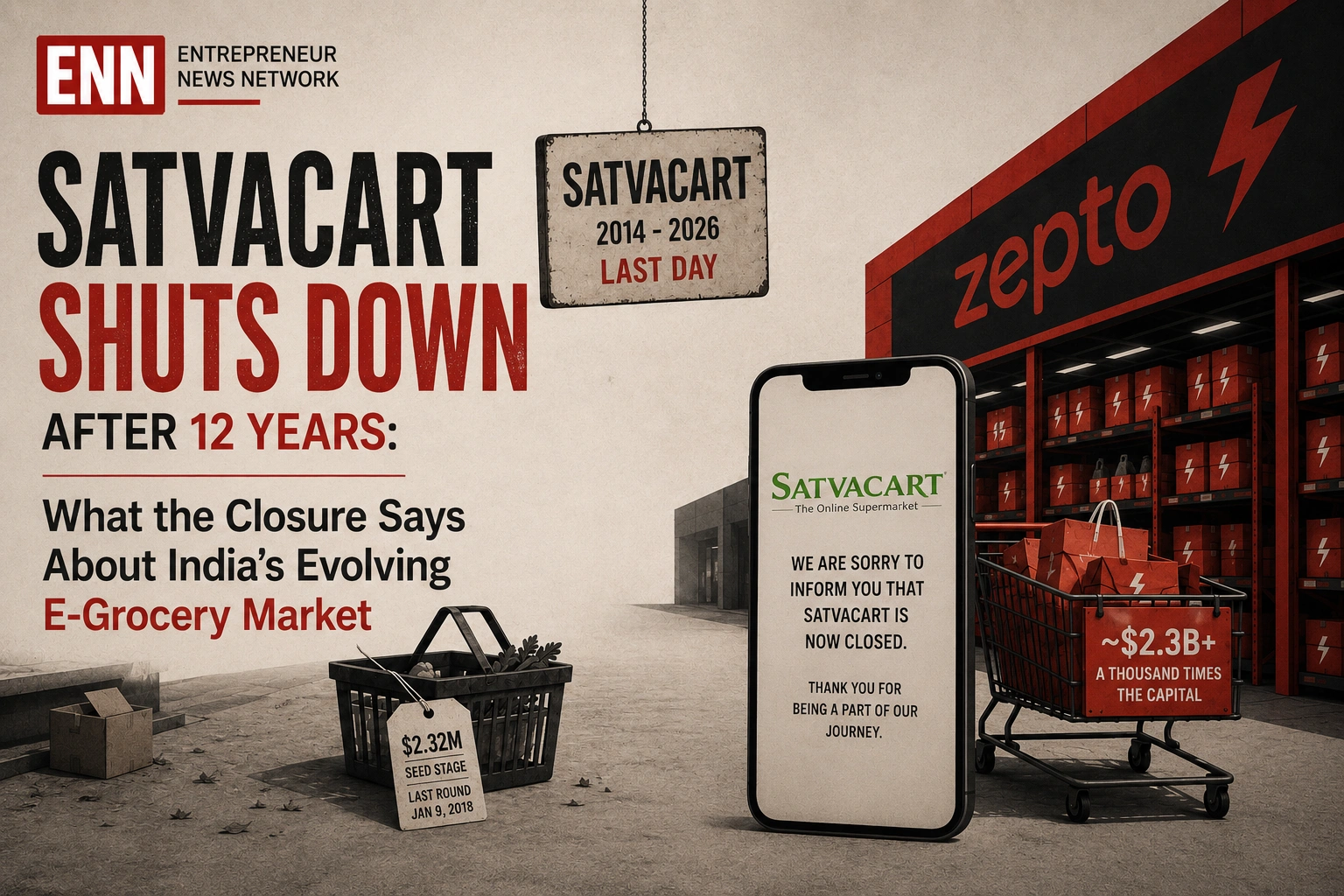
Gurugram, August 30, 2026: Early Indian e-grocery startup Satvacart has shut down after 12 years of operations, closing a chapter that began well before quick commerce transformed the country’s online grocery market.
The startup ceased operations on August 28, with founder Rahul H. Saxena confirming that the company’s team had been disbanded. The shutdown follows several years of efforts to raise capital, attract strategic investment and explore a potential acquisition.
For a startup that entered online grocery in 2014, Satvacart’s journey offers a revealing look at the difficult balance between profitability, scale, fundraising and survival in India’s rapidly changing consumer-tech ecosystem.
Satvacart Ends 12-Year Journey
Saxena announced the closure in a LinkedIn post, explaining that the company had reached a point where continuing operations was becoming increasingly difficult for the people who had remained with the business.
Satvacart had managed to raise funding over the years, but according to Saxena, much of it came through relatively small tranches. The company needed substantially larger capital to rebuild the business and pursue its next phase of growth.
The startup also explored strategic investment opportunities and acquisition discussions with multiple companies. However, none of these efforts resulted in a transaction.
Saxena said Satvacart’s emphasis on profitability contributed to the company remaining relatively small. While this approach helped the startup demonstrate that an online grocery business could become profitable, it also limited the scale that potential investors and acquirers increasingly looked for.
From Milk Subscriptions to Online Grocery
Satvacart was founded in 2014, entering the online grocery market at a time when India’s digital commerce ecosystem was still developing.
The company initially started with milk subscriptions in Gurugram before transitioning towards an inventory-led grocery business.
Its operating model centred around micro-clusters, with independent warehouses serving customers located within approximately a five-kilometre radius. The approach was designed to keep delivery operations local while maintaining control over inventory and fulfilment.
In 2015, Satvacart raised seed funding from Palaash Ventures and angel investors. The capital was intended to support expansion, customer acquisition and technology development.
Rather than pursuing aggressive marketing-led expansion, Satvacart adopted a comparatively measured strategy, with greater emphasis on building a sustainable and profitable operation.
Satvacart’s Profitability Strategy
One of the notable aspects of Satvacart’s journey was its focus on profitability at a time when India’s consumer internet market was increasingly driven by growth and venture capital.
According to Saxena, Satvacart had become one of the early online grocery businesses to demonstrate profitability in the category by 2019.
That achievement helped the company navigate several difficult periods in India’s e-grocery market.
However, profitability alone was not enough to guarantee long-term growth.
As India’s grocery market evolved, investors increasingly placed greater emphasis on scale, customer density, order volumes, technology infrastructure and expansion potential. That changed the economics of competing in the category.
Satvacart’s relatively conservative approach meant it survived market cycles but did not build the scale that later became critical to attracting large institutional investment or strategic buyers.
How Quick Commerce Changed Indian Grocery
Satvacart’s closure comes against the backdrop of one of the biggest transformations in India’s consumer internet industry.
When Satvacart entered the market, online grocery was still an emerging category. Companies such as BigBasket, Grofers and PepperTap were experimenting with different approaches to grocery delivery, including scheduled deliveries and hyperlocal fulfilment.
The market subsequently moved towards a dramatically different model.
The rise of quick commerce made delivery speed, neighbourhood-level store density and order frequency central to the competitive equation.
Companies such as Blinkit, Zepto and Swiggy Instamart helped establish consumer expectations around deliveries within minutes rather than hours or days. Large e-commerce companies also expanded their presence in rapid-delivery grocery.
This shift created a market where operational scale became increasingly important.
For businesses operating with smaller fulfilment networks, competing against companies capable of deploying large amounts of capital into dark stores, technology, logistics and customer acquisition became significantly harder.
Why Scale Became Critical
The Satvacart story highlights a central tension in India’s startup ecosystem: Is profitability enough if a company does not achieve sufficient scale?
For years, Satvacart’s business model demonstrated that an e-grocery operation could focus on economics rather than simply pursuing growth at any cost.
But the market eventually rewarded a different set of characteristics.
Quick-commerce companies built dense networks of fulfilment centres and used high order volumes to improve utilisation. They also had access to substantial venture capital that could fund rapid expansion.
That created a competitive environment where scale itself became an advantage.
A smaller company could potentially operate profitably, but still struggle to compete for investment, strategic partnerships or acquisition opportunities.
Funding Challenges Played a Role
Satvacart’s shutdown also illustrates how challenging fundraising can become for startups that have moved beyond the early stage but have not reached the scale investors expect.
The company received funding, according to Saxena, but the capital came largely in smaller amounts.
Satvacart needed a more substantial investment to rebuild and grow the business.
The startup subsequently held discussions with two larger investors over significant funding. Neither transaction ultimately materialised.
Acquisition discussions with several companies also failed to result in a deal.
For a company operating in a capital-intensive sector, the inability to secure a sufficiently large funding round can eventually become a structural constraint.
A Different Startup Lesson From Satvacart
Satvacart’s story is not simply about the failure of an early e-grocery startup.
It also raises questions about the changing definition of startup success.
The company prioritised profitability and managed to survive for more than a decade while India’s online grocery market went through several major transformations.
Yet longevity and profitability could not fully compensate for the lack of scale required in the modern quick-commerce environment.
For founders, the lesson is particularly relevant: building a profitable business and building a venture-scale business are not always the same thing.
A company may have healthy unit economics and loyal customers while still finding it difficult to attract the capital necessary to compete in a rapidly consolidating market.
What Satvacart’s Closure Means for India’s Startup Ecosystem
Satvacart’s shutdown provides another example of how India’s startup landscape has matured.
The early phase of India’s internet economy was characterised by experimentation across business models, including hyperlocal commerce, scheduled grocery delivery and subscription-based services.
The current market is considerably more concentrated around models capable of achieving significant operational scale.
Capital is also increasingly selective.
Investors are looking more closely at revenue quality, contribution margins, customer retention, cash requirements and the path to sustainable profitability.
Satvacart’s experience demonstrates that neither growth nor profitability exists in isolation. In highly competitive markets, companies need to find the right balance between financial discipline and the ability to scale quickly when market conditions demand it.
Founder Looks Ahead
Despite the shutdown, Saxena described the 12-year journey positively.
Building Satvacart involved working across technology, operations, fundraising, marketing, supply chain and customer experience.
With the company now closed, Saxena said he is looking forward to the next chapter.
For India’s startup ecosystem, Satvacart leaves behind a different kind of legacy: that of an early e-grocery company that entered the market before quick commerce, prioritised profitability, survived multiple industry shifts and ultimately became a case study in the growing importance of scale, capital and timing.
The Bottom Line
Satvacart’s closure marks the end of a 12-year journey in Indian e-grocery, but its story offers valuable lessons for today’s founders.
The company proved that profitability was possible in online grocery long before quick commerce became mainstream. Yet the subsequent transformation of the market showed that profitability without sufficient scale can become a disadvantage when competitors have access to significantly larger pools of capital.
As India’s startup ecosystem enters a more disciplined phase, Satvacart’s experience underscores an important reality: survival matters, profitability matters, but in winner-takes-most markets, scale can ultimately determine who gets to survive the next cycle.
This article is based on information provided in the source material, including statements attributed to Satvacart founder Rahul H. Saxena.
Sarvam AI Raises Investment From IndiGo Ventures to Expand Enterprise AI

Ruchi Kumar is the associate editor at Entrepreneur News Network and TVW News India, where she leads editorial strategy, brand storytelling, and startup ecosystem coverage. With a strong focus on innovation, business, and marketing insights, he curates impactful narratives that spotlight India’s evolving entrepreneurial landscape. She has written extensively on fintech, AI and emerging startups.