
New Delhi, September, 1, 2026- Artificial intelligence is entering September 2026 with developments spanning government, enterprise software, AI models, venture capital and consumer adoption.
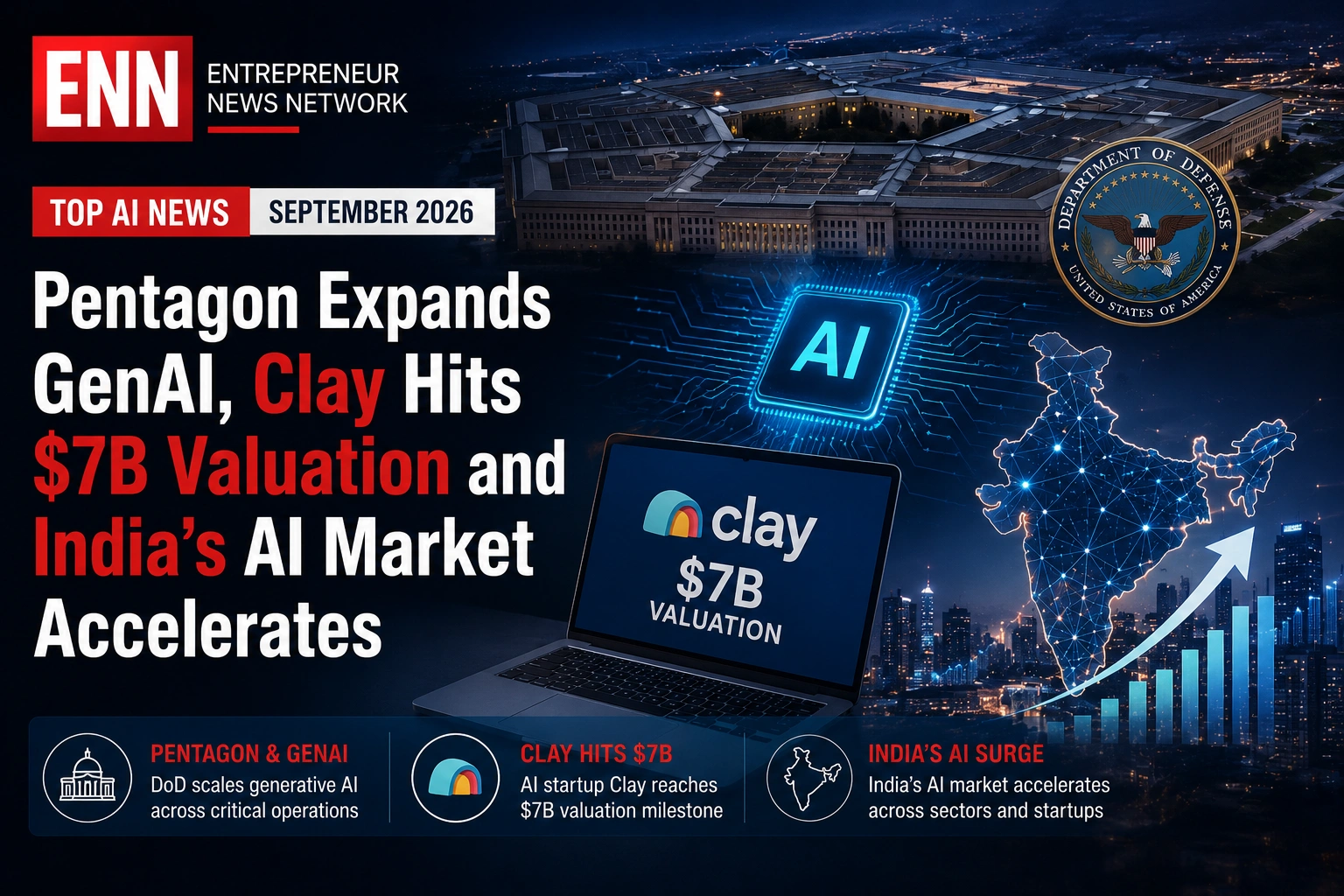
From the U.S. Department of Defense expanding access to multiple generative AI models to Clay securing a multibillion-dollar valuation, the latest developments show that competition is no longer limited to building better models. Access to users, enterprise workflows, government contracts and AI infrastructure are becoming equally important.
Here are five of the most significant AI stories shaping the industry.
Pentagon Expands GenAI.mil With ChatGPT Mil and Grok
The U.S. Department of Defense has expanded its GenAI.mil enterprise AI platform by adding OpenAI’s ChatGPT Mil and Starshield AI’s Grok for Government alongside Google’s Gemini.
The platform gives more than three million Joint Force personnel access to frontier AI models for unclassified tasks, including document preparation, planning, logistics, policy work and administration.
ChatGPT Mil has received accreditation for Controlled Unclassified Information at Impact Level 5, a security classification relevant to certain sensitive but unclassified government workloads.
GenAI.mil has reportedly attracted more than 1.7 million unique users since its launch approximately nine months ago.
The Pentagon’s multi-model strategy also reflects an effort to reduce dependence on a single AI provider. Different models can be used for different workloads, allowing government employees to select tools based on their requirements.
The development also highlights the increasingly competitive government AI market. Anthropic’s Claude remains outside the platform, with reports indicating that the Pentagon is moving away from its use of Claude models.
Why it matters
Government adoption could become an important growth channel for leading AI companies. The GenAI.mil rollout demonstrates how AI is moving from experimental technology into everyday administrative and operational workflows.
OpenAI to End Cursor Model Access Following SpaceX Acquisition
OpenAI has told AI coding platform Cursor that its access to OpenAI models will end on November 12, 2026, following SpaceX’s acquisition of Cursor in August.
OpenAI said the decision was linked to concerns about whether SpaceX would continue to comply with its contractual terms.
The impact on Cursor may be limited, however. Cursor CEO Michael Truell said OpenAI models account for only around 5% of the platform’s usage, with most users already relying on models from Anthropic and Google.
Anthropic has also indicated that it intends to continue increasing computing capacity for Claude within Cursor.
The dispute illustrates a growing challenge for AI application companies: maintaining relationships with multiple foundation-model providers can be essential for business continuity.
The bigger AI industry story
The episode also shows how ownership, partnerships and commercial agreements are becoming increasingly important in the AI ecosystem.
AI coding platforms are no longer simply choosing the best available model. They must also consider reliability, economics, strategic relationships and access to multiple providers.
Clay Reaches $7 Billion Valuation in New AI Funding Round
AI-powered sales and marketing platform Clay is reportedly raising fresh capital at a $7 billion pre-money valuation, with Wellington Management leading the round.
The new valuation represents a significant increase from the approximately $5 billion valuation established during a January 2026 employee tender offer.
It is also more than double Clay’s roughly $3.1 billion valuation following its $100 million funding round in 2025.
Clay uses AI agents to help businesses automate prospecting, data enrichment and customer outreach. Its platform connects information from multiple sources and helps go-to-market teams turn that data into actionable sales campaigns.
The funding demonstrates that investor interest remains strong in AI-native enterprise software, particularly products that integrate AI directly into revenue-generating workflows.
AI application companies attract institutional capital
Wellington Management’s participation is also notable because traditional asset managers are increasingly becoming involved in high-growth AI businesses.
The development suggests that investor attention is expanding beyond foundation-model developers toward companies building specialized AI applications for business users.
Alibaba Previews Qwen4 Architecture as China’s AI Competition Intensifies
Alibaba’s Qwen team has released Qwen3.8-Flash-Next, an open-weight multimodal mixture-of-experts model positioned as an early preview of the architecture expected to underpin the upcoming Qwen4 family.
The model reportedly contains 125 billion total parameters, while activating approximately 6 billion parameters per token.
That architecture focuses on improving efficiency while maintaining significant model capability.
The release comes amid intensifying competition among Chinese AI companies in the open-weight model market.
Moonshot AI’s Kimi K3, another major open-weight model, has also attracted attention with its extremely large parameter count and mixture-of-experts architecture.
Chinese AI developers are increasingly competing on both model performance and commercialization strategies.
Alibaba is reportedly considering revenue-sharing arrangements for certain large commercial users of its next open-weight model, indicating that the open-model ecosystem could increasingly experiment with alternative approaches to monetization.
Why Qwen4 matters
Alibaba’s Qwen series has become an important part of China’s open AI ecosystem. The development of Qwen4 could further intensify competition among Chinese AI laboratories while increasing pressure on leading global AI developers.
India’s AI User Base Continues to Expand
India is rapidly emerging as one of the world’s most important markets for consumer AI applications.
Perplexity has benefited from aggressive distribution partnerships in the country, including its collaboration with Bharti Airtel, which provides more than 360 million Airtel subscribers with a year of free access to Perplexity Pro.
Perplexity’s average daily in-app purchase revenue in India reportedly increased during the period from mid-July to mid-August, while its revenue during the first seven months of 2026 was reportedly around $878,000.
Other major AI companies are also pursuing partnerships designed to accelerate adoption.
OpenAI and Google have introduced their own premium AI access initiatives, including Google’s offer of an extended free AI Pro subscription for eligible Reliance Jio customers.
India presents a major monetization opportunity
The country’s enormous digital population makes India an attractive market for AI companies seeking rapid user growth.
However, a major challenge remains: turning free users into paying customers.
AI companies can acquire millions of users through telecom partnerships and promotional offers, but long-term revenue growth will depend on whether those users continue paying once promotional access ends.
For AI companies, India could therefore become an important test of whether large-scale consumer adoption can translate into sustainable monetization.
AI Competition Is Expanding Beyond Models
The latest developments point to a broader shift in the artificial intelligence industry.
The competition is no longer simply about which company has the most powerful model.
It is increasingly about:
- Government and enterprise distribution
- AI infrastructure and computing capacity
- Developer ecosystems
- Strategic partnerships
- AI-native applications
- Open-weight models
- Consumer adoption
- Monetization
The Pentagon’s multi-model approach, OpenAI’s decision involving Cursor, Clay’s rapidly rising valuation, Alibaba’s Qwen strategy and India’s accelerating AI adoption all demonstrate different sides of the same transformation.
As September 2026 begins, the next phase of the AI race may be determined not only by who builds the smartest models, but by who can put those models into the hands of the most users and turn them into indispensable products and businesses.
SLB to Acquire Kelvion, Expanding its Role Across Data Center Infrastructure

Ruchi Kumar is the associate editor at Entrepreneur News Network and TVW News India, where she leads editorial strategy, brand storytelling, and startup ecosystem coverage. With a strong focus on innovation, business, and marketing insights, he curates impactful narratives that spotlight India’s evolving entrepreneurial landscape. She has written extensively on fintech, AI and emerging startups.