
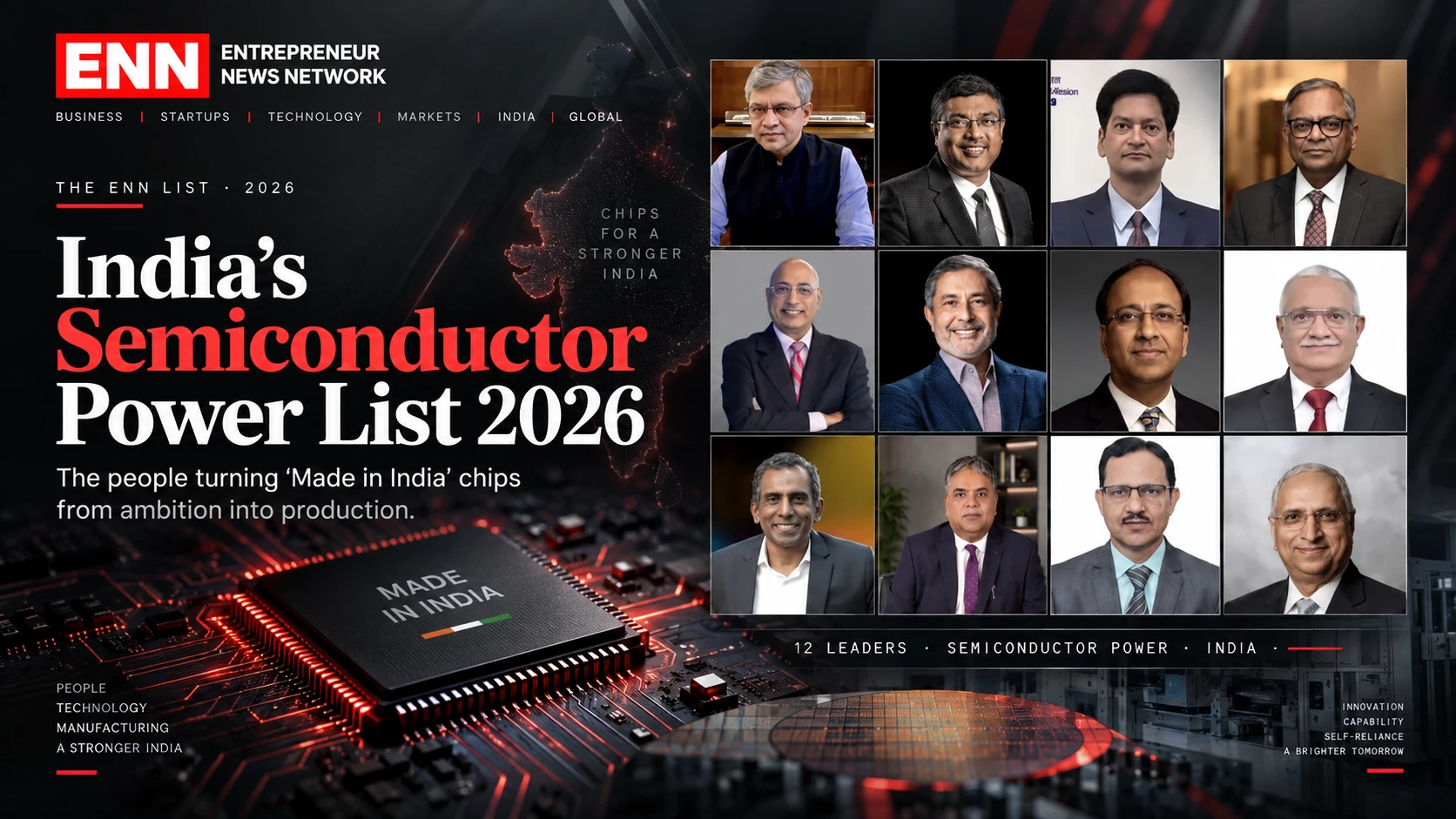
September 22, 2026 | New Delhi, India – India’s semiconductor programme stopped being a promise in 2026. Three plants are shipping commercially, twelve projects are approved, and a ₹1.27 lakh crore second phase is now funded. Here are the people behind it.
From files to factories
At SEMICON India 2026 in New Delhi this September, Prime Minister Narendra Modi described the shift plainly: the chip story had “moved from files to factories.” He added that, for the first time, “we are talking about commercial production” — chips leaving Indian plants for customers at home and abroad.
The numbers behind that sentence matter. Under the first phase of the India Semiconductor Mission, twelve projects carrying investment commitments of roughly ₹1.64 lakh crore were approved across six states. Three of them — Micron’s Sanand facility, Kaynes Semicon’s OSAT unit and CG Semi’s Sanand plant, inaugurated by the Prime Minister in July — are now in commercial production.
The second phase, Semicon 2.0, was cleared with an outlay of ₹1,27,500 crore, taking the mission’s total to about $13.5 billion from an initial $8 billion. It widens the aperture from fabs and packaging to six pillars: chip design, semiconductor equipment and materials, fabrication, advanced packaging, research and development, and talent.
SEMICON India 2026, held 17–19 September at Yashobhoomi, drew over 600 exhibitors — roughly 300 of them international — and delegates from more than 40 countries under the theme “Silicon to Systems: Building the Ecosystem.” Applied Materials used the platform to announce a $5 billion India plan.
The policy is now visible as concrete, cleanrooms and payrolls. What follows is the human layer: twelve people whose decisions in the last twenty-four months explain where India’s semiconductor industry actually stands.
The policymakers
1. Ashwini Vaishnaw — Union Minister, Electronics & IT
Vaishnaw is the political engine of the India Semiconductor Mission. He set out the six pillars of Semicon 2.0 and has been the government’s most consistent voice on why a country that designs a fifth of the world’s chips should also make them. He presented the first made-in-India chip to the Prime Minister, and was present when Aheesa unveiled its Vihaan-I chip at SEMICON India 2026.
2. S. Krishnan — Secretary, MeitY
If Vaishnaw sets direction, Krishnan runs the machinery: scheme notifications, inter-ministerial clearances, and the budget lines that turn approvals into plants. He has called 2026 a landmark year for Indian semiconductors, and described the 2026–27 Union Budget as a technology budget in a sector that depends on multi-year fiscal certainty.
3. Amitesh Kumar Sinha — Additional Secretary, MeitY & CEO, India Semiconductor Mission
Sinha is where policy meets project management. As ISM’s chief executive he oversees the programme that has approved twelve projects so far, and he has been vocal that semiconductor jobs are not restricted to a handful of metros — a point he has made specifically about talent from Jharkhand and Bihar reaching India’s chip lines.
The industrialists
4. N. Chandrasekaran — Chairman, Tata Sons
Chandrasekaran committed the group to the single largest private bet in the sector: India’s first commercial fab at Dholera, Gujarat, alongside a chip assembly and packaging unit at Jagiroad, Assam — around $14 billion combined. That decision, more than any policy document, told global suppliers that India’s fab ambition had a balance sheet behind it.
5. Dr. Randhir Thakur — CEO & MD, Tata Electronics
Thakur is building it. A veteran of Intel and Applied Materials, he is assembling a fab and its supply chain simultaneously — Tata Electronics signed 16 memoranda of understanding at SEMICON India 2026 alone and is courting hundreds of suppliers for Dholera. He has called India’s semiconductor journey “pretty strong,” crediting Semicon 2.0 with giving the industry policy continuity.
6. Sanjay Mehrotra — CEO, Micron Technology
Born in Kanpur and a co-founder of SanDisk, Mehrotra leads the global memory company whose Sanand assembly and test plant was the first to put Indian-packaged chips into commercial channels. Micron’s early move gave every subsequent investor a working precedent in Gujarat.
7. Anand Ramamoorthy — VP & MD, Micron India
Ramamoorthy executed the part investors underestimate: people. He led what Micron describes as the fastest headcount and competency ramp in Indian semiconductor history, building an operating workforce for a plant type the country had never run before.
8. Ramesh Kunhikannan — Founder & MD, Kaynes Technology
Kunhikannan founded Kaynes in Mysuru in 1989, long before “electronics manufacturing” was a national priority. Kaynes Semicon’s Sanand OSAT facility began production in 2026 as India’s second chip unit — the clearest evidence yet that an Indian mid-cap can enter semiconductor packaging and ship.
9. Vellayan Subbiah — Chairman, CG Power
Subbiah is behind CG Semi, whose Sanand OSAT plant the Prime Minister inaugurated in July 2026 and which produced the chip presented as a made-in-India milestone. The unit is targeting a scale that only makes sense if India’s electronics demand holds — management has pointed to an eventual capacity measured in millions of chips a day.
The designers and the connectors
10. Sridharan Mani — Founder & CEO, Aheesa Digital Innovations
Aheesa unveiled Vihaan-I at SEMICON India 2026 in the presence of Ashwini Vaishnaw — India’s first indigenously designed broadband networking chip, which achieved first-pass silicon in August 2026 with a production tapeout targeted for 2027. First-pass silicon is rare anywhere; for a first-time Indian product team it is the strongest argument yet for design-led, not just assembly-led, growth.
11. Ashok Chandak — President, IESA and SEMI India
Chandak sits between the industry and the government, and has welcomed Semicon 2.0 as a transformational step towards a globally competitive ecosystem, with the industry projecting investment potential well beyond the scheme’s own outlay. His constituency — hundreds of design houses, suppliers and service firms — is where the next tier of Indian semiconductor companies comes from.
12. Ajit Manocha — President & CEO, SEMI
Manocha has spent five editions of SEMICON India arguing a single point to the global industry: India should not merely join the semiconductor supply chain, it should become integral to it. The 40-plus countries represented at Yashobhoomi this year suggest the argument has landed.
What 2027 will test
Three questions decide whether 2026 was an inflection or a peak.
Does Dholera deliver? Packaging is where India started; a working fab is a different order of difficulty. Tata’s timeline is the sector’s timeline.
Does the design pillar produce products? Vihaan-I is a proof point of one. Semicon 2.0 funds design companies and IP cores explicitly — the test is how many reach production tapeout.
Does the supply chain localise? Equipment and materials are the thinnest part of the ecosystem. Applied Materials’ $5 billion commitment and Tata’s supplier hunt are the early signals; the government’s stated goal is for India to design and manufacture chips for 70–75% of domestic applications by 2029.
FAQ
How many semiconductor plants are operating in India in 2026?
Three are in commercial production — Micron, Kaynes Semicon and CG Semi, all in Gujarat. Twelve projects in total have been approved across six states.
What is Semicon 2.0?
The second phase of the India Semiconductor Mission, cleared with a ₹1,27,500 crore outlay covering six pillars: design, equipment and materials, fabs, advanced packaging, R&D and talent.
When will India’s first fab produce chips?
Tata Electronics’ Dholera fab is the first commercial fab under construction; the company says its projects are on track.
What was announced at SEMICON India 2026?
Held 17–19 September at Yashobhoomi, New Delhi, with 600+ exhibitors from 40+ countries. Announcements included Applied Materials’ $5 billion India plan, 16 Tata Electronics MoUs, and the unveiling of Aheesa’s Vihaan-I chip.

Ruchi Kumar is the associate editor at Entrepreneur News Network and TVW News India, where she leads editorial strategy, brand storytelling, and startup ecosystem coverage. With a strong focus on innovation, business, and marketing insights, he curates impactful narratives that spotlight India’s evolving entrepreneurial landscape. She has written extensively on fintech, AI and emerging startups.