

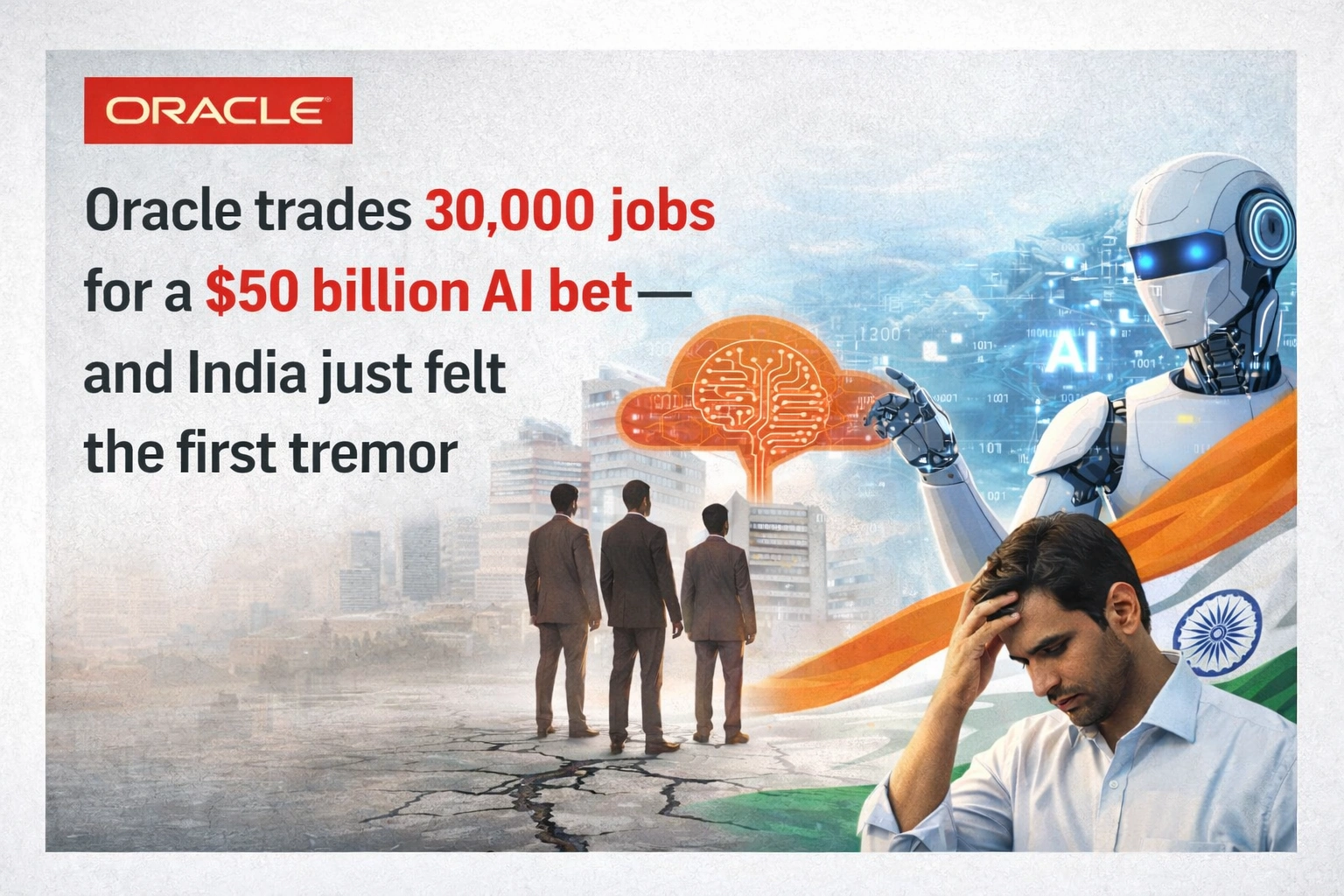
Oracle Trades 30,000 Jobs for a $50 Billion AI Bet — and India Just Felt the First Tremor
Termination emails landed at 6 AM. System access was gone before most employees had finished their first cup of chai. What happened at Oracle India is not an isolated corporate event — it is a signal of what is coming for the entire IT sector.
Oracle's global restructuring represents one of the largest single-company workforce reductions in the 2026 tech layoff cycle. Graphic: ENN / Data: Oracle filings, analyst estimates.
- Oracle is cutting up to 30,000 employees globally — nearly 20% of its total workforce — to fund a $50 billion AI infrastructure expansion.
- India, Oracle's largest hub outside the US with 50,000 employees, was hit hardest: estimates range from 2,500 confirmed cuts to as many as 12,000 affected workers.
- Terminations were executed via early-morning email, with immediate system lockouts — bypassing standard HR protocol.
- Analysts expect the layoffs to free up $8–10 billion in free cash flow, redirected toward GPU procurement and AI data centers.
- A second wave of cuts is expected within 30 days. This is not over.
On the morning of April 1, 2026 — a date many Oracle India employees will find difficult to forget — thousands of professionals woke up to a termination email. The sender line read "Oracle Leadership." Not HR. Not their direct manager. By the time they clicked through to the details, their laptop access was already revoked.
This was not a performance-based exit. It was not a negotiated departure. It was an operating model making a calculated, large-scale decision: that human capital in legacy roles is now a liability on the balance sheet, and GPU-filled data centers are the asset class of the next decade.
Oracle's pivot is one of the most dramatic in enterprise technology history — and its ripple effects will reshape hiring, salary expectations, and career trajectories across India's IT sector for years to come.
The Numbers Behind the Restructuring
To understand the scale of what Oracle is doing, you need to look at both what it is cutting and what it is building. These are not separate stories. The workforce reduction is literally the funding mechanism for the AI expansion.
Sources: Oracle filings, Reuters, Bloomberg analyst estimates. Stargate figure represents full programme scope across all partners.
India: Oracle's Largest Hub Outside the US, and the Hardest Hit
India houses Oracle's single biggest international workforce — 50,000 employees before the cuts. That concentration, built over decades of offshoring and capability-center expansion, is now working against those same employees.
The actual number of those affected remains contested. Media reports have cited figures as high as 12,000. Oracle's own internal communications and sources familiar with the matter suggest the confirmed number sits between 2,500 and 3,000. The gap between those two figures matters — but even the conservative number represents a seismic event for India's IT ecosystem.
Business units affected
Bar widths are proportional representations based on media reports and analyst commentary. Exact department-level figures not confirmed by Oracle.
6 AM. One Email. Access Revoked.
What made Oracle's layoff execution distinctly unsettling — even by the clinical standards of corporate restructuring — was the method. Employees were not called into meetings. There was no one-on-one conversation. There was no HR representative on the other end of a video call.
There was an email. Sent at 6:00 AM IST. From "Oracle Leadership."
"Many employees found themselves locked out of their systems before they had even opened the termination email. The access revocation and the notification arrived in the same digital moment."
— Based on employee accounts reported across multiple sources, April 2026
| Component | Details | Condition |
|---|---|---|
| Base severance | 15 days of base salary per year of service | Must sign DocuSign |
| Notice period payout | 1 month equivalent | Must sign DocuSign |
| Ex gratia top-up | 2 additional months | Must sign DocuSign |
| Unvested RSUs | Forfeited entirely | No recovery possible |
| Health insurance | No extension provided | Ends with employment |
This Is Not Oracle's Story. This Is the Industry's Story.
Oracle's restructuring is the most dramatic example yet of a pattern that has been building throughout 2025 and has accelerated sharply into 2026. Across the global tech and enterprise sector, the calculation is changing: human capital in operational and legacy-software roles is being systematically exchanged for AI infrastructure capital.
The names on the broader 2026 layoff list tell the full story of how far this mandate has spread beyond Silicon Valley. This is no longer a tech sector phenomenon.
Layoffs have left the tech bubble — industries affected
The efficiency mandate has left the tech sector. Every industry is recalculating the cost of human labour against AI automation.
India's IT job market is expected to tighten significantly through Q2–Q3 2026. Mid-level hiring will slow. Salary growth expectations will moderate. The pipeline of experienced professionals entering the market — many with strong Oracle, cloud, and enterprise software backgrounds — will compress compensation benchmarks in those categories for the next 12–18 months.
From Nouns to Verbs: The Only Pivot That Protects You
There is a pattern in how capable, experienced professionals respond to moments like this. It rarely looks like loud panic. It looks like quiet erosion. A slow, creeping sense that the rules you built your entire career around are being rewritten while you are still playing by them.
For decades, professionals in large organisations built their identities around Nouns. The Director. The Vice President. The Senior Architect. The Enterprise Solutions Expert. These titles were polished and worn like armour — signals of status, competence, and security.
But what Oracle's 6 AM email demonstrated is this: a Noun belongs to the company. When the company decides to restructure, the Noun disappears with it. If your entire professional identity is wrapped in that title, the collapse feels absolute — not just financial, but existential.
"Titles belong to companies. Your ability to build, to solve, to design, to navigate ambiguity, to mentor — those Verbs belong entirely to you. They are portable. They survive the cuts."
— Perspective on career identity in the age of AI disruption
Tied to org chart. Vanishes with restructuring.
Status signal. Company-owned. Non-transferable.
Defined by a specific tech stack. Becomes legacy.
Employer-dependent identity. Gone at 6 AM.
Systems, products, teams, trust — anywhere.
Complex problems under ambiguity. Always scarce.
Ambiguity, politics, change. AI cannot do this.
Human intelligence. Cross-context. Irreplaceable.
The question worth sitting with: if your company disappeared tomorrow, which action would you still feel a deep need to perform? That answer is your real professional identity.
What to Do If You Are in an Oracle-Adjacent Role Right Now
Waiting for a readiness script that does not exist is the most expensive habit in a shifting market. Here is what the data and career intelligence points to:
Oracle's stock is up. Investors are pleased. The company's AI infrastructure revenue grew 243% year-on-year. By every market metric, this restructuring is working exactly as intended.
For the tens of thousands of professionals navigating the human side of that equation, the math feels very different. But the response cannot be paralysis. The storm that reached Oracle India on April 1, 2026 is not a singular event — it is the leading edge of a structural shift that is moving through every large organization in every sector.
The professionals who navigate this well will not be the ones who panicked. They will be the ones who paused long enough to ask a different question: not "how do I protect my Noun?" but "which Verb am I willing to build my next decade around?"
That is the only answer the market cannot automate away.
- Oracle Corporation — official company communications and investor filings, April 2026
- Reuters — Oracle layoffs reporting, April 2026
- CNBC — Oracle AI infrastructure investment coverage
- Economic Times — India workforce impact analysis
- Bloomberg Technology — Oracle debt and AI capex reporting
- US Department of Labor — H-1B petition data, 2026
- Analyst estimates: Stargate initiative scope per OpenAI/SoftBank announcements

Ruchi Kumar is the associate editor at Entrepreneur News Network and TVW News India, where she leads editorial strategy, brand storytelling, and startup ecosystem coverage. With a strong focus on innovation, business, and marketing insights, he curates impactful narratives that spotlight India’s evolving entrepreneurial landscape. She has written extensively on fintech, AI and emerging startups.