

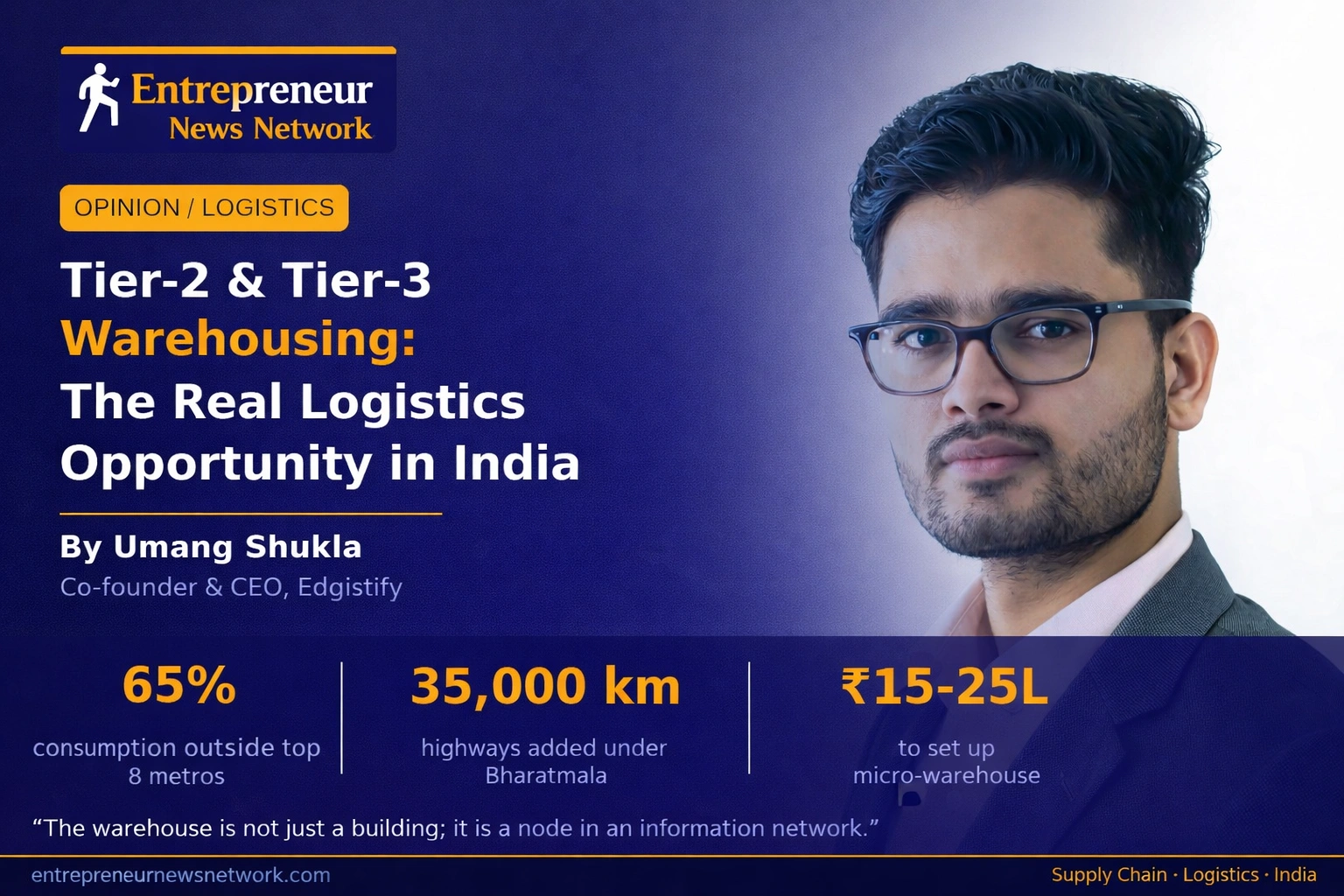

Here is a fact that should reshape how we think about Indian logistics: nearly 65% of India's consumption now happens outside the top eight metropolitan cities. Yet the overwhelming majority of organised warehousing capacity remains concentrated in these metros. This mismatch is not a minor inefficiency; it is a structural gap that is costing businesses money, costing consumers time, and creating one of the largest untapped opportunities in the Indian supply chain.
For startups and MSMEs willing to operate where the demand actually is, the opportunity is significant.
Defining the Opportunity
Tier-2 cities — think Jaipur, Lucknow, Coimbatore, Indore — are regional economic hubs with populations typically between 10 lakhs and 40 lakhs. They have functional infrastructure, growing consumer bases, and are increasingly home to manufacturing clusters. Tier-3 cities are smaller, often below 10 lakh population, with developing infrastructure but rapidly growing demand.
Historically, these cities were afterthoughts — places where goods arrived late, inventory was an approximation, and delivery timelines were suggestions rather than commitments. That is changing, driven by forces that are structural rather than cyclical.
Why Warehousing Is Moving Beyond the Metros
The economics have shifted. Land costs in Mumbai or Bengaluru's logistics corridors have risen 40–60% over the past five years. Rental rates for Grade-A warehousing in metro peripheral areas have surged significantly. Meanwhile, comparable facilities in Tier-2 cities command considerably lower rates.
But cost arbitrage alone does not explain the shift. Three deeper forces are at work.
First, e-commerce has democratised demand. When a consumer in Raipur expects the same two-day delivery as someone in Delhi, the only way to deliver profitably is to store inventory closer. Centralised mega-warehouses in metros cannot serve this distributed demand efficiently. The last-mile costs eat into margins, and delivery times stretch beyond customer tolerance.
Second, infrastructure has caught up. The Bharatmala project has added over 35,000 km of highway corridors. The Delhi-Mumbai Industrial Corridor, the Eastern and Western Dedicated Freight Corridors, and state-level expressway projects have fundamentally changed connectivity. Cities that were logistically isolated a decade ago are now within viable trucking distance of major consumption centres.
Third, manufacturing is decentralising. Production clusters for textiles, auto components, food processing, and consumer goods are increasingly located in Tier-2 and Tier-3 cities where labour costs are lower, and land is available. Warehousing needs to follow production, not just consumption.
What This Means for Startups
Tier-2 and Tier-3 markets offer something increasingly rare: the ability to build and iterate without the cost structures that force premature scaling or death.
Micro-warehousing models work here. A 5,000–10,000 square foot facility positioned correctly can serve as a distribution node for an entire district. The capital requirements are manageable — often ₹15–25 lakh to set up versus ₹1–2 crore for metro operations. This allows for experimentation with different service models before committing to scale.
Technology adoption creates disproportionate advantage. Most warehousing in smaller cities remains manual, with paper-based inventory tracking, no real-time visibility, and high error rates. Introducing even basic warehouse management software, barcode scanning, and inventory optimisation tools can dramatically improve accuracy and throughput. The competition is often unorganised; operational excellence becomes a genuine differentiator.
Full-stack logistics services find ready customers. D2C brands and regional e-commerce sellers need more than storage — they need picking, packing, shipping integration, and returns handling. In metros, they have options. In Tier-2 cities, reliable full-service providers are scarce. The startup that can offer an integrated solution becomes indispensable.
Specialised storage commands premium pricing. Cold chain for dairy and produce, climate-controlled storage for pharmaceuticals, secure facilities for high-value goods — these are underserved categories in smaller cities. The infrastructure gap means that operators who invest in specialised capabilities can command margins that would be impossible in competitive metro markets.
What This Means for MSMEs
For manufacturing and trading MSMEs, the calculation is different but equally compelling.
Many MSMEs currently operate with distant warehousing — storing goods in metro facilities and shipping them back to customers in their own regions. This is economically irrational but often happens because organised warehousing options do not exist locally. The cost is reflected in transportation expenses, delivery delays, and stockouts that result in lost sales.
Establishing or accessing local warehousing changes the arithmetic. Transportation costs drop. Delivery times shrink from days to hours. Inventory can be managed responsively rather than speculatively. For an MSME selling ₹10–20 crore annually, the savings can run into several lakhs per year — often enough to meaningfully improve operating margins.
There is also an asset monetisation angle. MSMEs with surplus space — an unused portion of a factory, an underutilised godown — can convert these into shared warehousing facilities. In markets starved for organised storage, even modest facilities can generate rental income while serving the owner's own needs. This is particularly relevant for seasonal businesses that need flexibility rather than year-round fixed capacity.
The Challenges Are Real
None of this is straightforward. Smaller cities come with smaller talent pools. Finding warehouse managers, inventory controllers, and operations staff with relevant experience is genuinely difficult. Companies need to invest in training and often promote from within rather than hiring ready-made expertise.
Last-mile connectivity remains inconsistent. Highways may be excellent, but the final 10–15 kilometres to customer locations can involve unpaved roads, unclear addressing, and fragmented delivery networks. This is where local knowledge and relationships matter more than pure technology.
Demand volatility is higher. Metro markets have diversified customer bases that smooth out fluctuations. Smaller markets can swing dramatically with local economic conditions, seasonal patterns, or the fortunes of anchor customers. Building flexibility into operations — through variable cost structures, shared capacity, and scalable systems — becomes essential.
Access to capital remains constrained. Banks and financial institutions are less familiar with warehousing assets in Tier-2 and Tier-3 locations. Loan approvals take longer, collateral requirements are higher, and working capital facilities are harder to secure. Patient capital and creative financing structures matter.
The Road Ahead
The shift towards distributed warehousing is not a trend; it is a correction. For decades, Indian logistics developed around a metro-centric model that no longer reflects where production and consumption actually happen. The companies that will thrive are those building systems — not just facilities — that can operate efficiently across dispersed geographies.
For startups, this means thinking about technology and operations as inseparable. The warehouse is not just a building; it is a node in an information network. Real-time inventory visibility, demand forecasting, and automated order routing — these capabilities matter more in distributed networks than in centralised ones, because the margin for error is smaller and the cost of inefficiency is higher.
For MSMEs, this means rethinking logistics as a strategic function rather than a cost centre. The businesses that treat warehousing and distribution as afterthoughts will continue to lose ground to competitors who understand that being close to the customer — really close, not one-thousand-kilometres-and-three-days-close — is a fundamental competitive advantage.
The opportunity is clear. The infrastructure is improving. The demand is already there. What remains is execution — and that, as always, is where the real work begins.
Umang Shukla is the Co-founder and CEO of Edgistify, a technology-driven logistics and warehousing platform focused on solving India's supply chain challenges beyond the metros. Edgistify works with D2C brands, MSMEs, and enterprises to provide full-stack warehousing and last-mile distribution solutions across Tier-2 and Tier-3 cities.
