

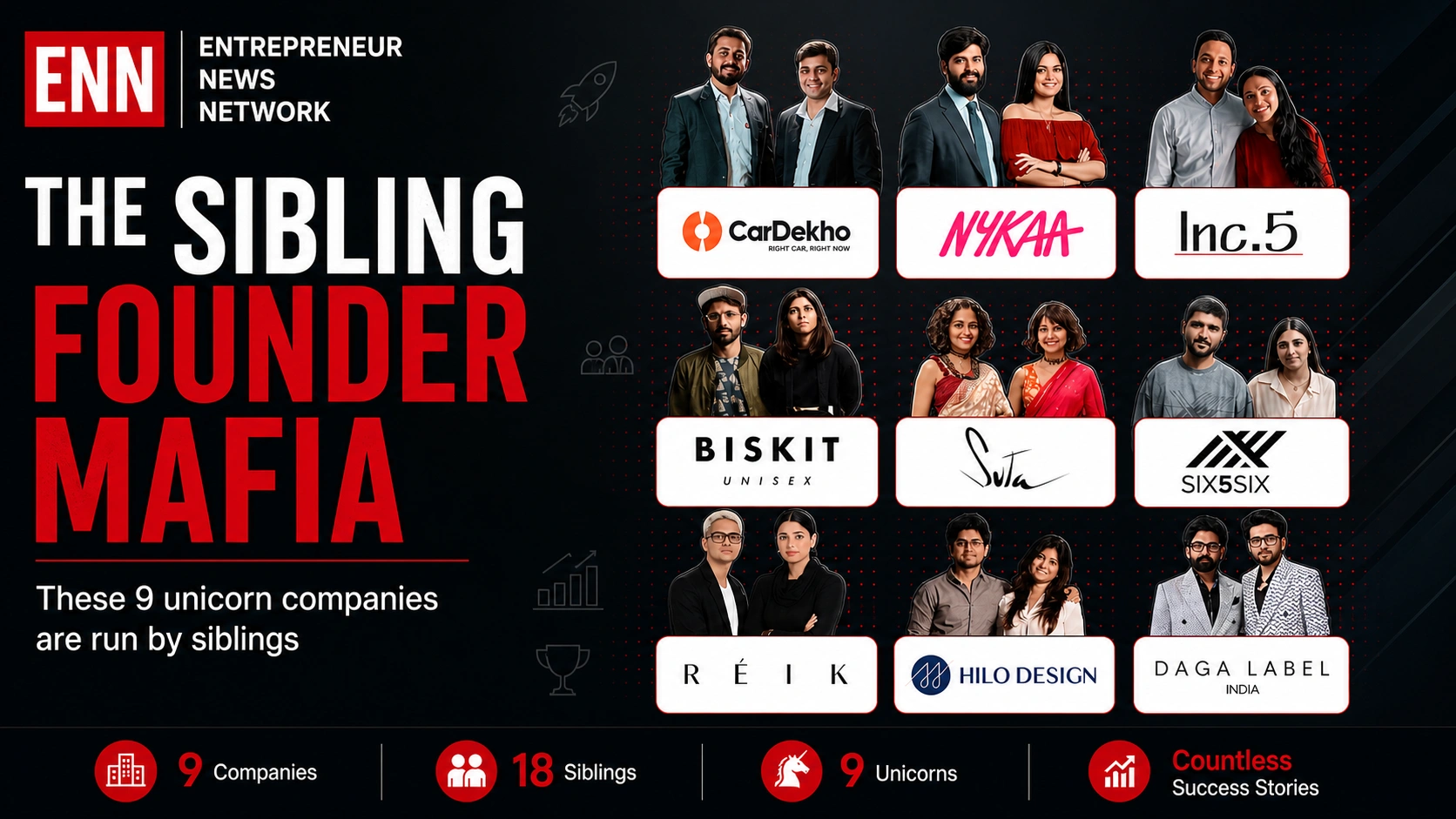
India's Sibling Founder Mafia:
Built on Blood, Scaled on Trust
When your co-founder already knows your darkest fears, your worst habits, and still believes in you — that's not just partnership. That's an unfair advantage.
By StartupIndia Editorial · May 1, 2026 · 12 min read
The Premise
The Startup World's Most Underrated Co-Founder Advantage
India's startup ecosystem loves a good co-founder story. Former classmates from IIT. Ex-colleagues from Goldman Sachs. Two strangers who met at a hackathon. But quietly, away from the headline-chasing venture capital circuit, a different kind of founding partnership has been compounding its advantage for decades: siblings.
Call them the Sibling Founder Mafia. Pairs — sometimes trios — of brothers and sisters who leverage something no accelerator programme can manufacture and no term sheet can price: trust that was built before the pitch deck, before the product, often before adulthood.
"When you've fought over the television remote and still chosen each other, navigating a board room disagreement is just Tuesday."
This investigation maps the cohort of modern Indian startups and unicorns led by siblings — from Category-A unicorns to bootstrapped streetwear labels — to understand what makes this co-founder structure not just viable, but often quietly superior.
The Leaderboard
The Sibling Mafia — Eight Brands to Know
Across sectors from automotive to artisanal sarees, here are the sibling-led companies reshaping their categories.
| Brand | Founders | Sector | Defining Move |
|---|---|---|---|
| CarDekho | Amit & Anurag Jain | Automotive / Fintech | Rebuilt from a ₹1 crore stock market wipeout to unicorn status using organic SEO from a garage in Jaipur. |
| Nykaa | Anchit & Adwaita Nayar | Beauty / Fashion | Children of founder Falguni Nayar, leading fashion and beauty verticals of a $7B+ brand. |
| Inc.5 Shoes | Almas Nanda & Amin Virji | Footwear / Retail | Pivoted grandfather's 1954 "Regal Shoes" into a ₹163 crore modern retail network of 54 stores. |
| Suta | Sujata & Taniya Biswas | Handloom / Fashion | Walked away from IIT, IIM, IBM, and Tata careers to revive handloom sarees. Now ₹50 crore revenue. |
| SIX5SIX | Avni & Ambar Aneja | Streetwear / Sports | Delhi-based, unfunded, ₹14 crore revenue streetwear brand competing with 130+ funded rivals. |
| Hilo Design | Sahith & Mouna Gummadi | Designer Ethnic Wear | Hyderabad-based brother-sister duo offering AI-assisted made-to-fit ethnic menswear. |
| Daga Label | Divyansh & Garvit Arora | Luxury Menswear | Noida brothers channelling their father's artisanal craft into luxury Indian menswear exports. |
| BISKIT | Harsha & Shruti Biswajit | Art / Fashion | A concept studio creating gender-neutral "wearable art" in strictly limited editions of 21 pieces. |
Deep Research
Four Stories That Define the Cohort
Each story below surfaces a different dimension of why the sibling co-founder model creates lasting competitive edge.
CarDekho: The Phoenix Siblings
Amit & Anurag Jain — Jaipur → Unicorn
In 2009, Amit and Anurag Jain lost their entire seed capital — ₹1 crore — in the stock market. They sat across from 40–50 employees with payroll due and effectively nothing in the bank. For many founding teams, this is the end.
Both IIT Delhi alumni, the brothers didn't dissolve the partnership or blame each other. They set up shop in a garage — literally — using rented wedding tables as desks, and rebuilt GirnarSoft from scratch. No external funding, no pivot to something easier.
Rather than burning cash on performance marketing, they invested deeply in organic Search Engine Optimisation. CarDekho became one of India's earliest and most successful examples of content-led, SEO-driven growth in the automotive vertical — a playbook that gave them structural advantages that paid-media-dependent rivals could never replicate.
Today CarDekho is a unicorn. In a gesture of deep cultural symbolism, the Jains recently gifted luxury cars to employees who had stayed with the company for over a decade — a full-circle moment for brothers who once couldn't afford their own office furniture.
The garage origin is not incidental. It is the proof that trust between siblings is a kind of capital that doesn't appear on any balance sheet, yet sustains a company through losses that would otherwise destroy it.
Suta: Reviving the Sari, One Weaver at a Time
Sujata & Taniya Biswas — Childhood nomads → ₹50 crore brand
Growing up in a family that moved frequently across India, Sujata and Taniya Biswas learned early that their most reliable constant was each other. By their own account, they finish each other's sentences — not as a cliché, but as a survival skill honed through childhood transience.
Their professional credentials were impeccable — engineering backgrounds, an MBA from IIM Lucknow, another from IIFT Delhi, careers at Tata and IBM respectively. They walked away from all of it. Not from recklessness, but from a shared conviction that India's handloom heritage was being lost while millennials scrolled past it.
Suta began as a Facebook page — at a time when that was genuinely novel as a sales channel. They photographed sarees themselves, wrote copy themselves, and hand-packaged early orders. The authenticity was indistinguishable from the passion because it was the same thing.
Today, Suta employs over 150 people directly and has created livelihoods for thousands of weavers across weaving clusters in West Bengal, Odisha, and Rajasthan. Annual revenue sits at ₹50 crore. The brand has made buying a handloom saree feel culturally modern rather than ancestrally obligatory.
Inc.5: The Legacy That Got a Haircut
Almas Nanda & Amin Virji — Regal Shoes, 1954 → ₹163 crore
Regal Shoes was a Mumbai institution — formal, reliable, conservative. Founded by their grandfather in 1954, it represented everything that the footwear market was in post-Independence India: functional over fashionable, utility above desire.
In 1998, 24-year-old Almas Nanda spotted a gap that her grandfather had never needed to see: young Indian women wanted shoes that were both stylish and genuinely comfortable — not one or the other. The Indian middle class was expanding, and it wanted to dress the part without sacrificing its feet.
Her brother Amin Virji took the operational scale. From a single 100-square-foot concept shop, the siblings built Inc.5 into a 54-store national retail network generating ₹163 crore in annual revenue. They made a deliberate choice to avoid distributors entirely, maintaining full brand control at every touchpoint.
Despite being listed on major e-commerce platforms, Inc.5 generates 95% of its revenue through physical retail — a counter-intuitive bet in a decade obsessed with digital-first. The siblings believe the shoe-buying experience is inherently tactile and that their in-store presentation is itself a differentiator.
SIX5SIX: Bootstrapped and Unbothered
Avni & Ambar Aneja — Delhi streetwear, 2015 → ₹14 crore unfunded
Founded in 2015, SIX5SIX entered what is arguably the most trend-volatile category in fashion — streetwear and sports apparel. The Delhi-based siblings had no manufacturing legacy, no retail footprint, and no venture capital cushion. What they had was taste and each other.
As of 2026, SIX5SIX Street remains entirely unfunded — a notable distinction in a landscape where competitors routinely raise large seed rounds to fuel customer acquisition and inventory. With over 130 active competitors in the same segment, the Aneja siblings have maintained a strong market ranking on self-generated revenue alone.
₹14 crore in revenue built without a single external rupee of investment is not an accident. It is a proof of concept for sustainable unit economics in Indian fashion — and a quiet rebuke to the "raise to grow" orthodoxy of modern startup culture.
Also Watch
Four More Sibling Stories Worth Following
Hilo Design
A brother-sister duo making ethnic menswear accessible through style consultations and made-to-fit tailoring. Their approach — called "style-assisted shopping" — treats the fitting experience as the product, not just the garment.
Daga Label
The Arora brothers carry forward their father's artisanal skills into a luxury menswear brand that champions Indian craft techniques. Their positioning bridges heirloom craftsmanship with contemporary menswear design — an increasingly rare combination.
BISKIT
Perhaps the most conceptually distinctive brand in the cohort, BISKIT operates as a concept studio rather than a fashion label. Each collection is strictly limited to 21 pieces, gender-neutral, and conceived as wearable art — placing it at the intersection of gallery and wardrobe.
Nykaa (Anchit & Adwaita)
While their mother Falguni Nayar founded and leads the $7B+ Nykaa group, both Anchit and Adwaita have taken on significant leadership roles. Anchit heads the company's digital beauty business while Adwaita leads Nykaa Fashion — a sibling division of responsibilities within a family-run empire.
Pattern Analysis
Why the Sibling Model Works: Five Structural Advantages
Looking across this cohort, certain patterns repeat regardless of sector or scale. These are not coincidences — they are the structural properties of sibling co-founder dynamics playing out in business context.
Pre-Built Trust
Trust is the slowest resource to build in any organisation. Siblings arrive with it fully formed — stress-tested across childhood conflicts, shared family crises, and years of proximity. In a startup, where decisions need to be made fast and disagreements need to be resolved without ego wars, this is worth months of runway.
Complementary Roles
Across the cohort, a recurring pattern emerges: one sibling handles the creative-strategic vision, the other the operational-financial engine. Almas conceived Inc.5; Amin scaled it. Sujata shaped Suta's aesthetic; Taniya operationalised the supply chain. The division is rarely planned — it seems to emerge naturally.
Long-term Orientation
Siblings build companies differently from co-founders who are acquaintances. There is less short-term optimisation for personal financial exits and more willingness to absorb pain — as the CarDekho brothers demonstrated in 2009 — because the relationship itself is the long-term investment.
Honest Conflict
Siblings can say things to each other that politely connected co-founders cannot. This directness — which might wound a professional partnership — often becomes a strength in sibling ventures. Bad ideas get killed faster. Good ones get championed more loudly.
Shared Cultural Memory
Especially in heritage or craft-based businesses (Suta, Inc.5, Daga Label), siblings share a common cultural inheritance that informs product direction organically. There is no need to align on aesthetic philosophy from first principles — they grew up inside the same one.
Sector Breakdown
Across Fashion, Tech & Beyond
The sibling cohort is not clustered in one industry — it spans automotive technology, artisanal fashion, heritage footwear, streetwear, and luxury craft. This breadth suggests the structural advantage transcends sector.
CarDekho
Amit & Anurag Jain
India's leading automotive marketplace. Built using organic SEO as the primary growth lever — a capital-efficient strategy that proved prescient when the digital advertising market became increasingly expensive for competitors.
Suta
Sujata & Taniya Biswas
A handloom saree brand with a genuine social mission: sustaining weaving communities while making traditional textiles aspirational for modern Indian women. Started on Facebook; now a multi-platform brand with 150+ employees.
Inc.5 Shoes
Almas Nanda & Amin Virji
A master class in legacy transformation. The siblings took a grandfather's conservative footwear brand and built a ₹163 crore fashion-retail company — while deliberately retaining 95% offline distribution as a competitive strength, not a limitation.
SIX5SIX
Avni & Ambar Aneja
Delhi's quiet streetwear disruptors. In a category driven by funded competitors, SIX5SIX has built meaningful scale without outside capital — a rarity in Indian fashion that signals unusually disciplined unit economics and brand-building.
Conclusion
The Advantage That Doesn't Appear on Any Cap Table
India's startup ecosystem is maturing rapidly. The easy-money era of 2021 is a cautionary memory, and investors are now scrutinising unit economics, capital efficiency, and — increasingly — founding team dynamics with far greater rigour.
In this context, the sibling founder model deserves a serious analytical look, not just a feel-good narrative. The evidence across this cohort suggests that sibling-led companies demonstrate higher resilience in adversity (CarDekho's 2009 reset), stronger long-term orientation (Inc.5's three-generation arc), and more authentic brand-building (Suta's mission-driven origin).
The greatest startups are not built on strategy. They are built on the capacity to keep going when strategy fails. And that capacity lives in the relationship between co-founders.
What this cohort collectively demonstrates is something that cannot be reverse-engineered by a professional co-founder matching service or a startup incubator's team-building workshop: when two people have already survived each other across a lifetime, surviving a startup is a smaller ask.
The Sibling Founder Mafia is not a marketing story. It is a structural observation about how pre-existing, deeply-tested trust translates into company-building advantages that compounds over time. As India's startup ecosystem enters its next decade, expect this cohort to grow — and to continue outperforming the conventional wisdom that the best partnerships are built in boardrooms.
They're built, it turns out, in living rooms.

Ruchi Kumar is the associate editor at Entrepreneur News Network and TVW News India, where she leads editorial strategy, brand storytelling, and startup ecosystem coverage. With a strong focus on innovation, business, and marketing insights, he curates impactful narratives that spotlight India’s evolving entrepreneurial landscape. She has written extensively on fintech, AI and emerging startups.