

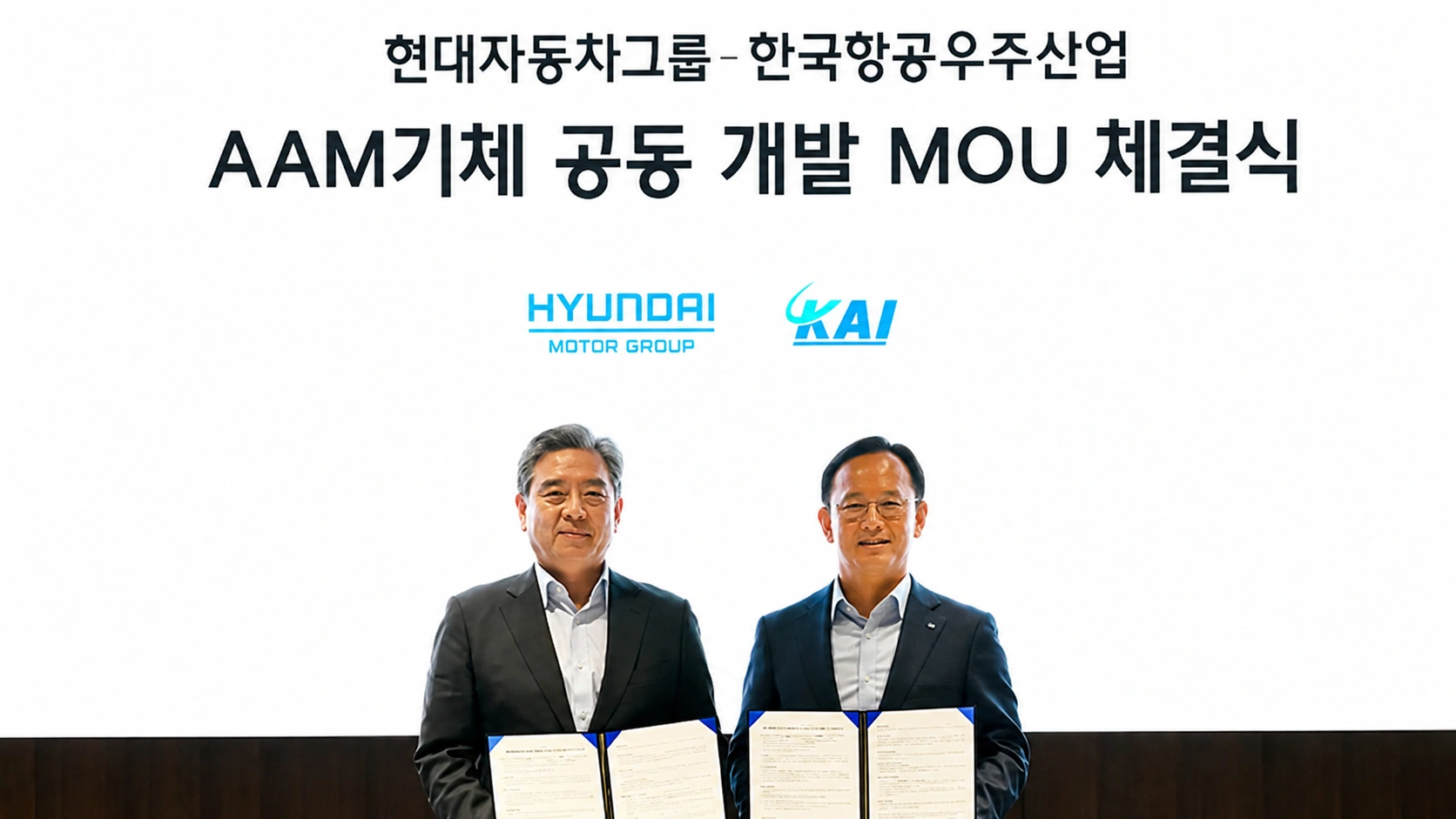
In a significant move to reshape the future of urban transportation, Hyundai Motor Group has entered into a strategic partnership with Korea Aerospace Industries (KAI) to jointly develop Advanced Air Mobility (AAM) aircraft. This collaboration aims to combine Hyundai’s large-scale manufacturing expertise with KAI’s deep capabilities in aircraft engineering, positioning both companies strongly in the rapidly expanding global air mobility market.
Strengthening Korea’s K-AAM Vision
Hyundai Motor Group has recently renewed its focus on AAM by restructuring leadership within its aviation arm, Supernal. The partnership with KAI is expected to accelerate the development of Korea’s domestic air mobility ecosystem, widely referred to as K-AAM.
The collaboration was formalized through a memorandum of understanding (MOU) signed at Hyundai Motor and Kia’s headquarters in Seocho-gu, Seoul. Senior leadership from both organizations attended the signing, including Vice Chairman Jaehoon Chang and KAI President Kim Jong-chul.
Focus on Electric-Powered AAM Aircraft
The agreement centers on the joint development and mass production of next-generation AAM aircraft powered by electric aviation systems. Hyundai will contribute its expertise in electric powertrain technology, while KAI will leverage its decades of experience in aircraft design and development.
Beyond manufacturing, both companies plan to collaborate across critical areas such as:
- Supply chain integration
- Aircraft certification processes
- Global customer network expansion
- Workforce and technology sharing
This integrated approach is expected to strengthen their competitive position in the emerging AAM sector.
Role of Supernal in Vertical Takeoff Aircraft
Supernal will play a key role in designing electric vertical takeoff and landing (eVTOL) aircraft, a cornerstone of urban air mobility. Simultaneously, Hyundai Motor and Kia’s aviation powertrain division will focus on commercializing advanced electric propulsion systems currently under development.
Highlighting the importance of the collaboration, Jaehoon Chang stated that partnering with KAI brings a strong advantage in developing safe and innovative aerial mobility solutions.
KAI President Kim Jong-chul emphasized that combining KAI’s expertise in both fixed-wing and rotary-wing aircraft with Hyundai’s manufacturing scale could position K-AAM as a global leader in the sector.
Leadership Boost with CTO Appointment
In a parallel development, Supernal has appointed Farhan Gandhi as its new Chief Technology Officer (CTO). With over 30 years of experience in rotary-wing aircraft research and development, Gandhi is expected to strengthen Supernal’s technological capabilities, particularly in vertical flight systems.
KAI’s Expansion into Civil Aviation
Founded in 1999, Korea Aerospace Industries has traditionally focused on military aviation, developing aircraft such as the KT-1 trainer and the Songgolmae drone. However, the company is now expanding into the civilian AAM market, signaling a strategic shift toward future mobility solutions.
Conclusion: A Strategic Leap in Global Air Mobility
The partnership between Hyundai Motor Group and Korea Aerospace Industries marks a crucial step toward building a scalable and competitive AAM ecosystem. By combining automotive manufacturing efficiency with aerospace innovation, the alliance is well-positioned to lead the next wave of urban air transportation.
As the global race for air mobility intensifies, this collaboration could play a defining role in shaping how people and goods move in the skies over the coming decades.

Ruchi Kumar is the associate editor at Entrepreneur News Network and TVW News India, where she leads editorial strategy, brand storytelling, and startup ecosystem coverage. With a strong focus on innovation, business, and marketing insights, he curates impactful narratives that spotlight India’s evolving entrepreneurial landscape. She has written extensively on fintech, AI and emerging startups.