
Entrepreneur News Network

The Founders Who Skipped the Pitch Deck — and Still Hit $500K in 7 Months

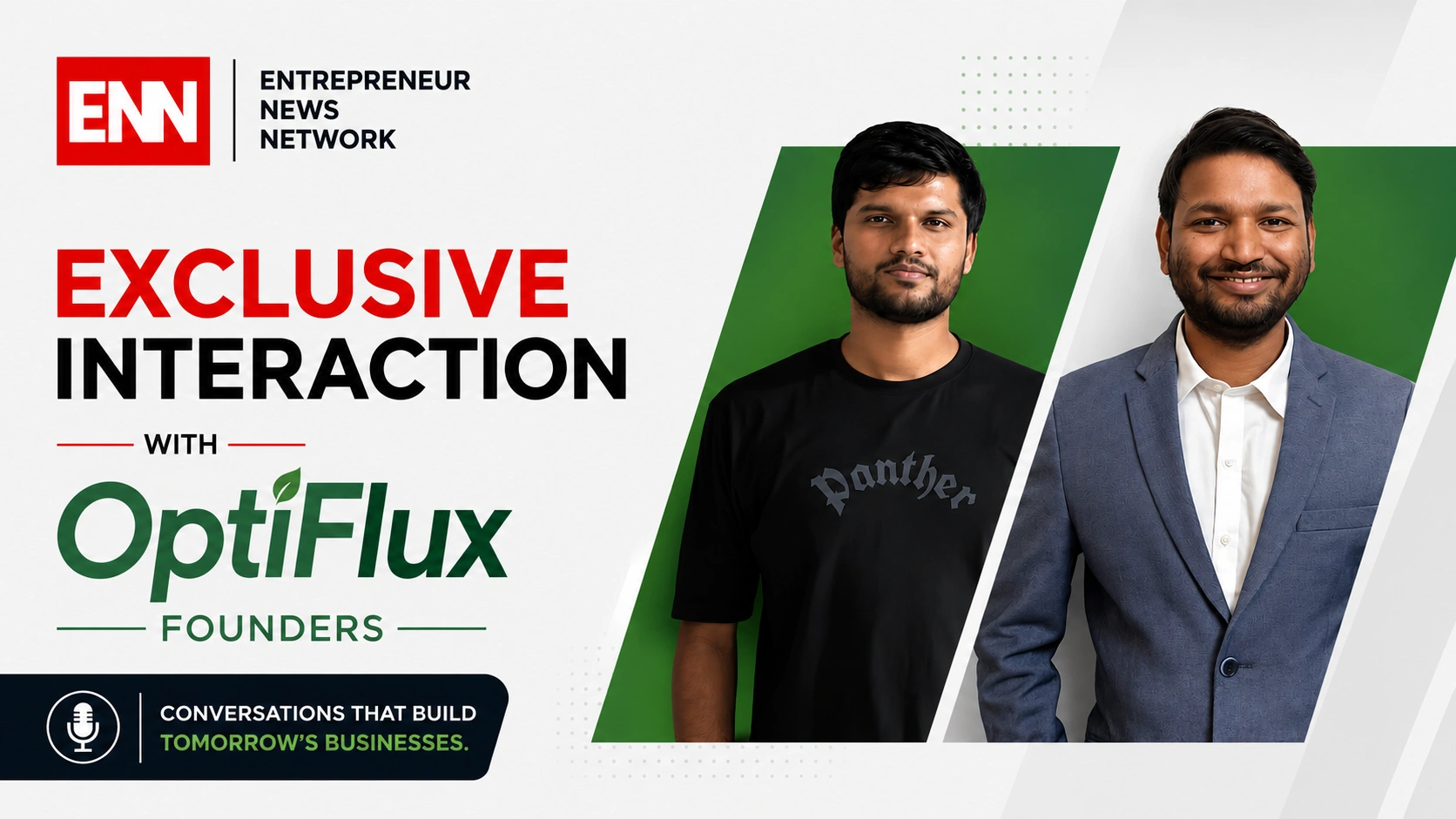
Exclusive Interview

The Founders Who Skipped the Pitch Deck — and Still Hit $500K in 7 Months

8 min read AI · Operations Research · Deep Tech India

In an era where every startup races to build an LLM wrapper and survive on investor runway, the founders of OptiFlux made a contrarian bet: solve hard mathematical problems, close a client first, and register the company only after the money was promised. No pitch decks. No pre-seed rounds. No product-market fit experiments. Just a converted lead and a GST registration delay standing between them and their first payment.

"We were not very sure what product we wanted to build. We just wanted to work at the top of research AI — because that is what we are good at."

Seven months and half a million dollars in revenue later, OptiFlux is quietly doing what most Indian deep-tech startups only talk about — bringing Operations Research and mathematical optimization to some of the largest industrial players in the world. From a Canadian retail chain bigger than Walmart, to one of the world's largest mining companies, to an AI dubbing platform for Chiranjeevi's team in Tollywood — the company operates across verticals that seem wildly unrelated but share one thread: every decision they optimize is worth millions.

We sat down with the founders to talk about why classical OR is making a comeback, what's really wrong with SaaS-for-everyone thinking, and how India could move from the world's cost center to its decision center — if the right builders show up.

$500K
Revenue · 7 months
21
Team · 8 consultants
$0
Marketing spend
The Interview
Q1
OptiFlux sits at the intersection of classical Operations Research and modern AI — at a time when everyone is doing LLMs. Is this a return to basics, or are you filling a gap that LLMs simply cannot?
Founder — OR & Supply Chain
In OR, we use both traditional methods and AI — but a lot of problems simply can't be solved with AI alone. Think about 10 manufacturing plants. Every single one runs differently. AI learns from previous data, from historical patterns. But if you want to build a system that is genuinely optimal for a specific plant, you first need to mathematically model how it actually operates. Once that model is right, AI on top of it becomes very powerful. Without that foundation, you're just guessing.
Q2
Most deep-tech startups in India die at the POC stage. How did you avoid that trap — and did you run any pilots before officially launching?
Founder — Strategy & Growth
We didn't follow the usual startup playbook. Most founders pick a problem, build something, then try to raise money. We weren't even sure what product we wanted to build. We started with services, found a problem in our network, and only registered the company after we'd already converted our first client. We were profitable from day zero — we actually had to wait for a payment because we hadn't finished our GST paperwork yet. The POC trap never applied to us because we validated before we built.
Q3
Everyone is talking about agentic AI and autonomous systems. What's the real difference between a system that acts automatically and one that is mathematically optimized for ROI?
Founder — OR & Supply Chain
We don't build general products. The problem with most automation platforms is they try to fit the same system everywhere — vehicle routing for Myntra, then Flipkart, then Amazon. They start adding parameters, and suddenly deployment takes years. We go into every client's plant, understand their specific operations, and build from scratch — sometimes using components from previous work, but never forcing a fit. Customization takes longer, but it gets you customers who actually stay.
Q4
You're working with a Canadian retail chain bigger than Walmart and one of the world's largest mining companies. How did a 7-month-old startup land these?
Founder — OR & Supply Chain
All of it came through referrals. We haven't spent a single rupee on marketing — not until March this year. Every client came from a previous happy customer or a trusted introduction. For the retail chain, we're solving price optimization across 1,500 stores and lakhs of SKUs — maximizing sales and margins while respecting constraints like competitor pricing and minimum margin floors. For the mining company, we're handling real-time workforce scheduling. If a train driver calls in sick, the system instantly matches skills to the open role and minimizes operational damage. These problems are hard. Not many teams can solve them. That's why we get the calls.
Q5
India is often called the world's cost center. Can deep-tech optimization change that narrative — positioning India as a decision center for global supply chains?
Founder — Strategy & Growth
It could. We're still cost-effective compared to Western alternatives, but our focus is always on quality — and quality is what keeps clients coming back. Whether India becomes a decision center depends entirely on the kind of value we generate. For us, the vision is to build the decision layer on top of existing ERPs — telling manufacturers what to produce, when, and in what sequence, so machines run better and margins improve. Even a 1% efficiency gain across a steel plant translates to millions. Scale that across industries, and you're talking about measurable national impact — including lower carbon output from more efficient processes.
Q6
What is the one unsolved problem in Indian industry that OptiFlux is targeting by 2030?
Founder — OR & Supply Chain
Manufacturing. Everyone in the Indian startup world talks about Blinkit and Zepto. Nobody is really thinking about the steel plants, chemical companies, and plastic manufacturers — old-economy industries that run on ERPs with basic analytics but no real intelligence. There's forecasting, but there's no optimization. No decision layer. That's what we want to build: a system that sits on top of ERP and tells you what to produce, when, in what order — so machines don't go idle and every ton you produce costs less. If we can do that at scale, we stop being a cost center and start being the brain.

Leave a Comment