

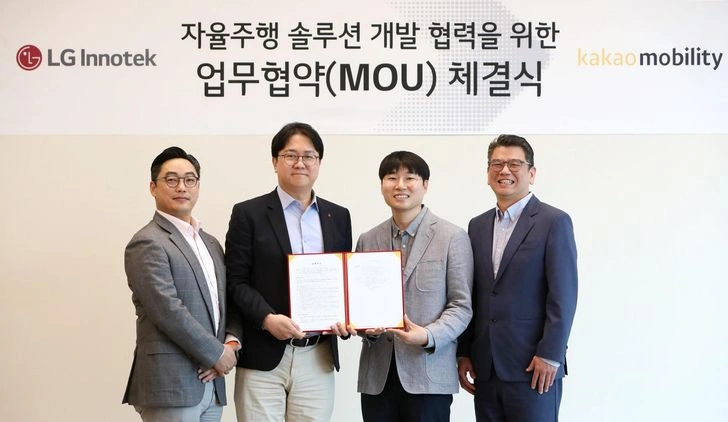
South Korea’s autonomous driving and artificial intelligence ecosystem is gaining momentum as major technology companies deepen collaborations in the fast-growing physical AI market. In a significant development, LG Innotek and Kakao Mobility have announced a strategic partnership to jointly develop autonomous driving AI technology.
The collaboration aims to combine LG Innotek’s advanced sensing technology with Kakao Mobility’s large-scale real-world driving data to accelerate innovation across autonomous vehicles, robotics, and drone systems.
Companies Sign MOU for Autonomous Driving Solutions
The two companies recently signed a memorandum of understanding (MOU) at LG Innotek’s headquarters in Seoul, South Korea.
Under the partnership:
- LG Innotek will use Kakao Mobility’s real-world driving data to improve the performance of its autonomous driving sensor modules.
- Kakao Mobility will integrate LG Innotek’s sensing technologies into its autonomous driving AI platform.
The collaboration is expected to strengthen both companies’ capabilities in physical AI systems, which refer to AI technologies designed to interact with and operate in the physical world through machines, vehicles, robots, and smart devices.
Growing Focus on Physical AI
Physical AI is rapidly emerging as one of the next major frontiers in artificial intelligence.
Unlike traditional AI systems focused mainly on software applications, physical AI powers:
🚗 Autonomous vehicles
🤖 Humanoid robots
🚁 Drones
🏭 Smart industrial automation
📦 Autonomous logistics systems
Industry experts believe physical AI could become one of the largest technology sectors over the next decade as AI increasingly moves from digital platforms into real-world environments.
Kakao Mobility to Strengthen AI Training Infrastructure
As part of the partnership, Kakao Mobility plans to strengthen its end-to-end autonomous driving system.
The company’s AI infrastructure currently supports:
- Driving data collection
- Data processing
- AI model training
- Autonomous driving deployment
By incorporating LG Innotek’s sensing technology, Kakao Mobility aims to improve the quality and accuracy of autonomous driving systems.
The company sees real-world driving data as a critical component for developing safer and more reliable AI-powered mobility solutions.
LG Innotek Expanding Autonomous Driving and Robotics Business
LG Innotek has identified sensing technology for physical AI as a major future growth area.
The company is targeting:
📊 2 trillion won (approximately US$1.32 billion) in revenue from its physical AI sensing business by 2030.
LG Innotek President Moon Hyuk-soo said the partnership with Kakao Mobility represents an important step in advancing sensing technologies for next-generation AI systems.
He stated that the company plans to provide customized sensing solutions not only for autonomous driving but also for robots and drones.
Global Race for Autonomous AI Leadership Intensifies
Technology companies worldwide are investing heavily in autonomous AI systems as demand rises for:
- Self-driving transportation
- Smart robotics
- AI-powered industrial automation
- Advanced sensing technologies
LG Innotek has been actively expanding its partnerships to gain an early advantage in the physical AI market.
Recent collaborations include:
- A partnership with Applied Intuition for autonomous driving solutions
- An agreement with Boston Dynamics to develop vision sensing systems for humanoid robots
These partnerships highlight the increasing convergence of:
🤖 Artificial intelligence
📡 Advanced sensors
🚘 Mobility technology
🏭 Robotics engineering
Autonomous Driving Market Continues to Expand
The global autonomous driving market is expected to witness significant growth due to advances in:
- AI-powered perception systems
- Sensor technology
- Edge computing
- Real-time data analytics
- Vehicle connectivity
Automakers, mobility companies, and technology firms are increasingly collaborating to accelerate commercial deployment of autonomous systems.
Real-world driving data is considered essential for training autonomous AI models, helping systems better understand:
✔ Road conditions
✔ Traffic patterns
✔ Human behavior
✔ Environmental variables
Asia Emerging as a Major AI Innovation Hub
South Korea is becoming an increasingly important player in the global AI and autonomous mobility race alongside countries like:
🇺🇸 United States
🇨🇳 China
🇯🇵 Japan
The country’s strong semiconductor, electronics, and automotive ecosystem is helping companies scale next-generation AI infrastructure and smart mobility technologies.
Industry analysts believe collaborations between hardware companies and AI mobility platforms could play a major role in shaping the future of autonomous transportation.
Conclusion
The partnership between LG Innotek and Kakao Mobility highlights the growing importance of physical AI in the future of mobility, robotics, and autonomous systems.
By combining advanced sensing technology with large-scale driving data and AI infrastructure, the companies aim to strengthen their position in one of the fastest-growing segments of the global technology market.
As AI increasingly expands into real-world applications, partnerships focused on autonomous systems, robotics, and smart mobility are expected to become a major driver of next-generation innovation.
Read more here
Sychedelic Raises $3.5 Million to Expand AI-Powered Neurotechnology Wearables Globally

Ruchi Kumar is the associate editor at Entrepreneur News Network and TVW News India, where she leads editorial strategy, brand storytelling, and startup ecosystem coverage. With a strong focus on innovation, business, and marketing insights, he curates impactful narratives that spotlight India’s evolving entrepreneurial landscape. She has written extensively on fintech, AI and emerging startups.