

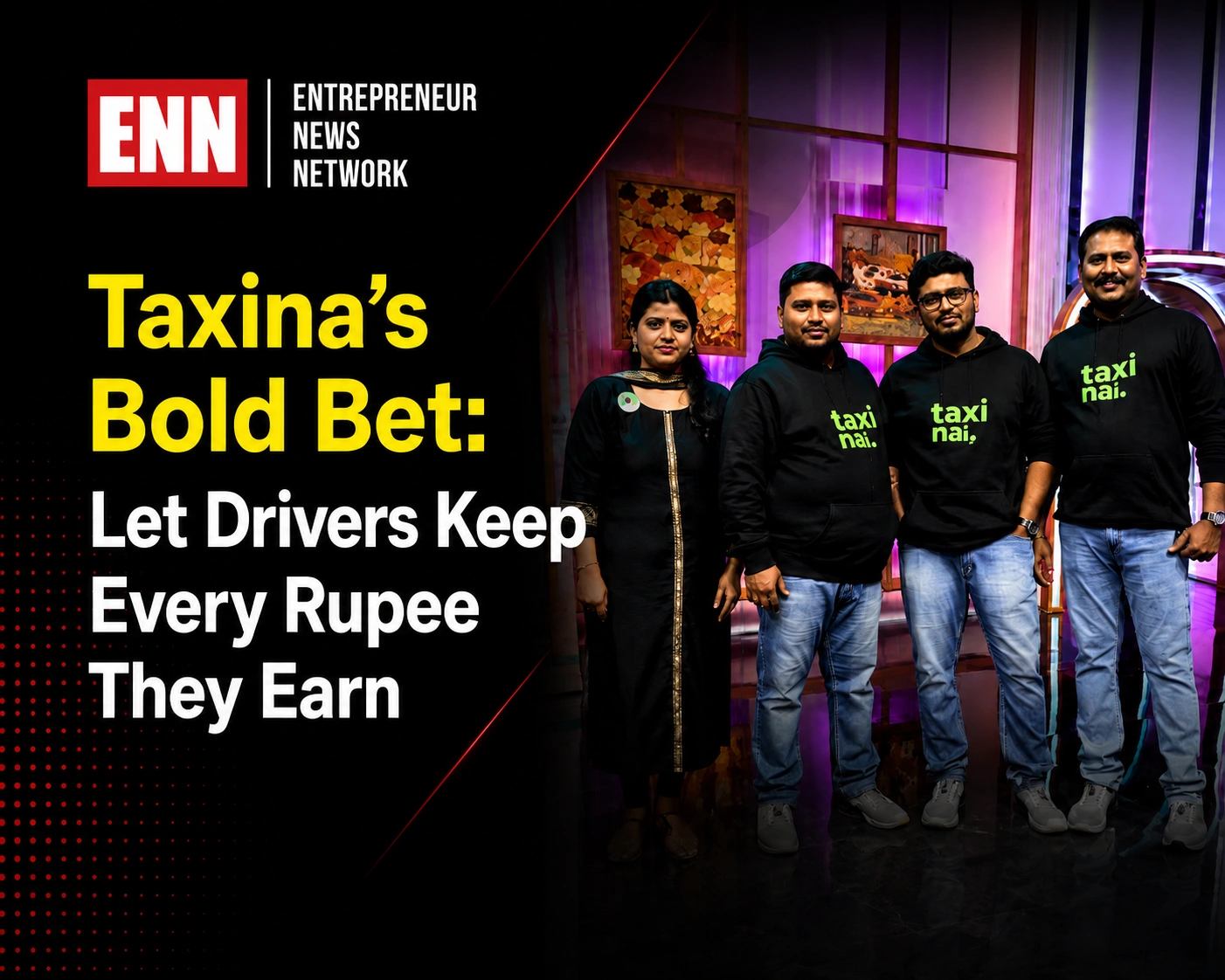
While millions of Indian gig drivers absorb commissions of up to 40% per ride, a Salem-based startup backed by Tamil Nadu’s taxi unions is betting that the real disruption in ride-hailing isn’t a better app — it’s a fairer business model.
For the better part of a decade, India’s ride-hailing economy has run on a single, unquestioned formula: drivers complete trips, platforms take a cut, and the more rides get completed, the more the platform earns — regardless of what happens to driver income along the way. That formula is now facing organised resistance. Ola, Uber, and Rapido drivers held a nationwide strike on February 7 over wages and security, with drivers describing how gig work that once promised freedom now delivers grind, wrestling with 25–40% commissions per ride.
The numbers behind that frustration are stark. Ola’s own filings show ₹4,000 crore in commissions collected in FY24 alone. With fuel priced around ₹100 per litre and maintenance consuming roughly 30% of earnings, a large share of drivers end up operating at a loss. A 2025 Fairwork India report gave both Uber and Ola an F grade for fair pay, noting that 85% of drivers log more than 10 hours a day for what the report described as minimal returns. Meanwhile, platforms continue to generate enormous revenue — Uber India alone logged $2 billion in revenue in 2024.
That structural mismatch — platform growth scaling alongside, rather than with, driver income — is precisely the gap that Taxina Mobility Pvt Ltd, a ride-hailing startup out of Salem, Tamil Nadu, is positioning itself to exploit.
A Subscription, Not a Commission
Taxina’s core innovation is deceptively simple to describe and structurally radical in practice: instead of taking a percentage of every fare, the company charges drivers a fixed monthly subscription fee for unlimited access to its platform — and drivers keep the entire fare from every ride.
The company offers a franchise-like opportunity in which drivers pay a fixed monthly subscription fee that grants them unlimited access to the ecosystem and technology provided by Taxina Mobility, allowing drivers to focus on service and earn consistent income without the daily stress of unpredictable deductions.
This stands in direct contrast to the regulatory baseline that exists on paper but is rarely honoured in practice. According to the 2020 Motor Vehicle Aggregators Guidelines, 80% of the total fare is supposed to go to the driver, with aggregator commission capped at 20%. Yet drivers reviewing their ride receipts have found that companies routinely deviate from these regulations, with commissions reported at 30% or higher and no clear explanation for the deductions.
Taxina has built a layer of price transparency directly into how rides are matched. Drivers set their own fares within a fair cap range, and passengers can choose their driver based on pricing, vehicle type, ETA, or ratings — rather than being assigned a fare determined by an opaque algorithm. The company describes its mission as building a level playing field that empowers the driving community — eliminating both algorithmic surge pricing on the passenger side and commission-driven uncertainty on the driver side.
The Capital Is Starting to Follow the Model
Taxina’s pitch has now attracted formal venture backing. The company raised ₹1.5 crore (₹15 million) from Chennai-headquartered Navyug Global Ventures, with the stated goal of creating a level playing field for drivers and passengers while empowering micro-entrepreneurs in the sector. The strategic investment is intended to help Taxina develop its sustainable ride-hailing model across India and globally.
Navyug’s leadership framed the bet explicitly around fairness as a structural feature, not a marketing slogan. Navyug Global Ventures MD-CEO Nikhil Chandan said Taxina has developed a sustainable model combining a ride-hailing application with a supportive ecosystem, achieving fairness among drivers by eliminating commissions and targets, while delivering transparent pricing, nurturing healthy competition among drivers, and safeguarding end-user interests.
Taxina Mobility, headquartered in Salem, currently carries a valuation of approximately ₹24.2 crore and has raised a total of $205,000 across two funding rounds to date. The platform currently operates across Chennai, Salem, Tiruppur, Erode, and Coimbatore — a deliberate Tamil Nadu-first footprint that mirrors how Ola itself once scaled regionally before expanding nationally.
Built by Founders With Skin in the Driver Community
Taxina was founded by Pinku Bharathi as Founder & CEO, alongside Bharath Kumar as Co-founder & CFO and Subha Saikumar as Co-Founder, with P. Velmurugan also listed among the company’s core team. The company’s driver app was formally launched in Salem with backing from the Tamil Nadu Startup and Innovation Mission, with Mission Director & CEO Sivarajah Ramanathan attending alongside JMJ Groups founder Joseph Raj — a launch event that signalled early institutional support from the state’s startup ecosystem rather than just private capital.
That state-level backing matters in a sector where driver trust has been eroded by years of unilateral policy changes from larger platforms. Taxina’s positioning as a platform “backed by Tamil Nadu’s taxi unions” gives it a credibility advantage that a pure technology pitch could not buy — it suggests the model was shaped in consultation with the people it depends on, rather than imposed on them.
More Than an App: A Driver Welfare Ecosystem
What separates Taxina from a simple low-commission alternative is the breadth of the ecosystem it has built around the core ride-hailing product. The company has layered in vehicle financing and loan support, health insurance and personal accident coverage, discounts on tyres and vehicle accessories, physical “pit shops” where drivers can rest between trips, workshops on customer service and self-improvement, and additional income streams through in-cab advertising.
This is a meaningfully different value proposition than anything Ola or Uber currently offers their driver base in India. Gig economy researchers have pointed to a deeper structural problem facing drivers on existing platforms — many purchased vehicles through loans from private financiers and now find themselves in severe debt traps, with one driver describing being promised earnings of ₹1 to 1.5 lakh per month only to end up taking home roughly ₹500 a day a decade later. A platform that bundles financing, insurance, and physical infrastructure support directly addresses the precariousness that has made gig driving in India increasingly unsustainable for the people doing it.
Why This Model Might Actually Scale
The skepticism around subscription-based ride-hailing is reasonable: a fixed monthly fee only benefits drivers who can guarantee enough ride volume to make the subscription worthwhile, and low-volume or part-time drivers might find a percentage-based commission less risky. But the current commission model has its own well-documented failure mode — a 2025 Labour Ministry audit found that only about 5% of gig platforms comply with existing fair-pay regulations, suggesting that regulatory enforcement alone is unlikely to fix driver economics in the near term.
Taxina’s bet is that a structurally aligned incentive system — where the platform’s revenue comes from a flat subscription rather than from maximising commission extraction per ride — removes the underlying tension that has made existing platforms adversarial toward their own driver base. The company has built its business model around drivers setting their own price per kilometre and earning without hidden fees or delayed payments, while passengers retain the ability to select their preferred driver, vehicle, and price point.
What’s at Stake for India’s Gig Economy
India’s gig workforce is not a marginal segment of the economy — it is a primary source of livelihood for millions of urban workers, a population that the ongoing 2026 driver strikes have made impossible to ignore. Drivers participating in nationwide protests have demanded a fixed per-kilometre rate of roughly ₹25–30, life insurance coverage of ₹10 lakh, and maternity benefits for their families — demands that speak directly to the kind of structural security that Taxina’s ecosystem model is attempting to build in from the outset rather than negotiate after the fact.
Whether Taxina can scale its subscription-and-ecosystem model beyond five Tamil Nadu cities into a genuine national challenger to Ola and Uber remains an open question — execution, driver acquisition costs, and the capital intensity of expanding insurance and financing partnerships across new states will all test the model in ways a single state launch cannot fully reveal. But the fact that institutional capital is now backing a driver-first alternative, at a moment when India’s two largest ride-hailing incumbents are facing nationwide strikes and failing grades on fair pay assessments, suggests the market may finally be ready to reward a platform that treats driver economics as the product, not an externality.
From $8,000 Silicon Valley Internship to ₹400 Crore AI Startup: Aman Goel’s Entrepreneurial Journey

Ruchi Kumar is the associate editor at Entrepreneur News Network and TVW News India, where she leads editorial strategy, brand storytelling, and startup ecosystem coverage. With a strong focus on innovation, business, and marketing insights, he curates impactful narratives that spotlight India’s evolving entrepreneurial landscape. She has written extensively on fintech, AI and emerging startups.