

Info-Tech Research Group has concluded its flagship Info-Tech LIVE 2026 conference in Las Vegas, bringing together thousands of CIOs, CISOs, CTOs, and senior technology executives to discuss one of the most pressing questions facing enterprises today: how to transform artificial intelligence investments into measurable business value.
Held at the Bellagio from June 9–11, the conference centered on the theme “Agentic IT: From Hype to Value,” reflecting a growing shift in the technology industry from AI experimentation toward enterprise-wide deployment, governance, and operational execution.
The event featured more than 200 sessions, industry keynotes, analyst briefings, workshops, executive roundtables, technology showcases, and peer-led discussions focused on helping organizations scale AI responsibly while maintaining security, accountability, and business alignment.

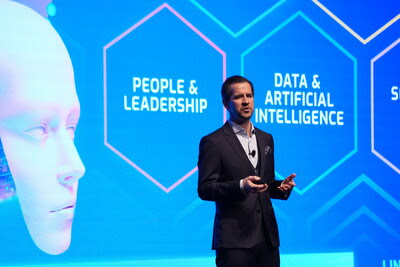
Rob Meikle, Executive Counselor at Info-Tech Research Group, showcased an early
Enterprise AI Enters a New Phase
One of the dominant messages emerging from the conference was that AI adoption is no longer the primary challenge for enterprises.
Instead, technology leaders are now focused on determining where AI delivers meaningful outcomes, how to govern autonomous systems, and which investments are most likely to generate measurable returns.
According to research presented during the event, enterprise enthusiasm for AI remains exceptionally strong.
Info-Tech’s latest AI Adoption in the Enterprise Survey revealed:
- 91% of IT executives are optimistic about AI’s business potential
- 96% expect AI budgets to increase over the next 12 months
- Only 42% report cross-functional AI adoption delivering measurable impact
- Just 50% have a board-approved AI strategy in place
The findings suggest that while organizations are investing heavily in AI, many are still struggling to establish the governance frameworks, ownership structures, and execution models required for long-term success.
Agentic IT Emerges as a Strategic Priority
A central focus of Info-Tech LIVE 2026 was the concept of Agentic IT, a framework designed to help organizations move beyond AI-assisted workflows toward autonomous systems capable of making decisions and executing tasks with limited human intervention.
Opening the conference, Info-Tech CEO Tom Zehren introduced the firm’s Agentic IT Framework, built around four strategic priorities:
- Owning the AI mandate
- Identifying high-value AI opportunities
- Establishing governance and operational discipline
- Measuring and scaling successful AI initiatives
The framework reflects the growing belief that future competitive advantage will come not from AI adoption alone, but from the ability to operationalize AI effectively across the enterprise.

Geoff Nielson, SVP of Brand, Reach & Influence at Info-Tech Research Group, presented the Become an Exponential CIO keynote at Info-Tech LIVE 2026 in Las Vegas.
Building the Agentic Enterprise
One of the most discussed themes at the conference was the evolution from AI-enabled organizations to fully agentic enterprises.
Carlene McCubbin, Associate Vice President of Agentic AI Implementation, highlighted how organizations are beginning to transition from basic AI assistance toward orchestrated workflows powered by autonomous agents.
According to McCubbin, successful deployment requires:
- Clear ownership structures
- Defined permissions and controls
- Incident management processes
- Workflow governance
- Full observability and auditability
The message was clear: autonomous AI systems cannot be scaled effectively without enterprise-grade governance and accountability frameworks.

Cybersecurity Faces a New AI Reality
As organizations embrace agentic AI, cybersecurity teams are confronting a rapidly changing threat landscape.
During his keynote, Technical Counselor Erik Avakian argued that AI is transforming cybersecurity from a traditional security challenge into an engineering challenge.
AI-powered attacks are increasing both the speed and complexity of cyber threats, forcing security leaders to rethink:
- Threat detection strategies
- Vulnerability management
- Compliance frameworks
- Data governance
- Security automation
Avakian emphasized the need for organizations to establish AI guardrails before deploying autonomous systems and prepare for emerging roles such as:
- CyberAI Agent Supervisors
- AI Security Engineers
- Agent Governance Specialists
Architecting AI for Enterprise Scale
Another major takeaway from the event was that autonomy without architecture creates risk.
Martin Bufi, Principal Research Director at Info-Tech, shared lessons learned from developing 63 AI agents, 123 tools, and multiple enterprise AI prototypes.
His session underscored several critical principles for organizations implementing agentic AI:
- Standardize workflows before automation
- Design AI agents around specific business tasks
- Build integrations deliberately
- Ensure agents can be monitored, controlled, and improved
- Establish clear performance metrics
These principles are increasingly important as enterprises seek to deploy AI systems that can operate independently while remaining aligned with business objectives.
The Evolving Role of the CIO
The conference also explored how AI is reshaping executive technology leadership.
Geoff Nielson, Senior Vice President of Brand, Reach & Influence, argued that CIOs are being asked to play a far broader role than traditional IT management.
Modern CIOs are expected to drive:
- Business transformation
- Data-driven decision making
- AI adoption strategies
- Innovation initiatives
- Enterprise-wide operational efficiency
However, many organizations continue to face challenges such as legacy processes, limited resources, stakeholder pressure, and fragmented technology environments.
According to Nielson, future IT success will depend on a combination of strong leadership, effective governance, stakeholder alignment, and the ability to connect technology investments to business outcomes.
Looking Ahead: Tech Trends 2027
Info-Tech also provided an early look at technology trends expected to influence enterprise IT strategies over the coming years.
Executive Counselor Rob Meikle identified several emerging themes, including:
- AI-driven transformation of technology stacks
- Changing workforce and talent models
- Vendor ecosystem disruption
- Convergence of digital and physical operations
- Geopolitical influences on technology investment
As AI continues to reshape industries, organizations will need to balance innovation with resilience, governance, and long-term strategic planning.
AI Success Will Be Defined by Execution
The overarching conclusion from Info-Tech LIVE 2026 was that enterprises have largely moved beyond questioning whether AI matters.
The challenge now is execution.
Organizations that succeed in the next phase of AI adoption will be those that establish strong governance, prioritize measurable business outcomes, invest in data readiness, strengthen cybersecurity foundations, and create clear accountability structures for autonomous systems.
As agentic AI continues to evolve, the role of technology leaders will increasingly focus on turning AI ambition into operational reality.
For CIOs, CISOs, and digital transformation leaders, the message from Las Vegas was clear: the future belongs not to the organizations experimenting with AI, but to those capable of scaling it responsibly and generating measurable enterprise value.

Ruchi Kumar is the associate editor at Entrepreneur News Network and TVW News India, where she leads editorial strategy, brand storytelling, and startup ecosystem coverage. With a strong focus on innovation, business, and marketing insights, he curates impactful narratives that spotlight India’s evolving entrepreneurial landscape. She has written extensively on fintech, AI and emerging startups.