

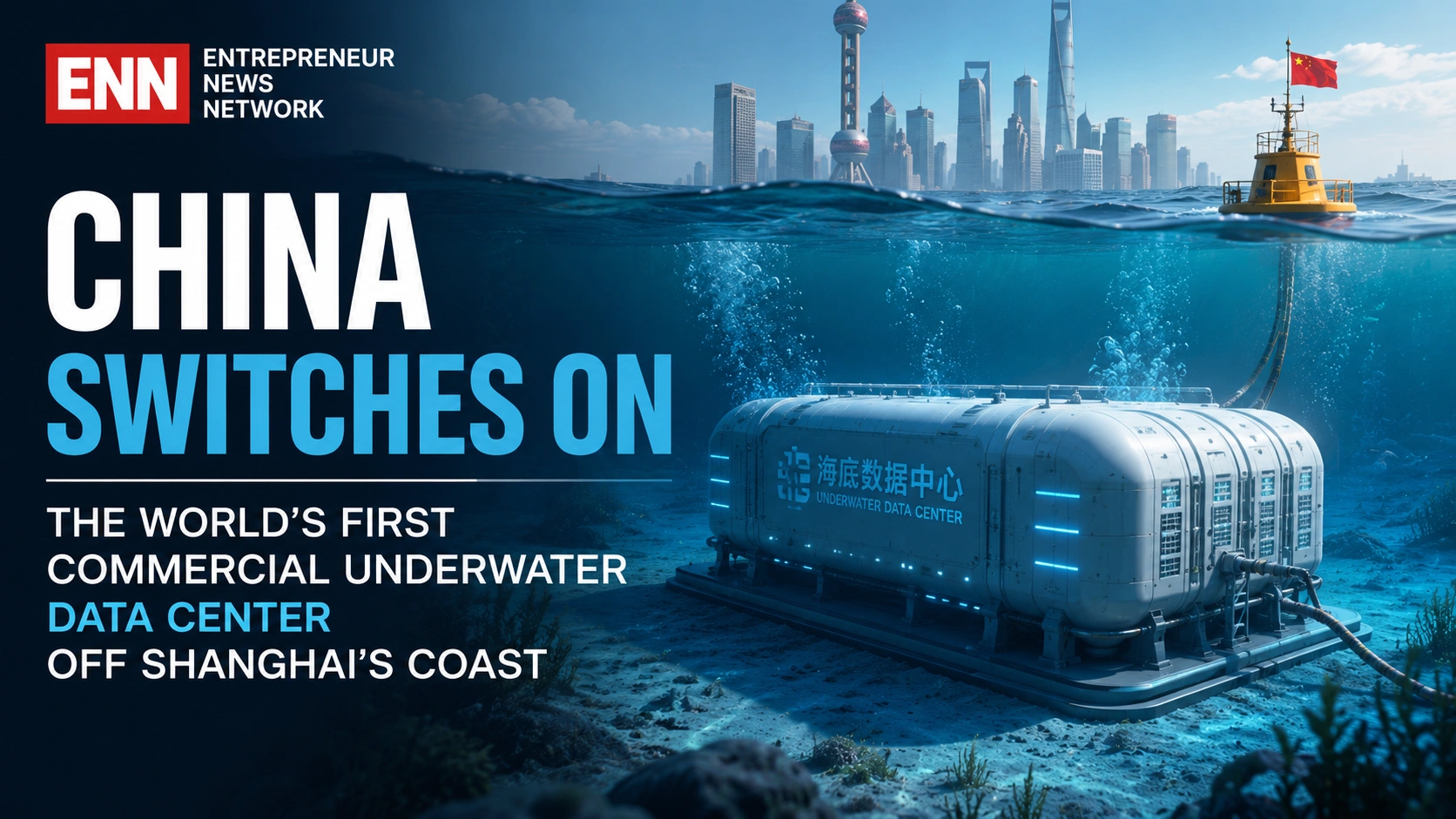
Roughly ten kilometers from Shanghai’s shoreline, a data center now sits on the seabed — and it’s already processing data commercially, marking what appears to be a global first for offshore computing infrastructure.
A Giant Structure, Hidden From View
The facility weighs close to 2,000 tonnes and stands 32 meters tall, but almost none of that is visible from land. It rests on the ocean floor, drawing its power from a nearby offshore wind farm rather than the conventional grid. Despite its size, engineers say a land-based facility offering the same computing capacity would need roughly ten times as much physical space — a reflection of how efficiently the underwater design packs in equipment compared to a sprawling terrestrial server farm.
Because the site sits offshore, day-to-day monitoring happens from a modest control room on land that operates around the clock. During a recent visit, poor weather tied to Shanghai’s rainy season had kept crews from sailing out to the facility itself, underscoring just how much of the operation is designed to run without anyone physically present. Whenever something needs attention, the land-based team flags it to colleagues stationed at the offshore site.
That remote setup isn’t just a convenience — it’s a safety net. If a typhoon or other severe weather forces staff to evacuate the platform, operators can keep the facility running from shore. According to Li Hongyu, an operation supervisor at Shanghai Hailanyun Technology, the company behind the project, nearly everything besides certain cranes and lifts can be monitored and operated remotely from the control room.
Why Build a Data Center Underwater?
The appeal isn’t just space efficiency. Data centers generate enormous amounts of heat, and cooling that heat is one of the industry’s biggest energy and water costs. Positioned 10 to 15 meters below the surface depending on the tide, the Shanghai facility takes advantage of seawater that sits at around 15 degrees Celsius year-round, using it as a natural cooling source.
Tu Feilong, the company’s technology director, explained that traditional data centers rely on mechanical cooling systems that generate their own heat, which then has to be vented through cooling towers — a process that consumes large amounts of both energy and water as it evaporates. By tapping into the ocean’s steady, cool temperatures instead, the underwater design sidesteps much of that overhead entirely.
The clients using the facility span telecom companies and AI developers, all of whom need serious server capacity. Hailanyun’s role, per Tu, is to supply the “green power cabinets” — the cooled, wind-powered housing units — while clients bring their own servers. Notably, he said virtually every server installed at the site so far runs on domestically produced computing hardware, feeding a continuous flow of processing power into China’s AI infrastructure.
Just the Beginning
What’s operating today is only the first phase of a larger buildout. Once complete, the full project is expected to reach a capacity of 24 megawatts, and the company estimates the underwater design will save around 6,000 kilowatt-hours of energy per year compared with an equivalent land-based center.
Shanghai isn’t the only place this is happening, either. Similar underwater data center projects are reportedly in the works along other stretches of China’s coastline, suggesting this could become a broader model for how the country builds AI and cloud infrastructure — one that trades scarce, expensive land for the ocean’s natural cooling and renewable offshore wind power.
Based on on-the-ground reporting and media reports from Shanghai, including interviews with Li Hongyu (Operation Supervisor) and Tu Feilong (Technology Director) of Shanghai Hailanyun Technology.

Ruchi Kumar is the associate editor at Entrepreneur News Network and TVW News India, where she leads editorial strategy, brand storytelling, and startup ecosystem coverage. With a strong focus on innovation, business, and marketing insights, he curates impactful narratives that spotlight India’s evolving entrepreneurial landscape. She has written extensively on fintech, AI and emerging startups.