

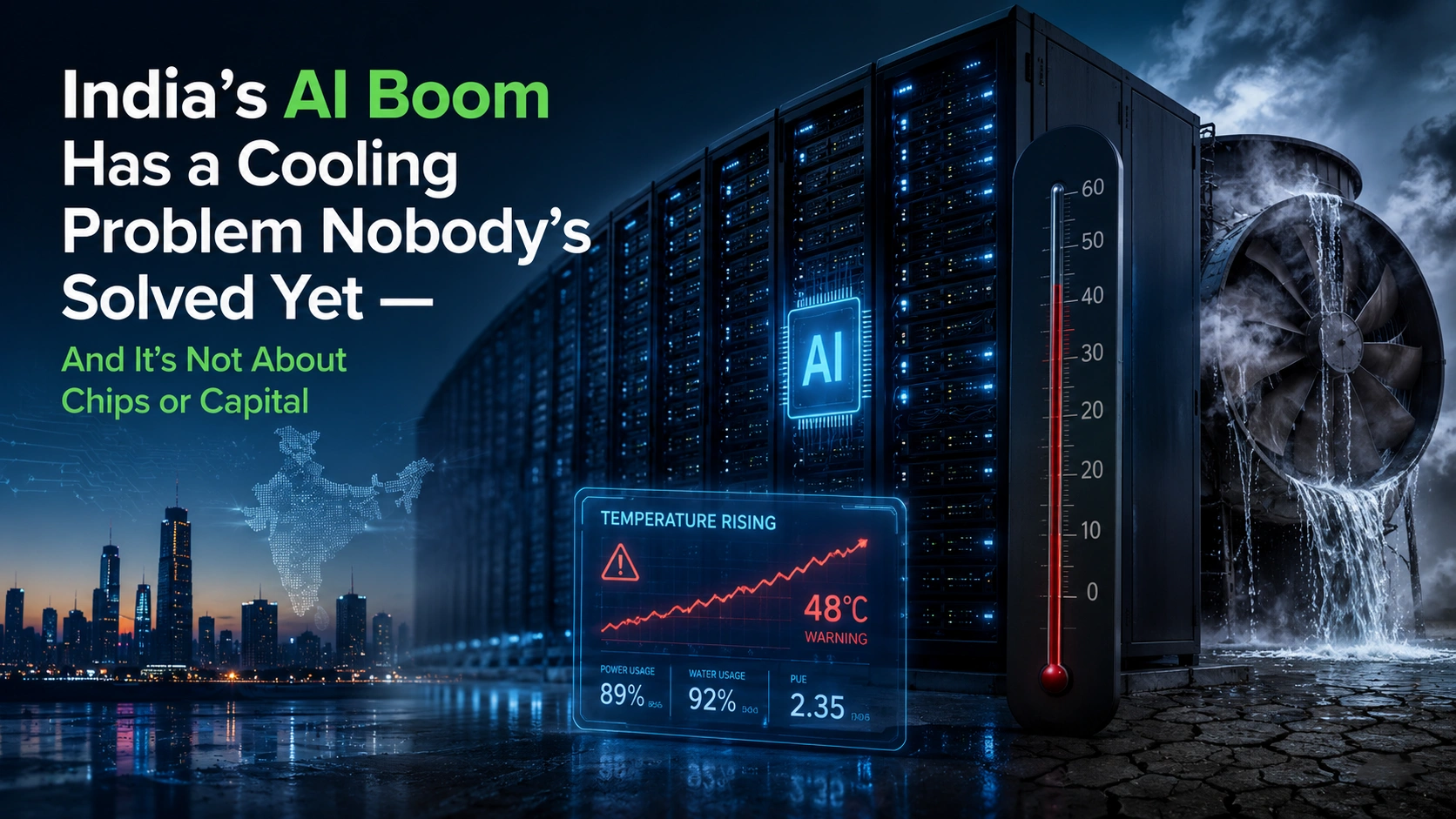
Bengaluru: India’s data centre industry is racing to build AI-ready infrastructure worth billions of dollars, but a critical engineering challenge is rapidly emerging behind the scenes—how to efficiently cool next-generation AI servers without placing unsustainable pressure on the country’s electricity and water resources.
As hyperscalers, cloud providers and enterprises accelerate investments in GPU-powered infrastructure, cooling is no longer just a facility management issue. It is becoming one of the biggest factors determining where future AI data centres can be built and how efficiently they can operate.
AI Workloads Are Redefining Data Centre Design
Traditional enterprise servers were designed for CPU-based workloads that generated relatively modest heat. AI infrastructure has fundamentally changed those assumptions.
Modern AI GPUs consume significantly more power than previous-generation processors, increasing rack densities beyond levels that conventional air-cooling systems were designed to handle. Industry experts estimate that cooling requirements for AI hardware are now 10–20 times higher than traditional computing infrastructure, making thermal management a critical operational challenge.
Cooling systems already account for a substantial share of total data centre energy consumption, meaning inefficient cooling directly impacts operating costs, sustainability goals, and overall infrastructure performance.
Water Is Becoming an Equally Critical Challenge
While electricity consumption receives most of the attention, water usage is emerging as another major concern.
Industry estimates suggest a conventional 100 MW data centre can consume close to two million litres of water every day, depending on its cooling design and local climate conditions. As India’s data centre capacity continues to expand, annual water consumption is expected to rise significantly over the coming decade.
This presents a unique challenge because many of India’s largest data centre markets—including Bengaluru, Chennai, Hyderabad, Mumbai and Delhi NCR—already face seasonal water stress.
The issue is not a single facility, but the cumulative impact of multiple hyperscale campuses drawing water from already constrained urban resources.
Why India’s Climate Makes Cooling More Difficult
Many conventional facilities rely on evaporative cooling systems that use water to remove heat.
However, these systems become less effective in hot and humid climates, precisely the environmental conditions found across several of India’s largest data centre hubs.
As AI infrastructure expands into coastal regions and high-density urban clusters, operators will increasingly need cooling technologies specifically designed for India’s climatic conditions rather than relying on traditional global designs.
Water Usage Effectiveness Is Becoming a New Industry Benchmark
For years, Power Usage Effectiveness (PUE) served as the primary measure of data centre efficiency.
Today, operators and enterprise customers are increasingly evaluating Water Usage Effectiveness (WUE) alongside energy efficiency as sustainability becomes a key procurement requirement.
Large cloud providers and hyperscalers are placing greater emphasis on facilities that minimise both electricity and freshwater consumption while maintaining high computing performance.
Four Technologies Driving the Next Generation of AI Cooling
Industry leaders are exploring several approaches to address rising AI cooling demands:
1. Liquid Cooling
Direct liquid cooling and immersion cooling are moving from pilot projects to commercial deployments. These technologies improve energy efficiency while supporting much higher rack densities required for AI workloads.
2. Membrane-Based Cooling
Emerging membrane cooling technologies significantly reduce water consumption while maintaining performance even in humid climates, making them particularly relevant for Indian conditions.
3. Recycled Water Systems
Several operators are evaluating treated wastewater and reclaimed water instead of freshwater, helping reduce pressure on municipal water supplies while improving long-term sustainability.
4. Climate-Specific Infrastructure Design
Rather than adopting a single cooling model nationwide, developers are increasingly selecting cooling technologies based on regional climate, grid stability, renewable energy availability, and water resources.
Investment Is Following Cooling Innovation
The growing importance of AI infrastructure is creating new opportunities across the cooling technology ecosystem.
Industry forecasts indicate strong growth in India’s data centre cooling market through 2030, with liquid cooling expected to become one of the fastest-growing segments as enterprises prepare for AI-driven computing demand.
State governments are also beginning to incorporate sustainability requirements into their data centre policies, encouraging energy-efficient designs, lower water consumption, and greater renewable energy integration.
The Bigger Picture
India’s AI infrastructure ambitions extend far beyond adding more servers or expanding computing capacity.
The long-term success of the country’s data centre industry will depend on whether operators can build facilities that are energy-efficient, water-resilient, AI-ready and environmentally sustainable.
As GPU-powered workloads continue to increase and demand for AI computing accelerates, cooling technologies are becoming strategic infrastructure rather than simply operational equipment.
The companies that successfully combine advanced cooling systems, efficient water management, renewable energy integration, and AI-ready infrastructure are likely to define the next phase of India’s digital economy.
BCCL Strengthens Leadership Team with Appointments of Ruchira Kanwal and Madhurita Sengupta

Ruchi Kumar is the associate editor at Entrepreneur News Network and TVW News India, where she leads editorial strategy, brand storytelling, and startup ecosystem coverage. With a strong focus on innovation, business, and marketing insights, he curates impactful narratives that spotlight India’s evolving entrepreneurial landscape. She has written extensively on fintech, AI and emerging startups.