

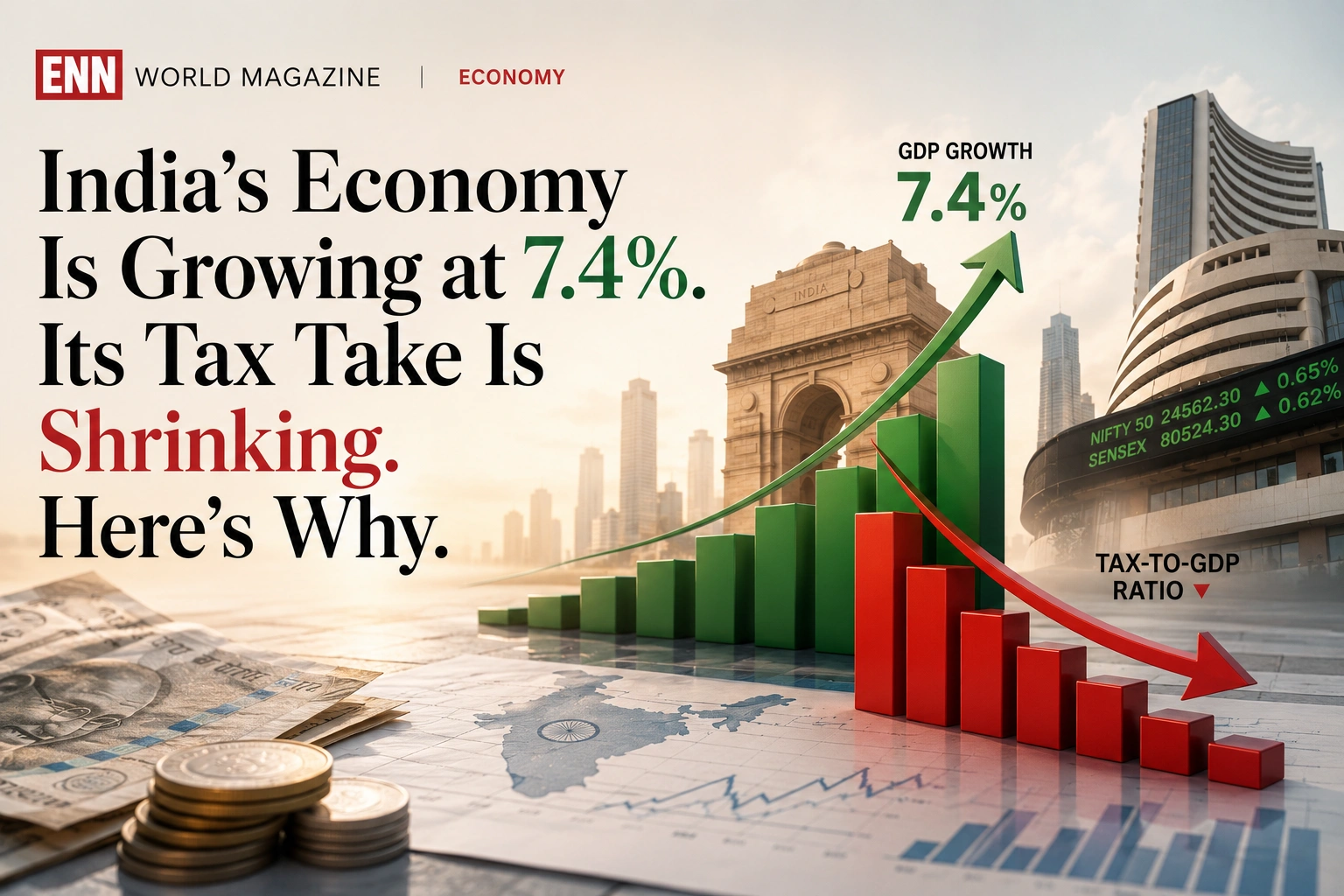
India’s real GDP is estimated to grow 7.4% in FY 2025-26, one of the fastest rates of any large economy — the IMF has its own forecast at 7.3%. Gross Goods and Services Tax collections in the same year came in at roughly ₹22 lakh crore, up 8.3% on the previous year. April 2026 set an all-time monthly record of about ₹2.42 lakh crore.
By any reasonable reading, that is a tax system working well.
Now the number that complicates it. Gross tax revenue as a share of GDP is budgeted at 11.2% for 2026-27, down from 11.4% the year before.
The economy is growing at 7.4%. The tax system’s claim on it is falling. Both statements are true simultaneously, and understanding why is more interesting than the usual conclusion about evasion.
First, correct the premise: collections are not weak
It is worth clearing this up because the popular version of the story is wrong.
Direct tax collections are at historic strength. The direct-tax-to-GDP ratio reached 6.64% in FY24 — a 24-year high — and current estimates put it in the 6.8% to 7.1% range. Income tax return filings rose from 7.40 crore in FY23 to 8.09 crore in FY24. GST has posted record after record.
So the honest framing is not that India collects less tax than before. It collects more tax than it ever has. The problem is that the tax base is growing more slowly than the economy it sits on, and there are three reasons for that — of which the first is the least discussed and probably the most important.
Reason one: taxes are levied on rupees, not on output
Here is the number almost nobody is talking about.
The government estimates real GDP growth at 7.4% and nominal GDP growth at 8%. That gap — barely half a percentage point — implies a GDP deflator of well under 1%.
That matters enormously, because tax is collected on nominal values. Income tax is charged on the rupees in your salary, not on the real output you produced. GST is charged on the rupee price of a good. When prices rise, the tax base rises automatically, without a single reform, a single new taxpayer, or a single enforcement action. Economists call it fiscal drag; finance ministries quietly rely on it.
For most of the last two decades India’s nominal GDP grew at 10% to 11%, which meant tax revenue had a built-in escalator of several percentage points a year before anyone did anything. Strip inflation out of the picture and that escalator disappears.
This is the mechanical answer to the puzzle. A 7.4% real economy with almost no price growth generates far less automatic revenue than a 6% real economy with 5% inflation. India is currently getting the growth without the fiscal dividend that usually comes attached to it.
Reason two: the ₹12 lakh decision
The second reason is deliberate policy, and it was expensive.
Under the new tax regime, an individual with taxable income up to ₹12 lakh pays no income tax at all, via the Section 87A rebate. For a salaried person with the ₹75,000 standard deduction, the effective threshold is higher still.
Consider what that means against India’s income distribution. Per capita income is roughly ₹2 lakh a year. The threshold at which an Indian begins to pay income tax therefore sits at about six times per capita income. In most comparable economies the threshold sits at or below per capita income — which is precisely why their tax bases are wide and India’s is not.
That was a defensible political choice and a real relief to the salaried middle class. But it removed a substantial slice of the emerging middle-income group from the direct tax net at the exact moment inflation stopped doing the government’s collecting for it.
Reason three: the base was never wide to begin with
The third reason is structural, and the numbers are stark.
| Measure | Figure |
|---|---|
| Share of India’s population that filed an income tax return (FY24) | 6.68% |
| Share of Indians who actually pay income tax | Roughly 1–2% |
| Income tax returns filed (FY24) | 8.09 crore |
| Filers in FY23 with zero tax liability | 5.16 crore of 7.40 crore — about 70% |
| Individuals reporting zero taxable income (AY 2023-24) | 4.90 crore |
| Share of total tax collections contributed by that 1–2% | Roughly 27% |
Read the third and fourth rows together. Around 70% of people who file an income tax return pay nothing. Filing is not paying, and the two are constantly conflated in public debate — including by governments quoting filer growth as evidence of a widening base.
The consequence is a system of extraordinary concentration: one to two per cent of the population generates something like a quarter of all tax revenue. No cushion, no depth, and enormous sensitivity to any change in the rules affecting that thin band.
What nobody will touch
Two structural exemptions explain most of the narrowness, and neither is likely to move.
Agricultural income is constitutionally exempt from central income tax. Agriculture accounts for roughly 16–18% of GDP and employs close to 45% of the workforce. Most of those people would fall below any threshold anyway — but the exemption is absolute, which also makes it the most reliable route for laundering non-agricultural income. Every tax commission for forty years has flagged it. No government has touched it, and none will.
The informal economy remains vast. A large share of economic activity happens in cash, in unregistered enterprises, outside any reporting perimeter. GST has formalised more of it than anything before, which is precisely why indirect tax collections look so healthy while direct tax does not.
Why this matters more than it sounds
A tax system this shaped has two uncomfortable properties.
It is fragile. When a quarter of revenue depends on one to two per cent of the population, a change to the exemption threshold or a slowdown in salaried employment moves the fiscal aggregates immediately. There is no breadth to absorb the shock.
It is regressive. If direct tax cannot deliver, the load shifts to GST — and GST is paid at the same rate by a person earning ₹15,000 a month and one earning ₹15 lakh. India’s fiscal system therefore leans on consumption taxes, which take a larger share of a poor household’s income than a rich one’s. The more the direct tax base narrows, the more regressive the whole structure becomes.
There is also a warning signal in the recent monthly data. GST growth has decelerated over the course of 2026 — from 8.7% year-on-year in April to 6.2% in June. If consumption is cooling while the direct tax base is being narrowed by design, both engines are losing power at once.
What would actually change it
Not enforcement. India’s enforcement and data infrastructure — AIS, TDS matching, GST invoice trails — is now genuinely formidable, and squeezing harder on 1–2% of the population is politically and mathematically exhausted.
Three things would move the number, in descending order of political difficulty:
- Lower the threshold as incomes rise. Not raising taxes — simply not raising the exemption limit every few years. Real fiscal broadening in most countries happened by letting growth pull people into the net, not by pushing the net further away.
- Tax agricultural income above a high floor. Exempt genuine smallholders; tax large agricultural incomes as income. It requires a constitutional conversation nobody wants.
- Keep formalising. GST did more for the tax base in five years than three decades of enforcement drives. The unfinished work is in services, property and the professional economy.
The bottom line
India does not have a tax collection problem. It has a tax base problem, currently masked by strong headline collections and exposed by unusually low inflation.
The country is growing at 7.4% and taxing 11.2% of that growth — down from 11.4%. The gap is not being created by people cheating. It is being created by an exemption threshold at six times per capita income, a constitutional carve-out for agriculture, and the disappearance of the inflation that used to do the collecting quietly in the background.
The uncomfortable implication is that India’s fiscal position may now be more dependent on inflation returning than on any reform the Budget is likely to announce.
Data sources: Press Information Bureau releases on FY 2025-26 GDP estimates; Union Budget 2026-27 documents; Central Board of Direct Taxes and Ministry of Finance figures on ITR filings and zero-liability returns as reported to Parliament; monthly GST collection releases; IMF World Economic Outlook forecast for India.
Analytical note: the GDP deflator figure is derived by this publication from the government’s own real and nominal growth estimates (7.4% and 8% respectively) and is an inference, not an official statistic. Threshold-to-per-capita-income comparisons use approximate per capita figures and are indicative. Where sources reported ranges — for instance the direct-tax-to-GDP ratio at 6.8–7.1% — the range is stated rather than a single point.
SK Telecom Launches SK Hyper to Accelerate AI Data Center Expansion

Ruchi Kumar is the associate editor at Entrepreneur News Network and TVW News India, where she leads editorial strategy, brand storytelling, and startup ecosystem coverage. With a strong focus on innovation, business, and marketing insights, he curates impactful narratives that spotlight India’s evolving entrepreneurial landscape. She has written extensively on fintech, AI and emerging startups.