

When the Job Ends, Should the Taxman Still Come Knocking?
A viral LinkedIn post about layoffs at Visa’s Bengaluru office has reopened a question India has avoided for years: why severance pay — money meant to keep a family afloat — is taxed like a bonus, while laid-off workers get almost nothing in return.
The Post That Struck a Nerve
Earlier this year, an ex-Visa employee described a Bengaluru-based manager losing their job despite “outstanding reviews,” as the company moved ahead with a fresh round of layoffs. The story, reported by Hindustan Times, might have stayed a routine layoff item. Instead, it landed in front of Sanket Sheth, the Bengaluru-based founder of Kreative Kode, who turned it into a pointed critique of the government’s role in a process it never signed up to run.
“Hearing of Visa layoffs, my anger is less on the company but more on a completely non-related entity. It’s the government.” — Sanket Sheth, Founder, Kreative Kode
Sheth’s argument was simple. Salaried employees pay tax every month of their working life and receive no meaningful social security in return. When they lose their job, the one cushion available to them — severance pay — is taxed too, often at the highest slab.
“Imagine working for years in a company like Visa. Paying lakhs in income tax every single year. Contributing to the economy. And then one day, you lose your job… The severance package you receive is taxed like a bonus. Flat 30%. Imagine, 30% deduction on the money that will pay your children’s school fees, your parents’ medicines, your EMI, your groceries.” — Sanket Sheth, on LinkedIn
His conclusion was pointed: “I struggle to understand why a severance package, whose entire purpose is to help someone survive unemployment, should be treated exactly like ordinary income.” The post struck a nerve well beyond Visa’s Bengaluru office, pulling in hundreds of comments from professionals who had lived through the same math.
“The bigger issue isn’t just how severance is taxed; it’s that India offers very limited income support for private-sector employees who suddenly lose their jobs.” — LinkedIn commenter
“India is not a welfare state anymore. Salaried middle class are punished heavily because they are also the most silent and obedient class.” — LinkedIn commenter
A Layoff Wave, By the Numbers
Sheth’s post landed at a moment when layoffs in India are no longer an occasional shock — they are a running headline. ENN – Entrepreneur News Network tracked tech-sector job cuts and the numbers tell a stark story:
| 19,049
tech layoffs recorded in India in 2025 — the second-highest of any country after the US |
~1 lakh+
tech jobs cut in India in the first half of 2026 alone, per industry trackers |
80%
collapse in fresher IT hiring in India from its peak |
TCS, India’s largest private-sector employer, cut roughly 12,000 jobs in 2025 — its largest workforce reduction in decades. Oracle followed in 2026 with cuts of about 12,000 roles in India as part of a 30,000-role global restructuring. Startups shed an estimated 20,000–25,000 jobs in 2025 alone, from Ola Electric to Gupshup to CARS24. Globally, AI-linked tech layoffs had already touched 1.28 lakh workers by July 2026 — more than all of 2025 combined — and India’s Economic Survey 2025–26 names AI adoption and automation as a primary driver.
This is not a story confined to any one company or sector. It’s a structural shift in how quickly a stable, tax-paying job can disappear — and how little happens next.
The Fine Print: How India Taxes a Pink Slip
Severance pay in India is not treated as compensation for a loss. Under Section 17(3)(i) of the Income Tax Act, it is classified as “profit in lieu of salary” — taxed exactly like a salary payment, at the employee’s regular slab rate.
There is a narrow carve-out. Section 10(10B) exempts retrenchment compensation up to the lower of ₹5 lakh or a statutory formula (roughly 15 days’ average pay for every completed year of service). But this exemption applies only to employees who qualify as a “workman” under the Industrial Disputes Act, 1947 — a legal category built around manual, clerical, and supervisory roles below a certain pay grade.
Most of the people losing jobs in India’s current layoff wave — software engineers, managers, product leads, mid-to-senior IT staff — do not meet that definition. For them, the exemption typically does not apply at all, and the entire severance amount is taxed as ordinary salary. For anyone already in the top tax bracket, that means roughly 30% tax plus a 4% cess — effectively taking close to a third of the payment before it ever reaches a bank account earmarked for rent, school fees, or a home loan EMI.
The Safety Net That Isn’t
India does have an unemployment benefit scheme on paper: the Atal Beemit Vyakti Kalyan Yojana (ABVKY), run through the Employees’ State Insurance Corporation (ESIC). It pays 50% of wages for up to 90 days, once in a lifetime, to employees who involuntarily lose their jobs.
The catch is eligibility. ESIC coverage is capped at employees earning up to ₹21,000 a month in gross wages — a threshold that has not moved since 2017. Anyone earning above that, which includes virtually every mid-level and senior salaried professional in India’s tech, finance, and services sectors, is simply outside the scheme. A separate, older scheme (the Rajiv Gandhi Shramik Kalyan Yojana) offers longer support but has similarly narrow, largely dormant coverage. MGNREGA, India’s most substantial jobs safety net, guarantees 100 days of paid work — but only in rural areas, and only for manual labour.
In other words, the exact workforce being hit hardest by the current layoff wave — urban, salaried, formally employed — is the one India’s existing unemployment schemes were never built to reach.
Compare that to the United States, where unemployment insurance is available broadly to laid-off workers regardless of income level, typically replacing about 50% of average weekly wages up to a state-specific cap, for as long as 26 weeks. It isn’t generous by global standards — several European economies replace a higher share of income for longer — but it is universal enough that a lost job doesn’t also mean an immediate income cliff.
What a Layoff Actually Does to a Family’s Finances
To see why this gap matters, consider a simplified but realistic scenario: a mid-to-senior tech professional in Bengaluru earning ₹24 lakh a year, laid off with a severance package of three months’ gross salary — a fairly typical settlement in India’s recent layoff rounds.
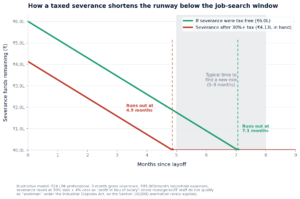
Illustrative model based on a ₹24 LPA salary, 3-month gross severance, and ₹85,000/month household expenses. See methodology note on the chart.
Run the numbers, and the picture is stark. On paper, three months’ severance (₹6 lakh) should cover roughly seven months of a typical urban household’s expenses — rent or EMI, groceries, school fees, insurance, and routine costs, estimated here at ₹85,000 a month. That’s close to the 5–8 month window that industry surveys suggest a mid-career professional typically needs to land a new role.
But because this employee doesn’t qualify as a “workman”, the entire severance is taxed as ordinary salary. After a roughly 31% tax bite, the same package shrinks to about ₹4.13 lakh in hand — enough to last under five months. That’s before the median point of a realistic job search, let alone the tail end of it. The tax doesn’t just take a slice of the payment; it takes away the very buffer the payment was designed to provide, right as the job market has slowed.
This gap is landing on household balance sheets that have little slack left to absorb it. RBI data shows India’s household financial savings — the liquid, quickly accessible kind — have shrunk to roughly 28.5% of total household savings, down from 40.3% just a few years earlier, as more household wealth sits in illiquid assets like gold and property. Meanwhile, household debt has climbed to an estimated 41.3% of GDP as of March 2025. A laid-off professional running out of severance early isn’t falling back on a cash cushion — more often, it’s a credit card, a personal loan, or a parent’s retirement fund.
Why This Isn’t a Niche Problem Anymore
A decade ago, an argument for expanding unemployment protection to salaried professionals might have sounded like a fringe concern. It doesn’t anymore. AI-driven restructuring, cost-cutting by IT majors and startups alike, and a fresher hiring market that has contracted by roughly 80% from its peak all point to a labour market where formal-sector job loss is becoming a shared, recurring risk rather than an individual misfortune.
As one commenter on Sheth’s post put it, the salaried middle class is “the most silent and obedient class” — paying tax reliably, rarely organising around workplace protections, and largely absent from the policy conversations that shape schemes like ESIC or the Industrial Disputes Act. That silence has a cost: a safety net designed decades ago for factory workers has never been updated for a workforce that now includes millions of software engineers, analysts, and managers.
What a Law Could Actually Look Like
None of this requires reinventing India’s social security architecture from scratch. A few targeted changes could close most of the gap:
- Extend the Section 10(10B) exemption — or create an equivalent provision — to cover a set number of months’ severance pay for all involuntarily laid-off employees, regardless of “workman” status.
- Build a contributory, portable unemployment insurance fund through EPFO, which already covers a far larger and higher-earning workforce than ESIC, funded by a small additional payroll contribution and paying wage-linked benefits for a fixed period after involuntary job loss.
- Raise or eliminate the eight-year-old ₹21,000 ESIC wage ceiling so that ABVKY-style relief reflects today’s salaries, not 2017’s.
- Simplify and speed up claims processing, so benefits arrive within weeks of a layoff — when the need is most acute — rather than months later, if at all.
Each of these exists in some form elsewhere in the world, or in an adjacent Indian scheme. The task isn’t inventing a new idea — it’s extending existing machinery to the workforce that funds it.
The Other Side of the Ledger
This isn’t a cost-free proposal, and it’s worth taking the counterarguments seriously. Exempting more severance income would reduce tax revenue, and critics could reasonably point out that white-collar, urban professionals are already better protected than India’s much larger informal workforce, which has no severance or safety net of any kind — so directing scarce policy attention here risks widening, not narrowing, inequality.
A payroll-funded unemployment insurance scheme also raises real implementation questions: who administers it, how claims are verified against genuine involuntary job loss versus resignation, and how it avoids becoming another compliance burden on employers already navigating India’s layered labour codes. Moral hazard — the concern that generous benefits blunt the incentive to find new work quickly — is a legitimate design constraint, which is why most successful models cap both the benefit amount and its duration.
These are arguments for careful design, not for inaction. A time-bound, wage-linked benefit funded through a system that already exists (EPFO) and capped severance tax relief are both narrow enough to be fiscally contained, while still closing the specific gap Sheth’s post identified: a worker who has paid tax for years, loses a job through no fault of their own, and is taxed again on the one payment meant to help them land on their feet.
The Bigger Question
Sheth’s post went viral not because it revealed a secret, but because it named something millions of salaried Indians already felt: that the system asks a great deal of the formally employed, tax-paying workforce, and offers very little back when things go wrong. Layoffs will keep happening — markets shift, businesses restructure, and AI is accelerating both. That part isn’t within any government’s control.
Whether the tax code adds insult to that injury is. As one former employee’s story became a founder’s viral post, and a founder’s post became a comments section full of similar stories, the question Sheth raised is no longer really about Visa. It’s about whether India is willing to treat a job loss as the emergency it is — or continue taxing it like good news.
Sources
- Bengaluru manager with outstanding reviews lost his job — Hindustan Times
- Bengaluru founder vows to move out of India after paying ₹4 crore tax — Hindustan Times
- Microsoft layoffs: severance package details — Hindustan Times
- Visa layoffs reignite debate on severance tax — Storyboard18
- Tech layoffs in 1st half of 2026 outpace all of 2025; India second-worst hit — Ground News
- How massive is the layoff quotient in 2026? — Sunday Guardian Live
- Tech Layoffs 2026: 55,000 and Indian IT freshers — Beincareer
- Infographic: layoffs by Indian companies across sectors — Deccan Herald
- Section 10(10B): Severance Pay & Retrenchment Tax Rules — eVaakil
- Income Tax Exemptions on Severance Payment — SAG Infotech
- Layoffs: What to Expect and Tax Implications — EZTax
- Atal Beemit Vyakti Kalyan Yojana — ESIC (Government of India)
- ESIC unemployment allowance extended till June 2027 — Upstox
- ESI Wage Ceiling and Coverage Rules — ESIC / HiNote
- Unemployment Allowance in India (2025-26) — ClearTax
- Unemployment Benefits by State 2026 — World Population Review
- Where do we save & invest? RBI Household Financial Savings 2024-25 — Relakhs
- RBI flags rising household debt risks as savings fall — StartupTalky
- The average time to find a new job after a layoff — Careerminds
India data centre capacity to reach 12 GW by 2030: Wood Mackenzie

Ruchi Kumar is the associate editor at Entrepreneur News Network and TVW News India, where she leads editorial strategy, brand storytelling, and startup ecosystem coverage. With a strong focus on innovation, business, and marketing insights, he curates impactful narratives that spotlight India’s evolving entrepreneurial landscape. She has written extensively on fintech, AI and emerging startups.