

BENGALURU, India — Thursday, August 13, 2026 –
Table Space, a company that leases and fits out office space, just told SEBI it made more profit before tax last year than it reported as a headline loss. That single line in its draft IPO papers, filed on August 11, is a decent summary of what’s actually happening in India’s Global Capability Centre boom right now.
The Bengaluru-based “managed workspace” provider filed its draft red herring prospectus for an IPO comprising a fresh issue of up to Rs 800 crore and an offer for sale of up to 6.54 crore shares, according to the filing reported by Entrackr. Its FY26 operating revenue rose 66.3% to Rs 2,262 crore from Rs 1,360 crore the year before. It also reported a net loss of Rs 403 crore — but that loss is almost entirely an accounting artefact from fair-value changes on preference shares. Strip that out and the company posted a profit before tax of Rs 135 crore.
Table Space isn’t a tech company. It’s a landlord with a fit-out business, leasing 9.33 million square feet across 33 office clusters in eight cities, 98% of it Grade A space, and renting it out to Global Capability Centres, Fortune 500 firms and multinationals. And it’s about to become the fifth such company to list in India in roughly a year, joining Smartworks, WeWork India, IndiQube and Awfis.
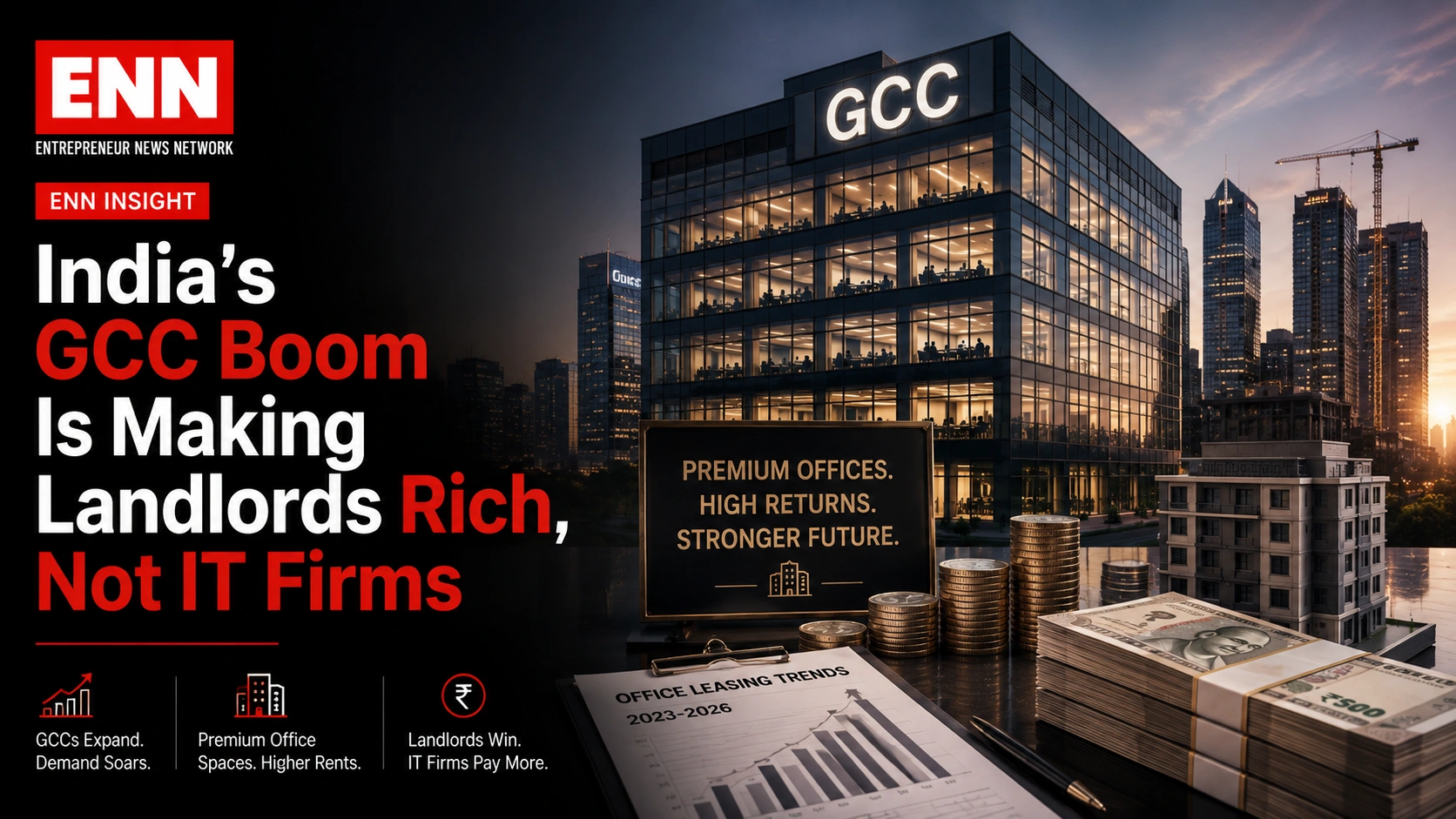
That’s the pattern worth pausing on. While venture money chases the next AI startup and IT services firms scramble to defend their turf, the most consistent, provable winners of India’s GCC expansion are the people who own the buildings.
The IPO queue
Table Space isn’t filing into empty space. WeWork India listed in October 2025 with a Rs 3,000-crore issue. IndiQube listed in July 2025. Both had already tapped the market before Table Space showed up. Executive Centre India has SEBI approval for a Rs 2,600-crore IPO of its own. BHIVE, a smaller player, closed a Rs 400-crore pre-IPO round in mid-2026 and is targeting a 2027 listing, according to a myHQ report cited by Business Standard.
The numbers behind the rush are real. India’s flex office market crossed 100 million square feet in FY26, per that same myHQ report, prepared with real estate consultancy Anarock. All five listed flex-office operators grew revenue in double digits in the fourth quarter of FY26. WeWork India posted its highest-ever quarterly profit, Rs 65.9 crore. Smartworks grew revenue 45% year-on-year and became the first listed operator to cross 10 million square feet. Awfis reported FY26 revenue of Rs 1,493 crore, up 24%, with profit up 66% to Rs 71 crore. IndiQube’s Q4 revenue crossed Rs 400 crore, up 35.2%.
The reason, in one number: GCCs accounted for a record 45.5% of all office leasing in India in the first quarter of 2026, per the same report. Enterprise clients now make up the majority of revenue at every listed flex-office operator. India has more than 2,100 GCCs today, according to Everest Group data cited by Communications Today, and the space is still expanding.
What the IT services industry is doing about it
Here’s the part that usually gets left out when GCCs come up: the boom that’s filling office parks is not obviously good news for India’s traditional IT services companies — the sector that built the country’s reputation as the world’s back office.
According to Everest Group analysis reported by Communications Today (via The Hindu BusinessLine), the growth of GCCs “can cannibalise traditional outsourcing revenue streams.” Enterprises increasingly keep their highest-value, most strategic work — AI modelling, cloud architecture, data science — inside their own captive centres rather than handing it to a vendor. What’s left for outsourcing firms is lower-margin work. GCCs are also outbidding IT services firms for talent, offering 20-40% more compensation, pulling away the very engineers and architects that vendors need for the work they do still win.
The response from big IT firms has been to stop fighting the trend and start selling into it. TCS has set up a dedicated unit, GVIC, to help clients build and run GCCs. Cognizant is running a “Build-Operate-Transfer” arrangement for Citizens Financial Group’s new Hyderabad centre — Cognizant builds and operates it, then eventually hands the whole thing, staff included, over to the client. Everest Group estimates the GCC-linked opportunity for service providers at roughly $25 billion in 2026, growing about 25% a year. That’s real money. But BOT deals carry lower margins than long-term outsourcing contracts, and once a centre transfers, the recurring revenue — and the staff — leaves with it. It’s a business built on training your own replacement.
The part investors aren’t fully buying
None of this is a clean growth story once you check what the stock market thinks. WeWork India’s October 2025 debut was weak: shares opened at Rs 646.50 and slipped to Rs 621.15, a 4.14% loss on listing day, with the issue subscribed just 1.15 times overall (retail investors covered barely 0.61 times their portion). IndiQube, which listed a year earlier, was trading roughly 31% below its Rs 237 issue price as of late May 2026, based on market pricing data — a detail investors weighing the Table Space IPO will likely note, even as the underlying leasing business keeps growing.
That gap — real revenue growth on one side, tepid public-market appetite on the other — is the least-covered part of this story. Everyone agrees GCCs are expanding. Nobody has fully agreed on who gets to keep the profit from that expansion, or at what valuation.
Why this matters for founders
For India’s entrepreneurs, the read isn’t “go build office parks.” It’s narrower than that: in a gold rush, the surest money is sometimes in infrastructure, not in the activity everyone’s excited about. GCCs are the activity. Landlords are the infrastructure. IT services firms, caught in between, are being pushed to either supply GCCs as contractors or lose their best people to them — and neither option looks as good as owning the real estate.
Editor’s note: Table Space’s occupancy, revenue and IPO structure are drawn from its DRHP as reported by Entrackr, a primary trade source, and are the most reliable figures in this piece. IndiQube’s post-listing share price move is sourced from a market-data aggregator rather than exchange data directly and should be treated as approximate. GCC count and service-provider market-size figures are third-party estimates (Everest Group, via Communications Today/The Hindu BusinessLine) and were not independently verified against a primary count.
Sources: Table Space files DRHP with SEBI to raise Rs 800 Cr via fresh issue – Entrackr; India crosses 100 mn sq ft flex office space as GCC demand surges – Business Standard; India’s GCC boom drives IT firms toward build-operate-transfer model – Communications Today; WeWork India lists at ₹621.15 with 4.14% discount – 5paisa; Executive Centre joins growing list of flex-office players taking IPO route – Business Standard

Ruchi Kumar is the associate editor at Entrepreneur News Network and TVW News India, where she leads editorial strategy, brand storytelling, and startup ecosystem coverage. With a strong focus on innovation, business, and marketing insights, he curates impactful narratives that spotlight India’s evolving entrepreneurial landscape. She has written extensively on fintech, AI and emerging startups.