

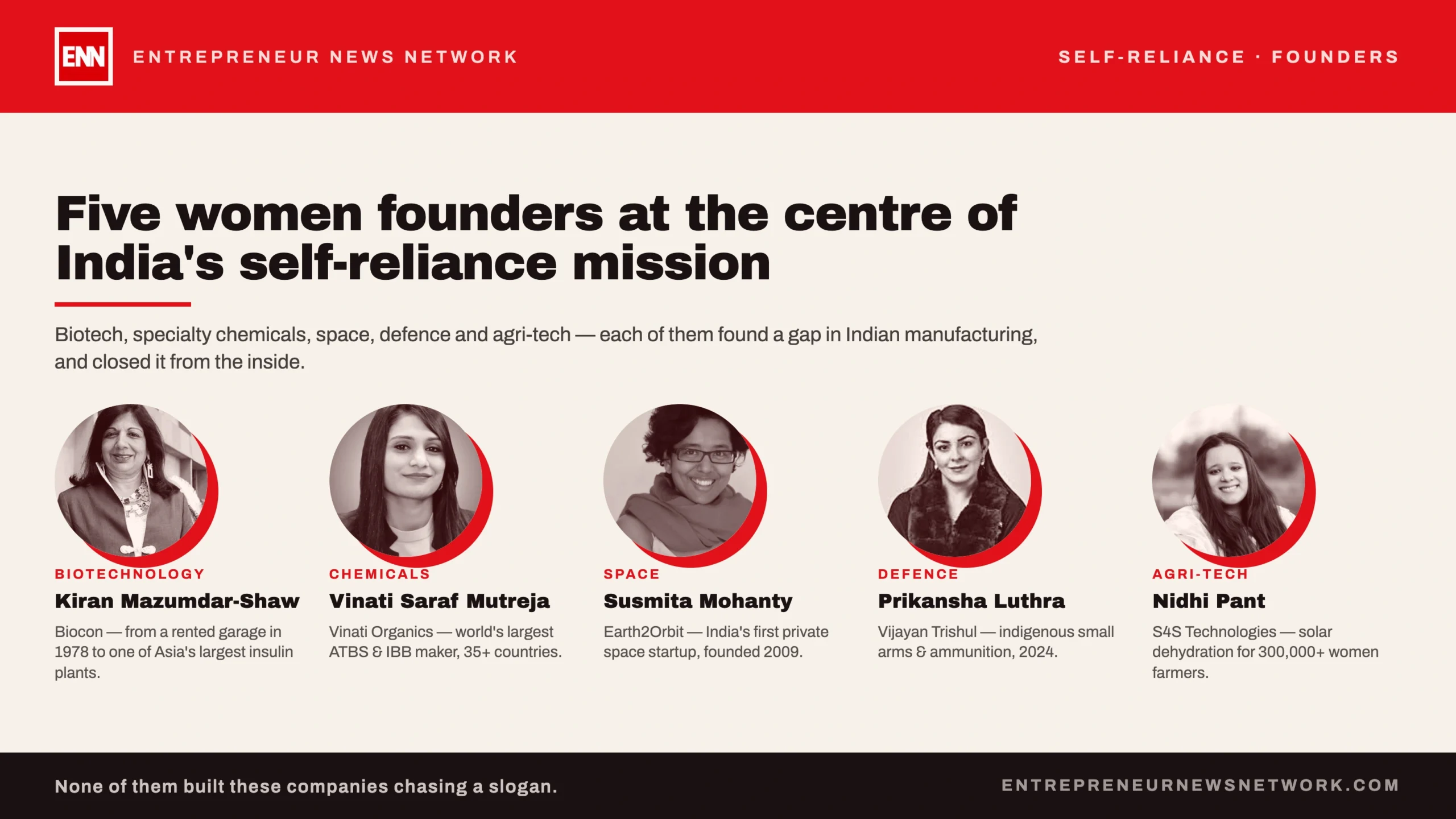
Mumbai, August 20, 2026: When India talks about Atmanirbhar Bharat — the national push toward self-reliance across pharmaceuticals, defence, chemicals, space and agriculture — the conversation tends to default to policy schemes and large industrial houses. But some of the most concrete, on-the-ground progress toward that vision is coming from companies built and led by women. They are cutting India’s dependence on imported insulin and biologics, manufacturing specialty chemicals the country used to buy abroad, building indigenous small arms and defence systems, running one of India’s only dedicated space think tanks, and helping hundreds of thousands of smallholder farmers stop losing a third of their harvest to spoilage.
This article profiles five of them — chosen not for celebrity, but because each one sits at the centre of a sector Atmanirbhar Bharat explicitly targets: biotechnology and pharma, specialty chemicals manufacturing, space technology, defence production, and agri-processing.
1. Kiran Mazumdar-Shaw — Biocon: Ending India’s Import Dependence on Insulin and Biologics
Kiran Mazumdar-Shaw founded Biocon in 1978, starting out of a rented garage in Bengaluru with an initial focus on industrial enzymes, at a time when almost no venture capital existed for a young woman with a brewing degree and no formal biotechnology training. Nearly five decades later, Biocon is one of Asia’s largest biopharmaceutical companies and operates one of Asia’s largest insulin manufacturing facilities, located in Malaysia’s Johor region, alongside its Indian operations.
Biocon’s core achievement, in Atmanirbhar Bharat terms, is import substitution at scale: the company built India’s domestic capability to manufacture insulin, biosimilars and complex generic drugs that the country previously had to import at high cost. Biocon Biologics has since gone further, acquiring Viatris’ global biosimilars business for $3.3 billion in 2022 and, as of December 2025, moving to acquire the remaining minority stake in Biocon Biologics at a valuation of roughly $5.5 billion — a signal of how far the company has scaled from its origins as a domestic manufacturer to a global biosimilars exporter. Mazumdar-Shaw’s Forbes-listed net worth stood at $3.6 billion as of mid-August 2026, making her one of India’s few self-made women billionaires.
Her stated ambition — to make India the world’s top insulin supplier and to build her legacy around “affordable healthcare” — is a direct articulation of what self-reliance in pharma is meant to achieve: not just import substitution, but exporting Indian-made medicine to the world.
2. Vinati Saraf Mutreja — Vinati Organics: Making India the World’s Factory for Specialty Chemicals
Vinati Organics was founded in 1989 by Vinod Saraf; his daughter, Vinati Saraf Mutreja, joined the business after an engineering degree from Wharton and Carnegie Mellon and has since built it into a company that claims the title of the world’s largest manufacturer of two specific chemical intermediates: ATBS (used in water treatment, oilfield chemicals and superabsorbent polymers) and IBB. That is not a domestic-market claim — it is a global manufacturing leadership claim, achieved from Indian factories.
This matters for Atmanirbhar Bharat because specialty chemicals are exactly the kind of high-value, import-dependent manufacturing segment India has historically ceded to China, the US and Europe. Vinati Organics now exports to more than 35 countries, supplying major industrial and chemical companies across the US, Europe and Asia, and has expanded from a single-product manufacturer into a diversified, multi-facility chemicals business with EcoVadis Gold certification for sustainable manufacturing. Under Mutreja’s leadership as CEO and Managing Director, the company has continued to reinvest in R&D-led product development rather than compete purely on cost — a model closer to how Germany or Japan approach specialty manufacturing than the commodity-chemical playbook India is often associated with.
3. Susmita Mohanty — India’s First Private Space Entrepreneur and Space Diplomat
Susmita Mohanty holds a PhD, has worked on the International Space Station programme at Boeing and briefly at NASA Johnson Space Center, and has co-founded three space companies across three continents: Moonfront in San Francisco (2001–2007), Earth2Orbit in Bangalore (2009–2021) — widely regarded as India’s first private space startup — and LIQUIFER Systems Group in Vienna, which she still runs. Earth2Orbit worked at the intersection of satellite services and space policy at a time when India’s space sector was almost entirely government-run through ISRO, well before the 2020 reforms that opened the sector to private players.
In October 2021, Mohanty launched Spaceport SARABHAI, described as India’s first dedicated space think tank, where she now serves as Director General. Its stated mission is to help set the stage for India’s own space unicorns by 2030 and to build international dialogue on the strategic role of Asia-Pacific nations in space exploration, including work on nuclear and space technology non-proliferation and export controls. Her recognitions include BBC’s 100 Women (2019), a Fortune magazine cover feature (2017) and the Women Transforming India Award (2022).
Mohanty’s relevance to Atmanirbhar Bharat is less about a single company’s revenue and more about sequencing: she was building indigenous, privately-led space capability and policy infrastructure years before India’s space sector liberalization made that a national priority, and she continues to shape the think-tank and diplomatic groundwork that determines whether India’s private space industry becomes globally competitive rather than merely government-dependent.
4. Prikansha Luthra — Vijayan Trishul Defence Solutions: Indigenous Small Arms and Defence Systems
Vijayan Trishul Defence Solutions (VTDS) was co-founded in 2024 by Sahil and Prikansha Luthra, who serves as Co-Founder and Director. The company manufactures small arms, ammunition and advanced defence systems for the Indian Armed Forces and law enforcement agencies, operating within one of the most tightly regulated and technically demanding sectors of Indian industry. VTDS has positioned itself explicitly within India’s Defence Production and Export Promotion Policy (DPEPP) framework, and the company showcased its indigenous manufacturing capabilities at the UP International Trade Show in September 2024.
Luthra, who comes from a journalism background rather than a traditional defence-engineering or military pedigree, has been recognized as a Women Entrepreneur in Defence Manufacturing. Her own framing of the work cuts against the assumption that defence manufacturing leadership requires a particular gender or background: leadership in defence tech, she has said, comes down to “clarity of vision, the readiness to be innovative, and the willingness to take responsibility” rather than gender. VTDS is a small, young company relative to Biocon or Vinati Organics, but it represents exactly the kind of import-substitution defence manufacturer that India’s DPEPP is designed to multiply — reducing reliance on foreign arms and ammunition suppliers one domestically manufactured product line at a time.
5. Nidhi Pant — S4S Technologies: Stopping a Third of India’s Harvest From Going to Waste
Nidhi Pant co-founded S4S Technologies in 2013 with six university friends — Vaibhav Tidke, Swapnil Kokte, Ganesh Bhere, Shital Somani, Tushar Gaware and Ashwin Pawade — to address a specific, enormous problem: roughly 30% of India’s agricultural produce is wasted before it ever leaves the farm, largely because smallholder farmers lack affordable cold storage or processing options and are forced to abandon unsellable surplus during bumper harvests. S4S built low-cost, solar-powered dehydration units that let farmers process surplus crops into shelf-stable products on-site, converting what would be waste into an additional income stream.
The company’s impact figures are independently notable: over 300,000 women smallholder farmers have seen profit increases of 10–15%, and roughly 2,000 female entrepreneurs running S4S-enabled micro-enterprises have doubled or tripled their incomes. S4S has set a target of reaching three million smallholder farmers and 30,000 entrepreneurs, with a 2026 goal of cutting 1.2 million tonnes of food waste — equivalent to removing an estimated 10 million tonnes of CO2 from the atmosphere. The model won the Earthshot Prize in 2023, and Pant has separately been named a UN Young Champion of the Earth and received the Cisco Youth Leadership Award. For a self-reliance agenda that depends as much on rural income and food-system resilience as it does on factories and fabs, S4S is a rare example of import substitution happening at the level of the individual farmer’s field.
Why These Five, Together
Lined up side by side, these five founders map almost exactly onto the sectors Atmanirbhar Bharat names as strategic: pharmaceuticals and biologics, specialty chemicals manufacturing, space technology, defence production, and agriculture. None of them built their companies primarily as a response to a government slogan — Biocon predates the phrase “Atmanirbhar Bharat” by four decades, and Earth2Orbit shut down the year before the current wave of space-sector interest began. What connects them is that each identified a point of import dependence or structural fragility in an Indian sector, and built a company to close that gap from the inside, at manufacturing or grassroots scale rather than through policy advocacy alone. That is arguably a more durable definition of self-reliance than any single scheme: capability that exists because someone built it, and that keeps compounding whether or not the political spotlight stays on it.
Sources: Forbes — Kiran Mazumdar-Shaw profile; Forbes — Meet India’s Self-Made Biologics Brewmaster Billionaire; Vinati Organics — company site; Forbes India — Vinati Saraf Mutreja: Focusing on Quality; Spaceport SARABHAI — Susmita Mohanty; ThePrint — India’s 1st space think tank; Zee News — Prikansha Luthra profile; Manufacturing Today India — VTDS; Earthshot Prize — S4S Technologies; YourStory — Meet the women entrepreneurs building for Bharat.
Guidehouse Opens New Hyderabad Hub, Plans to Hire 1,000 Professionals

Ruchi Kumar is the associate editor at Entrepreneur News Network and TVW News India, where she leads editorial strategy, brand storytelling, and startup ecosystem coverage. With a strong focus on innovation, business, and marketing insights, he curates impactful narratives that spotlight India’s evolving entrepreneurial landscape. She has written extensively on fintech, AI and emerging startups.