

By ENN | Entrepreneur News Network, New Delhi, India | August 21, 2026
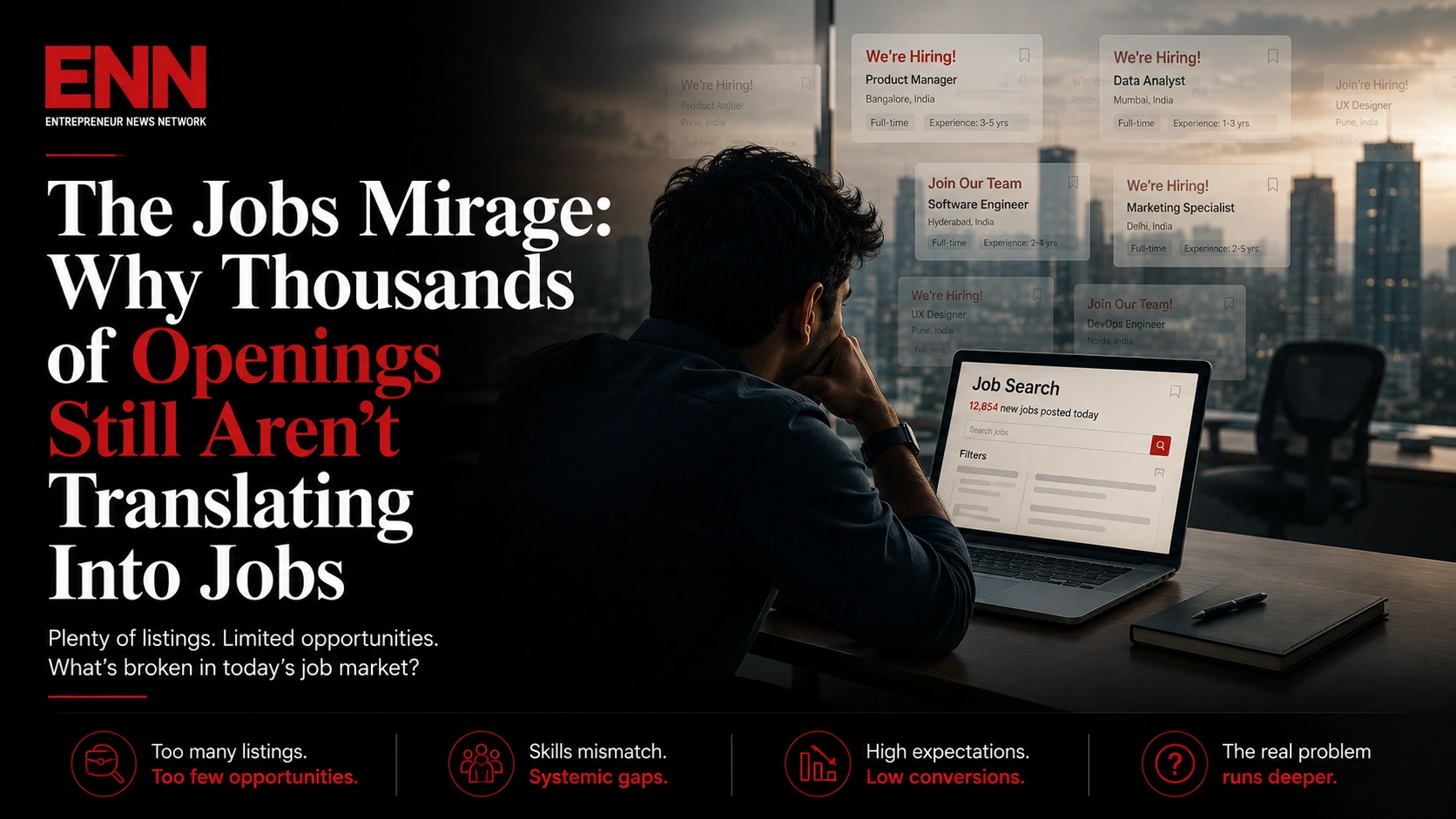
Open any major job portal today and the numbers appear encouraging: thousands of vacancies, new listings every day, filters for every skill and location, and countless “urgently hiring” labels.
Yet for many jobseekers, the experience is completely different.
Applications disappear without responses. Interview opportunities remain scarce. Jobs posted weeks ago suddenly vanish. Fresh graduates struggle to secure their first role, while experienced professionals increasingly find themselves competing for fewer openings.
This disconnect points to a deeper problem in the labour market.
The issue is not simply that there are too few job advertisements. It is that the relationship between a job listing and a genuine hiring opportunity has become increasingly unreliable.
From ghost jobs and AI-driven productivity gains to experience requirements, skills mismatches and the rise of gig work, several forces are reshaping the employment market simultaneously.
The “Ghost Job” Problem
Not every job advertised online necessarily represents an immediate hiring opportunity.
The phenomenon of “ghost jobs” refers to vacancies that remain online even when an employer has no immediate intention of filling them, has already filled the position or is simply collecting applications for potential future requirements.
Some companies maintain listings to build talent pipelines. Others use them to understand the availability and salary expectations of potential candidates.
In some cases, outdated vacancies may simply remain active because hiring teams or automated recruitment systems have not removed them.
For jobseekers, however, the outcome is the same: time spent applying to positions that may never result in an interview.
This creates a major trust problem in digital recruitment.
Economic Growth Is Not Automatically Creating More Jobs
The second issue is much larger than recruitment platforms.
Across several developed economies, productivity and corporate output can rise without a corresponding increase in employment.
Artificial intelligence is becoming an important part of this equation.
AI tools can automate repetitive tasks, improve productivity and allow businesses to increase output without expanding headcount at the same pace.
For companies, this can mean higher efficiency and lower operating costs.
For workers, particularly those seeking their first corporate role, it creates a more complicated environment.
The traditional relationship between economic growth and job creation is becoming less predictable.
The Entry-Level Door Is Getting Narrower
One of the clearest effects is being felt by young professionals.
Many roles that historically served as entry points into careers now increasingly ask for prior experience.
This creates a difficult cycle:
Employers want experience → graduates need jobs to gain experience → fewer companies are willing to provide that first opportunity.
The trend is particularly visible in technology and other white-collar sectors.
AI is also changing the nature of entry-level work. Tasks that once provided junior employees with practical experience — research, documentation, basic analysis, coding assistance and administrative work — can increasingly be automated or accelerated using AI tools.
That raises an important question for companies:
If AI removes the traditional entry-level work, where will tomorrow’s experienced workforce get its experience?
India Faces an Even Sharper Employment Challenge
The contradiction is particularly significant in India.
The country produces millions of graduates every year, but the number of high-quality, formal jobs available to absorb them remains considerably smaller.
The State of Working India 2026 report from Azim Premji University highlights the scale of the challenge, with around 5 million students graduating annually, while only a portion transition into employment.
The problem is not simply unemployment.
It is also underemployment.
Many graduates end up working in roles that do not require their level of education or technical training. Others remain outside the formal workforce while waiting for opportunities they consider appropriate to their qualifications.
At the same time, Indian employers in sectors such as manufacturing, construction and skilled trades continue to report shortages of technicians, electricians, welders and machine operators.
That creates one of India’s biggest labour-market contradictions:
India has millions of educated jobseekers while businesses simultaneously struggle to find workers with specific practical skills.
The Skills Mismatch Is Becoming More Important
This suggests that India’s employment challenge is not solely about the number of jobs being created.
It is also about whether the skills of available workers match the jobs being created.
India’s education system continues to produce large numbers of graduates, but employers increasingly require specialised technical, digital and vocational capabilities.
Social perceptions also play a role.
Many young Indians continue to prioritise white-collar employment, while skilled vocational careers often receive less attention despite strong demand.
Bridging this gap will require stronger connections between universities, vocational institutions and employers.
Gig Work Is Absorbing Some of the Pressure
When formal employment fails to absorb the growing workforce, India’s gig economy provides an alternative.
The number of gig workers has grown substantially in recent years, with delivery, mobility, logistics and other platform-based services creating millions of income opportunities.
But gig work should not automatically be treated as equivalent to traditional employment.
Many gig workers face:
- Variable monthly income
- Limited employment protections
- No traditional paid leave
- Limited employer-sponsored benefits
- Dependence on platform algorithms
- Fluctuating demand
For many workers, gig platforms provide a crucial entry point into the labour market.
But they do not necessarily provide the stability traditionally associated with a formal job.
Why Job Portals Can Create a False Sense of Opportunity
The result is a labour market where the number of visible vacancies can create an impression of abundance even when the number of genuine hiring opportunities is much smaller.
Consider the chain:
More job listings → more applications → greater competition → fewer responses → declining candidate trust.
When combined with ghost listings, automated recruitment systems and increasingly specific job requirements, the online job search can become exhausting without necessarily becoming more productive.
For employers, this also creates a problem.
If candidates increasingly believe that job advertisements do not represent genuine opportunities, companies could find it harder to attract qualified talent.
What Companies Can Do
Employers can play an important role in restoring confidence in recruitment.
Greater transparency could include:
- Clearly identifying whether a role is actively hiring
- Removing filled vacancies quickly
- Publishing realistic experience requirements
- Explaining recruitment timelines
- Providing candidates with meaningful updates
- Clearly distinguishing talent-pipeline positions from immediate vacancies
Companies could also reconsider how they develop entry-level talent.
If AI is eliminating some of the traditional junior tasks, organisations may need to deliberately create new apprenticeship, trainee and mentorship pathways.
Otherwise, the industry risks creating a shortage of experienced professionals several years down the line.
What Jobseekers Should Focus On
For candidates, the changing labour market suggests that simply sending more applications may not be the best strategy.
Skills that directly correspond to employer demand can provide a stronger advantage.
Technical capabilities, vocational expertise, AI literacy, data skills, cybersecurity, engineering, skilled manufacturing and specialised digital capabilities are likely to remain important areas of opportunity.
For graduates, internships, apprenticeships, project-based experience and demonstrable portfolios can also help bridge the experience gap.
The goal increasingly is not just to have a degree.
It is to demonstrate what you can actually do.
The Bigger Question: What Does a “Job” Mean in the AI Economy?
The jobs mirage ultimately points to a bigger transformation.
AI is changing how businesses organise work. Recruitment platforms are changing how candidates search for employment. Gig platforms are changing how people earn. And employers are increasingly prioritising specialised skills over traditional credentials.
The labour market is therefore not simply experiencing a shortage of jobs.
It is experiencing a reconfiguration of what counts as a job, what skills employers value and how workers enter the workforce.
For India, the stakes are particularly high.
With a large young population and a narrowing demographic window, converting India’s workforce into productive employment will be central to sustaining economic growth.
The challenge is no longer simply creating more openings.
It is creating more real opportunities — and making sure the people looking for them have the skills to fill them.
ENN Editorial Take
The biggest employment story may not be the number of vacancies appearing on job portals.
It may be the widening gap between a job being advertised and a job actually being created.
As AI increases productivity, companies rethink entry-level hiring and India’s graduate population continues to expand, the next phase of the labour market will be defined by one question:
Are we creating jobs — or just creating listings?
Gaurav Agrawal Joins Reliance Intelligence as Chief Operating Officer for the US

Ruchi Kumar is the associate editor at Entrepreneur News Network and TVW News India, where she leads editorial strategy, brand storytelling, and startup ecosystem coverage. With a strong focus on innovation, business, and marketing insights, he curates impactful narratives that spotlight India’s evolving entrepreneurial landscape. She has written extensively on fintech, AI and emerging startups.