

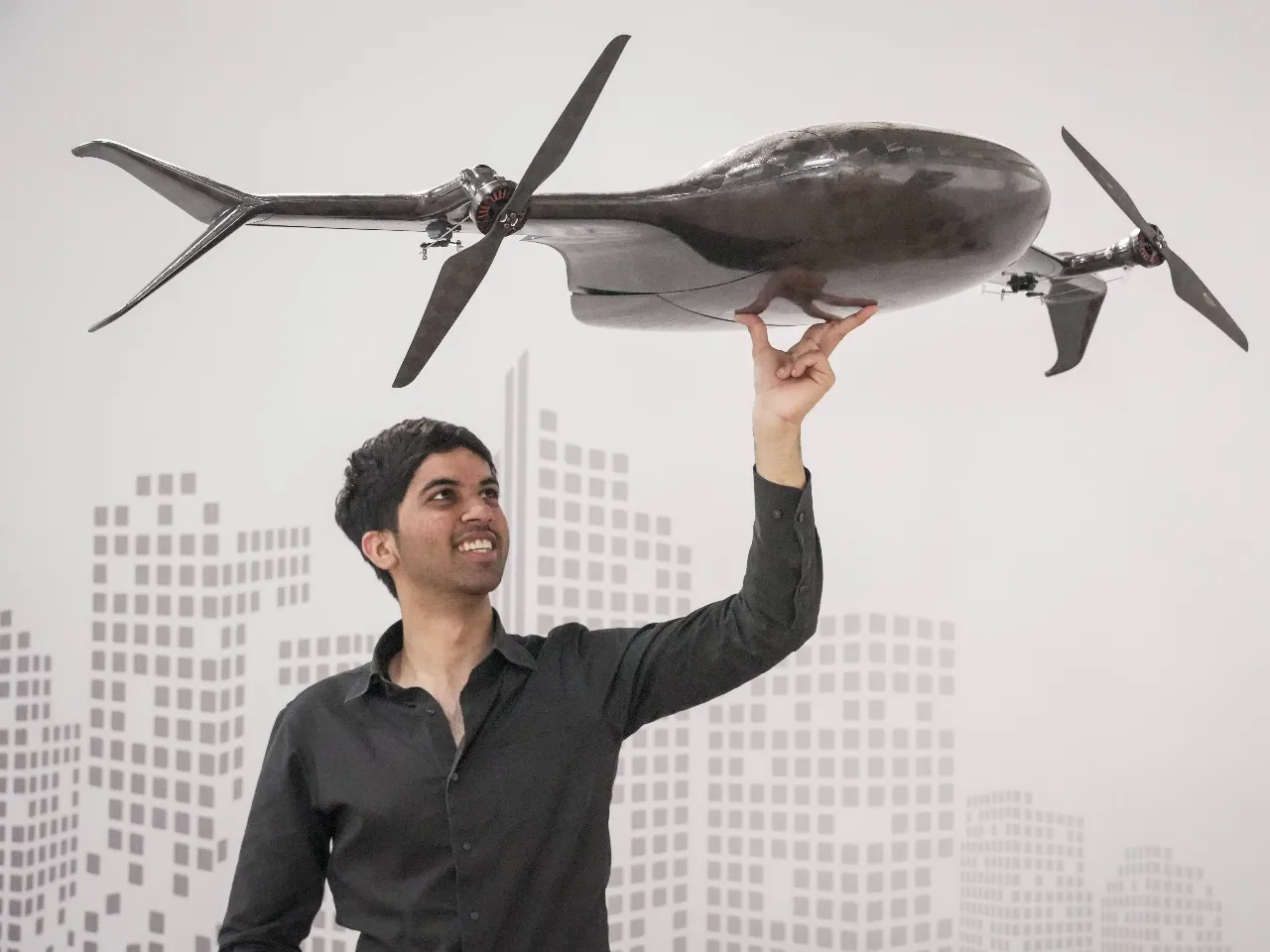
Bengaluru-based aerospace startup Airbound has raised $37 million in Series A funding as it moves closer to commercialising autonomous aircraft for logistics and, eventually, passenger transportation.
The funding round was led by Greenoaks, with participation from DoorDash, Lachy Groom, Lightspeed and Humba Ventures.
Airbound plans to use the fresh capital to accelerate aircraft engineering, large-scale manufacturing and market expansion as it develops a new model for autonomous air transportation.
Airbound Targets the Future of Autonomous Delivery
Founded by Naman Pushp, Airbound is developing lightweight autonomous aircraft designed to make air transportation more affordable and practical.
The company is initially focused on autonomous delivery services, particularly for smaller cargo loads. Over time, it plans to develop larger aircraft capable of carrying heavier cargo and potentially passengers.
Airbound believes conventional transportation faces a fundamental trade-off: road transport is generally cheaper but slower, while air freight is faster but significantly more expensive.
Its approach is designed to challenge that model by developing aircraft that can transport individual packages with greater efficiency.
“We believe in a world where all movement happens in the air,” said Naman Pushp, Founder and CEO of Airbound, describing the company’s long-term vision for autonomous transportation.
Blended-Wing-Body Aircraft Designed for Efficiency
Airbound’s aircraft use a blended-wing-body design, allowing the aircraft to take off vertically before transitioning into horizontal flight.
This architecture is intended to combine the flexibility of vertical take-off with the efficiency of fixed-wing flight.
The company is initially concentrating on smaller aircraft and plans to gradually develop larger models as its technology matures.
The strategy allows Airbound to build operational experience with smaller payloads before expanding into more complex transportation applications.
More Than 1,000 Autonomous Flights Completed
Airbound has already moved beyond the development stage and conducted more than 1,000 autonomous flights with Narayana Health.
The aircraft have been used to transport medical samples between healthcare facilities, helping reduce transportation times from hours to minutes.
These operations are providing Airbound with real-world data and experience as it works toward larger-scale commercial deployment.
The healthcare use case also demonstrates the potential for autonomous aircraft to support time-sensitive logistics where faster transportation can make a significant difference.
Airbound Chooses Delivery-as-a-Service Model
Rather than selling aircraft directly to logistics companies, Airbound plans to operate its aircraft through a delivery-as-a-service model.
Under this approach, Airbound would retain control over its aircraft, technology and fleet while providing transportation services to customers.
The model could allow the company to manage aircraft operations centrally while improving fleet utilisation and maintaining greater control over its autonomous technology.
For customers, the approach could reduce the need to purchase, maintain and operate their own autonomous aircraft fleets.
Greenoaks Sees Opportunity to Disrupt Air Freight Economics
Neil Shah, Partner at Greenoaks, said Airbound could challenge the longstanding cost-versus-speed trade-off in logistics.
The investment firm believes autonomous aircraft could eventually make fast delivery economically competitive with traditional road transportation, particularly for individual packages.
Airbound’s strategy is therefore not simply focused on building another drone. It is attempting to create an alternative transportation infrastructure for moving goods through the air.
From Cargo to Passenger Transportation
While logistics remains Airbound’s immediate focus, the company’s longer-term ambitions extend beyond deliveries.
The startup expects its aircraft technology to eventually support larger cargo aircraft and passenger transportation.
Its development strategy is based on starting with smaller aircraft and progressively increasing payload capacity as the technology, manufacturing capabilities and operating infrastructure mature.
This could position Airbound within the emerging market for autonomous aerial mobility, where companies are exploring applications spanning logistics, healthcare, e-commerce and passenger transportation.
$37 Million Funding to Support Commercial Scale
The new $37 million Series A round gives Airbound additional capital to move from technology development toward commercial-scale operations.
The company will focus on:
- Scaling aircraft engineering
- Developing large-scale manufacturing capabilities
- Expanding its autonomous delivery operations
- Building commercial infrastructure
- Developing larger aircraft platforms
- Expanding its market presence
The funding also highlights growing investor interest in autonomous logistics and next-generation mobility technologies.
Airbound’s Vision for Autonomous Transportation
Airbound’s broader thesis is that advances in aircraft design and autonomous technology could fundamentally change the economics of transportation.
The startup believes more efficient aircraft could make it possible to move goods faster without the cost premium traditionally associated with air freight.
For now, the company’s focus remains on autonomous cargo delivery, with healthcare providing one of its early real-world applications.
But if Airbound can successfully scale its technology and manufacturing operations, the company could eventually expand into larger cargo and passenger transportation markets.
With $37 million in new funding and more than 1,000 autonomous flights already completed, Airbound is betting that the future of logistics could increasingly move from roads to the sky.
India’s Data Centre Boom: 101 Million Sq Ft Footprint and $300 Billion Investment Wave by 2030

Ruchi Kumar is the associate editor at Entrepreneur News Network and TVW News India, where she leads editorial strategy, brand storytelling, and startup ecosystem coverage. With a strong focus on innovation, business, and marketing insights, he curates impactful narratives that spotlight India’s evolving entrepreneurial landscape. She has written extensively on fintech, AI and emerging startups.