

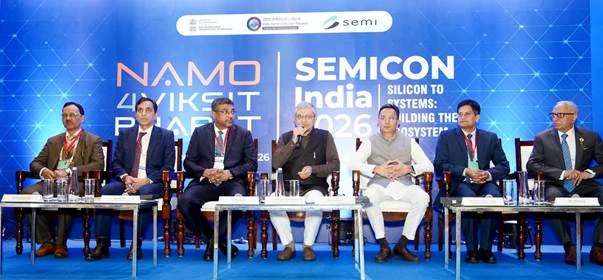
New Delhi, September 17, 2026 – India has received investment commitments of around ₹1 lakh crore ($11–12 billion) under its Semicon 2.0 programme, with the government expecting the investments to generate nearly 100,000 new jobs across the semiconductor ecosystem over the next two to three years, Electronics and Information Technology Minister Ashwini Vaishnaw said on Thursday.
Speaking to reporters at SEMICON India 2026 in New Delhi, Vaishnaw said the second phase of India’s semiconductor programme would move beyond establishing individual chip manufacturing facilities to building a broader ecosystem spanning design, equipment, materials, fabrication, advanced packaging, research and talent.
While Semicon 1.0 focused on creating the foundation for India’s semiconductor industry, Semicon 2.0 is intended to scale capabilities across the wider value chain, he said.
The investment commitments are expected to translate into projects as companies obtain the necessary board and shareholder approvals, according to the minister.
Six pillars underpin Semicon 2.0
The government’s expanded semiconductor strategy is built around six broad areas.
Semiconductor design
India plans to support the creation and scaling of 200 semiconductor design startups, including through access to funding, venture capital, customer discovery and intellectual-property protection.
Vaishnaw said 20 of the 105 semiconductor startups supported during the first phase have already secured venture capital funding.
The government also wants companies to move from individual chip design towards systems design, allowing Indian firms and engineers to participate in more complex technology development.
Machines and materials
The second pillar focuses on developing domestic capabilities in semiconductor equipment, machinery and materials.
Vaishnaw said global capital-equipment companies are increasingly exploring India for both design and manufacturing operations. India’s existing precision-manufacturing capabilities across aerospace, aviation, electronics and other sectors could support this expansion, he said.
The strategy also seeks to build capabilities in areas including gases, chemicals and precision manufacturing that are essential to semiconductor production.
Fabs
The third pillar is focused on expanding fabrication capabilities across multiple technologies, including silicon, compound, logic, memory and display fabs.
The minister said growing interest from global semiconductor companies indicated increasing confidence in India’s ability to host manufacturing operations.
Advanced packaging
Semicon 2.0 will also expand India’s advanced semiconductor packaging capabilities.
Advanced packaging has become increasingly important as chipmakers seek greater system-level performance and efficiency, making packaging a strategic part of the semiconductor manufacturing chain.
Applied research and development
The fifth pillar focuses on industry-led applied R&D involving companies, government and academic institutions.
Under the proposed model, companies would identify R&D projects, with funding participation from industry and the government and academic institutions contributing research capabilities.
The stated objective is to develop commercially relevant technologies and create tangible outcomes for India’s semiconductor ecosystem.
Talent development
India currently has around 400 universities and institutes involved in semiconductor chip-design education under the first phase, according to Vaishnaw.
Semicon 2.0 will seek to expand that curriculum towards systems design.
The government also aims to train 100,000 technicians over five years, working with industry and international institutions, including Taiwan’s ITRI, to develop skills aligned with semiconductor manufacturing requirements.
Government seeks ecosystem around fabs
Vaishnaw said India’s semiconductor ambitions extend beyond attracting individual fabs.
The government wants to establish capabilities around capital equipment, materials, gases, chemicals, precision manufacturing and supply chains, creating a more integrated domestic manufacturing base.
The minister also pointed to increasing efforts by semiconductor companies to diversify their global supply chains, positioning India as a potential manufacturing and technology location.
Cost and quality remain key focus
Vaishnaw said competitiveness in terms of cost and quality would remain central to semiconductor projects from selection through construction and commercial production.
He said facilities that have already started commercial production are competing in global markets, with customers taking up production capacity.
The government is also tracking the pace at which facilities under construction are adding manufacturing capacity.
11 MoUs and five announcements at SEMICON India
SEMICON India 2026 saw a series of agreements and announcements covering semiconductor manufacturing, packaging, equipment, materials, design and workforce development.
Among the key developments were:
- Suchi Semicon and eInfochips exchanged their first batch of commercial devices.
- Tata Electronics and Nexperia signed an MoU covering wafer manufacturing, assembly and testing, technology collaboration and innovation.
- Tata Electronics and Ascendas First Space agreed to develop a 363-acre vendor park in Dholera, Gujarat.
- Tata Electronics and Fujifilm agreed to support localisation of critical semiconductor materials.
- Tata Electronics and JSR signed an MoU covering photoresists and advanced chemicals for Tata Electronics’ Dholera fab.
- Tata Electronics and BESI Singapore agreed to collaborate on advanced semiconductor packaging in India.
- Tata Electronics and Semiconductor Laboratory (SCL) agreed to work on semiconductor design services, process technology, supply-chain localisation and talent development.
- Tata Electronics, Gati Shakti Vishwavidyalaya, L&T EduTech and Jacobs Solutions agreed to collaborate on semiconductor facility engineering and infrastructure skills.
- Kaynes Semicon and OptoML India agreed to jointly develop advanced packaging and System-on-Module solutions.
- Kaynes Semicon, GridCrest Technologies and Sensesemi agreed to explore packaging, assembly and testing opportunities.
- India Semiconductor Mission and Intel India launched an Introduction to Semiconductors course.
- Intel India and NAMTECH signed an MoU focused on AI and semiconductor workforce development.
- HORIBA inaugurated its HORIBA KOACH Experience Centre.
- Sensesemi Technologies and GridCrest Technologies signed an MoU covering smart metering solutions.
- Six ChipIN Regional Centres were announced to broaden access to semiconductor design capabilities.
- CDIL announced commercial semiconductor production and an association with Japan’s Shindengen Electric Manufacturing for package development.
India pushes toward a full-stack semiconductor industry
The government’s approach marks a shift from focusing primarily on semiconductor fabrication towards building capabilities across the industry’s entire value chain.
That includes the upstream ecosystem of design, equipment and materials, manufacturing through fabs and packaging facilities, and downstream requirements such as systems development, talent and supply-chain infrastructure.
SEMICON India 2026 is being held at Yashobhoomi in New Delhi from September 17 to 19. The event features more than 600 participating companies, representatives from 52 countries, more than 400 executives and over 150 speakers, with around 50,000 visitors expected.
The exhibition includes country pavilions from Japan, South Korea, Malaysia, the Netherlands, Singapore and Sweden, along with 12 state booths, a Startup Pavilion, Innovation Showcase, Student Hackathon and Workforce Development Pavilion.
India’s semiconductor strategy is therefore increasingly being framed not only around building chips domestically, but around creating the supporting industrial, technological and human-capital infrastructure needed to participate across the global semiconductor value chain.
Women in Data Centers: The Leaders Shaping India’s Data Center Industry

Ruchi Kumar is the associate editor at Entrepreneur News Network and TVW News India, where she leads editorial strategy, brand storytelling, and startup ecosystem coverage. With a strong focus on innovation, business, and marketing insights, he curates impactful narratives that spotlight India’s evolving entrepreneurial landscape. She has written extensively on fintech, AI and emerging startups.
1 thought on “India’s Semicon 2.0 Targets Full-Stack Chip Ecosystem With ₹1 Lakh Crore Investment Commitments”