

Wednesday, October 28, 2026 – India’s Global Capability Centre (GCC) ecosystem has become a major engine of global technology, financial services, engineering and business operations. The country had 2,117 GCCs employing approximately 2.36 million professionals and generating $98.4 billion in revenue in FY2026, according to the NASSCOM-Zinnov India GCC Landscape Report 2026.
As multinational companies expand their Indian operations, some of the largest centres have grown into substantial technology and business hubs, supporting global products, financial systems, digital platforms and research initiatives.
But which companies employ the most people through their India-based capability centres?
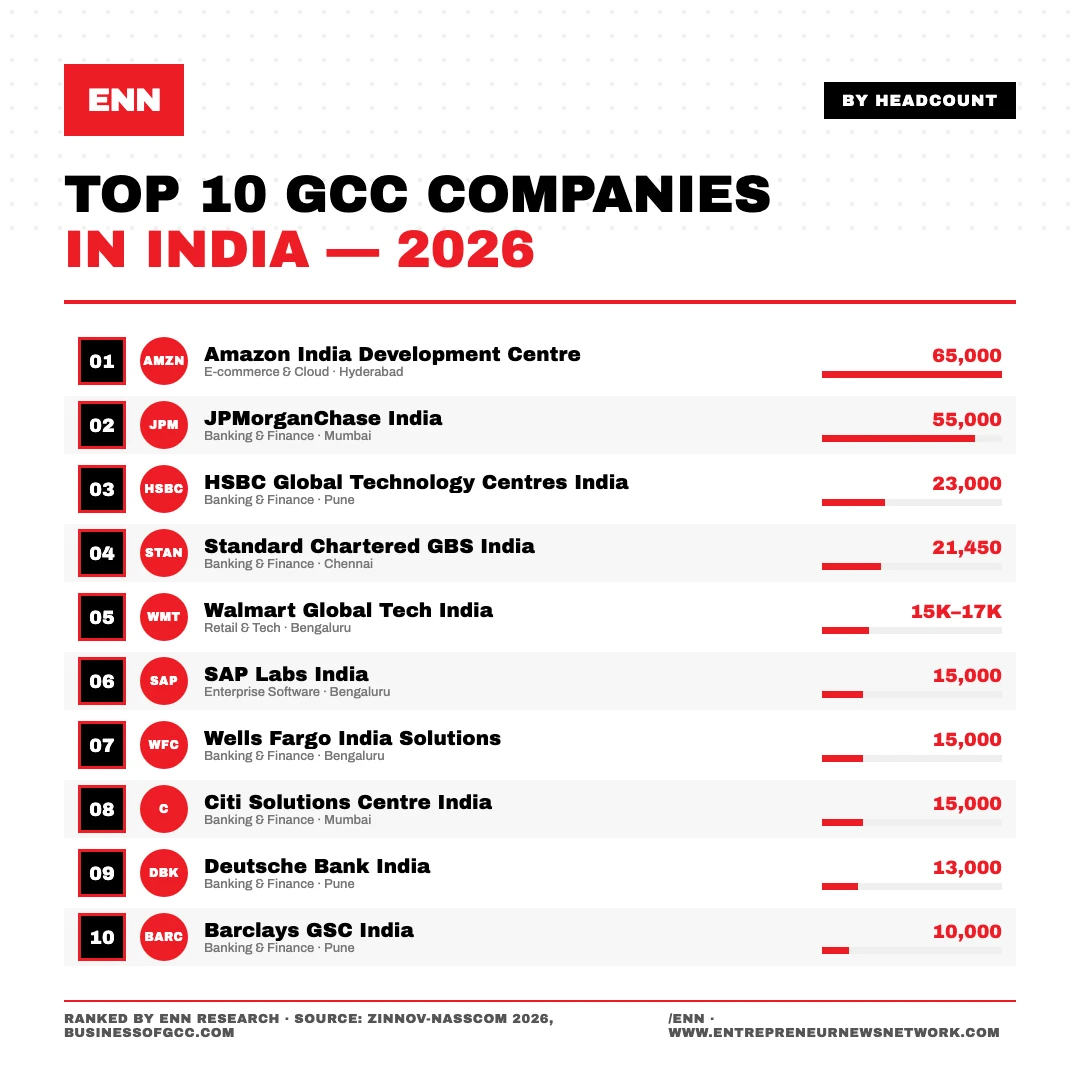
Based on the latest headcount estimates and company information available in the supplied research, Amazon India Development Centre ranks first, with an estimated 65,000 employees, followed by JPMorganChase India at approximately 55,000. HSBC’s technology operations and Standard Chartered’s Global Business Services division complete the next two positions.
This ranking examines 10 major GCC employers, their estimated workforce, principal Indian locations and business responsibilities. Since companies disclose employee numbers differently, the figures should be treated as approximate rather than perfectly comparable totals.
India’s GCC Industry in 2026: Key Numbers
The scale of India’s GCC ecosystem provides important context for understanding the size of individual employers.
According to the NASSCOM-Zinnov report:
- 2,117 GCCs operate in India.
- 2.36 million professionals work across the ecosystem.
- $98.4 billion is the reported annual market revenue for FY2026.
- 32% growth in the number of GCCs has occurred since FY2021.
- 506 Forbes Global 2000 companies operate GCCs in India.
The industry is also evolving beyond traditional offshore delivery. Artificial intelligence, product engineering, cybersecurity, cloud infrastructure and data analytics are becoming increasingly important parts of GCC operations.
For multinational companies, India offers access to a substantial technology workforce and established business ecosystems. For employees, large GCCs can provide opportunities to work on international products, financial systems and enterprise technology platforms.
Methodology: How the Top GCC Companies Were Ranked
This article uses the company-specific headcount estimates and supporting references provided for the October 2026 edition.
The ranking focuses on multinational companies’ in-house capability centres rather than third-party IT services providers such as TCS, Infosys and Accenture.
The following principles apply:
- Headcount: Figures represent approximate workforce estimates from the supplied research, not a new independent employee census.
- Reporting periods: Company figures come from different reporting dates, primarily late 2025 through 2026.
- Scope: Some companies disclose technology-centre headcount, while others report broader operations, including finance, risk, technology and business services.
- Ranges: Where the supplied data provides a range, it is retained rather than replaced with an unsupported exact number.
- Comparability: Rankings should be interpreted cautiously where employee definitions or organisational boundaries differ.
The list is an editorial comparison, not an official industry ranking. Readers should consult individual company disclosures for the latest figures and reporting definitions.
Top 10 GCC Companies in India by Headcount
| Rank | Company | Estimated India Headcount |
|---|---|---|
| 1 | Amazon India Development Centre | Approximately 65,000 |
| 2 | JPMorganChase India | Approximately 55,000 |
| 3 | HSBC Global Technology Centres India | More than 23,000 |
| 4 | Standard Chartered GBS India | More than 21,450 |
| 5 | Walmart Global Tech India | Approximately 15,000–17,000 |
| 6 | SAP Labs India | Approximately 15,000 |
| 7 | Wells Fargo India Solutions | Approximately 15,000 |
| 8 | Citi Solutions Centre India | Approximately 15,000 |
| 9 | Deutsche Bank India | Approximately 13,000 across broader operations |
| 10 | Barclays Global Service Centre India | Approximately 10,000 |
Note: These figures are indicative estimates drawn from different reporting periods and organisational scopes. They should not be interpreted as a directly comparable, independently audited headcount dataset.
1. Amazon India Development Centre — Approximately 65,000 Employees
Amazon India Development Centre tops this list with an estimated workforce of approximately 65,000 employees across multiple Indian cities.
Its major locations include Hyderabad, Bengaluru, Chennai, Mumbai, Pune and Gurugram. Hyderabad is a particularly important technology hub for the company.
Amazon’s India development teams contribute to global products and services spanning cloud computing, e-commerce technology, Alexa and payments. Engineers, scientists and product professionals work on systems used across Amazon’s international businesses.
The centre’s scale reflects the importance of India to Amazon’s global technology organisation. Its teams contribute to product development, infrastructure, software engineering and customer-facing technology.
Amazon’s broader India workforce includes employees in functions beyond its captive technology operations. Those roles should not automatically be counted as part of the GCC figure.
Why it matters: Amazon demonstrates how a multinational company can use India not only for technology support but also for the development and operation of products serving customers worldwide.
2. JPMorganChase India — Approximately 55,000 Employees
JPMorganChase is one of India’s largest multinational financial-services employers, with a reported India workforce of approximately 55,000 across its major operations.
Its presence spans Mumbai, Bengaluru and Hyderabad, supporting technology development, banking operations, analytics, risk management and other global functions.
The bank’s India teams contribute to systems that support financial transactions, digital banking, data infrastructure and enterprise technology.
JPMorganChase has also continued investing in its Indian footprint. Its planned Mumbai campus in Powai is designed to accommodate a substantial workforce, while the company has expanded its technology and business operations in other cities.
Demand for cloud architecture, cybersecurity, data engineering and AI-related capabilities is an important part of the wider shift in financial-services technology.
Why it matters: JPMorganChase illustrates how GCCs have become central to the operating models of major global banks, supporting both critical infrastructure and technology innovation.
3. HSBC Global Technology Centres India — More Than 23,000 Employees
HSBC’s technology centres in India employ more than 23,000 professionals, according to the company’s India technology careers information cited in the supplied research.
The principal locations include Pune, Hyderabad and Bengaluru.
These centres support the bank’s international operations through software development, automation, data engineering, cybersecurity and other technology functions.
As banking becomes increasingly digital, technology teams play a crucial role in modernising customer platforms, strengthening security and improving the efficiency of financial services.
HSBC’s India technology operations also reflect the broader movement towards specialised engineering and data capabilities within multinational financial institutions.
Why it matters: HSBC’s Indian centres demonstrate how global banks rely on distributed technology teams to develop, maintain and improve systems used across multiple markets.
4. Standard Chartered GBS India — More Than 21,450 Employees
Standard Chartered Global Business Services (GBS) India is another major employer in the country’s financial-services GCC ecosystem.
The organisation operates primarily from Chennai and Bengaluru. Its responsibilities span technology, software development, banking operations, IT support and services for the bank’s international businesses.
The supplied company profile reports more than 21,450 India-based employees.
Standard Chartered’s centres function as hubs for specialised capabilities and business-process transformation. Their work supports the bank’s operations across multiple international markets.
The organisation’s scale also highlights the continued importance of India to global banking infrastructure, particularly as banks invest in digital services and more sophisticated technology systems.
Why it matters: Standard Chartered shows how GCCs can combine technology development with operational expertise, creating integrated teams that support global banking functions.
5. Walmart Global Tech India — Approximately 15,000–17,000 Employees
Walmart Global Tech India is a major technology hub supporting one of the world’s largest retailers.
Its operations are anchored in Bengaluru, with additional locations in cities including Gurugram, Hyderabad, Mumbai, Pune and Chennai.
The organisation develops and maintains technology used in retail, e-commerce, supply-chain management, data analytics and digital commerce.
Its work supports Walmart’s international business and contributes to technology capabilities relevant to its wider retail ecosystem.
The supplied research places its workforce at approximately 15,000 to 17,000 employees, although the exact number depends on the reporting date and definition used.
Why it matters: Walmart Global Tech demonstrates how retail companies are turning their Indian technology centres into important product-development and digital-transformation hubs.
6. SAP Labs India — Approximately 15,000 Employees
SAP Labs India is a major research and development centre within the global enterprise software company’s operations.
Its teams work across Bengaluru, Hyderabad and Pune, contributing to software engineering, enterprise applications, cloud technology and business platforms.
The centre supports the development of products and technologies used by organisations worldwide, including systems for enterprise resource planning, data management and business operations.
The supplied research places its workforce at approximately 15,000, although published estimates vary depending on the period and organisational scope.
SAP’s India operations reflect the growing role of the country in global software development and product innovation.
Why it matters: SAP Labs India highlights the transition from conventional offshore development to product ownership and core research and development responsibilities.
7. Wells Fargo India Solutions — Approximately 15,000 Employees
Wells Fargo India Solutions supports the US financial-services company’s global operations through technology, analytics and business functions.
Its principal locations include Bengaluru and Hyderabad. The supplied research estimates its workforce at approximately 15,000 employees.
Teams in India contribute to software development, cloud engineering, digital banking, data analytics and other capabilities supporting the bank’s operations.
The company’s India footprint also reflects the way global financial institutions consolidate and reorganise their technology operations as business priorities evolve.
Headcount figures should be interpreted in the context of changes to office locations, organisational structure and the functions included in company disclosures.
Why it matters: Wells Fargo illustrates the importance of Indian GCCs in supporting the technology infrastructure of large, internationally active financial institutions.
8. Citi Solutions Centre India — Approximately 15,000 Employees
Citi’s India capability centres support global banking and financial-services operations through technology, data, risk and business functions.
Its India footprint spans Mumbai, Pune, Chennai, Gurugram and Hyderabad.
The supplied research estimates the workforce of its capability-centre operations at approximately 15,000 employees, although the total may vary depending on which business units and support functions are included.
Citi’s technology teams contribute to systems supporting financial transactions, digital banking, analytics and risk management.
As financial institutions continue modernising their platforms, India remains an important source of technology talent and specialised operational capabilities.
Why it matters: Citi’s presence demonstrates how GCCs support the complex technology and control systems required by multinational banks.
9. Deutsche Bank India — Approximately 13,000 Employees
Deutsche Bank’s Indian operations include significant technology, analytics, risk and business-service capabilities.
Pune is a major location, alongside Mumbai.
The supplied research places its broader India workforce at approximately 13,000 employees. Some narrower estimates of technology-centre headcount are lower, indicating that different sources may be measuring different organisational units.
The bank’s Indian teams contribute to global operations, including technology development, risk-related work and support for financial services.
The distinction between a company’s overall India workforce and its dedicated GCC workforce is particularly important in this case.
Why it matters: Deutsche Bank highlights the role of India in supporting the technology, control and operational infrastructure of global financial institutions.
10. Barclays Global Service Centre India — Approximately 10,000 Employees
Barclays Global Service Centre India rounds out the top 10, with an estimated workforce of approximately 10,000 employees in the supplied research.
Pune is the centre’s principal location, with additional operations in other Indian cities.
The organisation supports the bank’s international businesses through technology, analytics, software development and operational services.
Its work spans areas such as trading technology, cloud engineering and risk-related systems.
The concentration of employees in Pune also illustrates how individual cities can develop deep specialisations in financial-services technology and operations.
Why it matters: Barclays demonstrates how global banks use Indian capability centres to support critical systems and develop specialised expertise.
Other Major GCC Employers Just Outside the Top 10
Several other multinational companies operate substantial GCCs in India and deserve attention.
Novartis
Novartis has a significant Hyderabad presence supporting global pharmaceutical and business functions. The supplied research estimates approximately 9,000 employees at its major India hub.
Goldman Sachs
Goldman Sachs operates major teams in Bengaluru and Hyderabad, supporting technology, analytics and financial-services operations. The supplied research places its India workforce at approximately 9,000.
American Express
American Express has an important India presence, particularly in Gurugram, supporting technology and business functions. The supplied estimate is approximately 8,000 employees.
These figures are indicative and may reflect different organisational scopes. Their inclusion outside the top 10 should not be treated as a definitive comparison with the ranked companies.
Why India’s Largest GCCs Matter to the Economy
The scale of these employers reflects a wider change in India’s economic relationship with multinational businesses.
GCCs are increasingly involved in developing products, managing enterprise technology, building AI capabilities and supporting global decision-making.
Their impact extends beyond direct employment. Large centres can generate demand for office infrastructure, professional services, training, technology suppliers and local business ecosystems.
The NASSCOM-Zinnov FY2026 report places the overall GCC ecosystem at $98.4 billion in revenue, with approximately 2.36 million professionals working across 2,117 centres.
That scale also creates opportunities for Indian cities to attract investment and develop specialised talent pools.
However, workforce size alone does not measure a centre’s strategic importance. A smaller centre responsible for critical intellectual property or a major global product may have considerable influence despite employing fewer people.
The next stage of GCC development is therefore likely to be shaped by both workforce scale and the complexity of the work undertaken in India.
AI Is Changing the Future of GCC Hiring
Artificial intelligence is becoming a central part of GCC strategy.
Large companies are investing in AI engineering, data infrastructure, cybersecurity, automation and cloud platforms. These capabilities can help GCCs take on more sophisticated responsibilities within their parent organisations.
At the same time, AI may change the relationship between headcount and output. Companies may increasingly focus on productivity, specialised skills and business impact rather than simply expanding employee numbers.
For professionals, this means demand may become more concentrated in areas such as AI development, machine learning, data engineering, cloud security and product management.
For employers, the challenge is to build teams that can combine technical depth with business understanding.
As India’s GCC industry matures, its competitive advantage will depend not only on the size of its workforce but also on the expertise, innovation and global responsibilities that workforce can deliver.
Conclusion: Which Companies Lead India’s GCC Workforce?
Amazon India Development Centre and JPMorganChase India occupy the top two positions in this indicative ranking, followed by HSBC and Standard Chartered.
Walmart, SAP, Wells Fargo, Citi, Deutsche Bank and Barclays also represent significant multinational technology and business operations in India.
The wider industry is evolving rapidly. With $98.4 billion in reported FY2026 revenue and 2.36 million professionals, India’s GCC ecosystem has become a substantial part of the global business landscape.
Yet the next phase will not be defined by employee numbers alone. AI adoption, product ownership, specialised expertise and the ability to influence global business decisions will increasingly determine which centres create the greatest value.
For India, the opportunity is clear: move from being a location where global companies employ large teams to a market where those teams shape the products, technology and decisions that drive global growth.
Sarvam AI’s Defence Deal Is Really About Who Controls India’s Military Data

Ruchi Kumar is the associate editor at Entrepreneur News Network and TVW News India, where she leads editorial strategy, brand storytelling, and startup ecosystem coverage. With a strong focus on innovation, business, and marketing insights, he curates impactful narratives that spotlight India’s evolving entrepreneurial landscape. She has written extensively on fintech, AI and emerging startups.