

1st, November, 2026 – The unicorn fire sale of 2026 has become a defining story in the startup and venture capital ecosystem. Several companies that once commanded multibillion-dollar valuations have changed hands at substantially lower prices, highlighting the growing gap between peak private-market valuations and what strategic buyers are willing to pay.
Four prominent examples stand out: Miro, Headspace, Airtable and Brex. Collectively, these companies reached peak valuations exceeding $44 billion during the 2021–2022 funding boom. Their reported 2026 transaction values were substantially lower, reflecting different circumstances across enterprise software, digital wellness and financial technology.
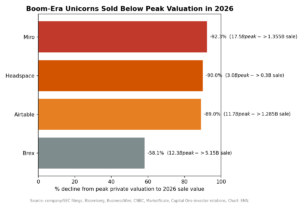
In this ENN Research ranking, Miro recorded the steepest percentage decline from its reported peak valuation, followed by Headspace, Airtable and Brex.
The transactions also reveal an important distinction: a company can remain commercially viable while its acquisition value falls sharply from its previous private-market valuation. Revenue, profitability, strategic fit and the terms of a transaction all influence what a buyer is prepared to pay.
Top 4 Unicorn Fire Sales of 2026: The Ranking
ENN compared each company’s reported peak private-market valuation with the disclosed value of its 2026 transaction.
| Rank | Company | Peak valuation | Reported 2026 deal value | Approximate decline |
|---|---|---|---|---|
| 1 | Miro | $17.5 billion | $1.355 billion | 92.3% |
| 2 | Headspace | $3 billion | $300 million | 90.0% |
| 3 | Airtable | $11.7 billion | $1.285 billion | 89.0% |
| 4 | Brex | $12.3 billion | $5.15 billion | 58.1% |
Source: ENN Research, based on the transaction figures and historical valuations provided. Percentages are approximate and should be interpreted in light of differences between enterprise value, equity value and total transaction consideration.
The ranking compares disclosed deal values with historical peak valuations rather than measuring the investment returns of individual shareholders. The two figures are not necessarily calculated on identical financial bases.
1. Miro: A 92.3% Decline From Its Peak Valuation
Miro, the visual collaboration and online whiteboard platform, tops ENN’s ranking of the biggest unicorn valuation declines in 2026.
The company reached a reported valuation of $17.5 billion in January 2022, during the period when investors were assigning premium valuations to rapidly growing software businesses. That funding environment rewarded strong user adoption, recurring revenue and expectations of continued expansion.
In September 2026, software company Bending Spoons agreed to acquire Miro at an announced enterprise value of approximately $1.355 billion. The acquisition subsequently closed in October 2026, according to Bending Spoons’ transaction announcements.
Using those figures, Miro’s enterprise value at the time of the transaction was approximately 92.3% below its 2022 peak valuation.
However, the headline percentage does not tell the entire story. Transaction valuations can differ depending on whether they include cash reserves, debt, reinvestment by existing shareholders or other components of consideration. Miro’s reported transaction terms included shareholder reinvestment into Bending Spoons, meaning alternative valuation measures can produce a different percentage decline.
The company also has a substantial operating footprint. Reports cited in the supplied research indicate that Miro serves more than 250,000 organisations and generates approximately $600 million in annual recurring revenue.
Why it matters: Miro’s transaction illustrates how a software company with a large customer base and recurring revenue can receive a valuation far below its previous funding-round peak. The difference reflects a reassessment of its financial and strategic value, not necessarily the disappearance of its underlying business.
2. Headspace: A 90% Decline From Its $3 Billion Peak
Headspace, the meditation and mental wellness platform, ranks second in ENN’s unicorn fire sale analysis.
The company reached a reported valuation of approximately $3 billion in 2021 following its merger with Ginger, a behavioural healthcare business. The combination aimed to bring digital meditation, mental wellness and broader behavioural health services together under one platform.
In September 2026, Sword Health, an AI-driven healthcare company focused on musculoskeletal care, agreed to acquire Headspace for a reported $300 million.
The reported transaction value represents a 90% decline from Headspace’s previous $3 billion valuation.
Yet the acquisition also demonstrates why valuation declines should not automatically be equated with business failure. The supplied reporting indicates that Headspace generates more than $200 million in annual revenue and is EBITDA-profitable.
At a reported acquisition value of $300 million, that revenue would imply a valuation of approximately 1.5 times annual revenue, assuming the figures are comparable and refer to the same financial period.
This is substantially different from the premium valuations that some digital health and wellness companies achieved during the 2021 funding boom.
Sword Health’s acquisition also creates a potential strategic opportunity to combine Headspace’s mental wellness offering with a broader technology-enabled healthcare platform.
Why it matters: Headspace highlights how investor expectations, sector valuations and strategic ownership can change over time. A business can continue generating meaningful revenue while commanding a much lower acquisition valuation than it did during a period of abundant venture capital.
3. Airtable: An Approximately 89% Decline From Its Peak
Airtable, the software platform that combines spreadsheet-style interfaces with database functionality and workflow automation, ranks third.
The company reached a reported peak valuation of $11.7 billion in 2021, when investors showed strong interest in software businesses that enabled organisations to build applications and automate work without extensive traditional coding.
In August 2026, Bending Spoons agreed to acquire Airtable at a reported enterprise value of approximately $1.285 billion. The acquisition reportedly closed in September 2026.
Compared with Airtable’s historical peak valuation, the disclosed enterprise value represents an approximate decline of 89%.
The transaction also raises questions about how software companies are valued in a changing market.
Airtable reportedly generated approximately $480 million in annual recurring revenue. At the disclosed enterprise value of $1.285 billion, that would imply a multiple of roughly 2.7 times annual recurring revenue.
This comparison is useful because recurring revenue is an important metric for subscription software businesses. However, revenue multiples alone do not establish whether a transaction represents fair value. Growth rates, margins, customer retention, operating expenses, debt and future investment requirements also matter.
The distinction between enterprise value and equity value is particularly important in Airtable’s case. Reports cited in the supplied research indicate that including cash reserves produces a substantially higher headline equity value than the enterprise-value figure used in this ranking.
Consequently, the percentage decline depends on which transaction measure is compared with the historical peak. ENN uses the disclosed enterprise value for this ranking and identifies the basis to make the comparison more transparent.
Why it matters: Airtable’s sale illustrates the repricing of enterprise software businesses following the exceptional valuations of the pandemic-era technology boom. It also demonstrates why transaction analysis must account for cash and other balance-sheet items rather than relying on headline figures alone.
4. Brex: A 58.1% Decline From Its Peak Valuation
Brex experienced the smallest percentage decline among the four companies in ENN’s ranking, although its reported transaction value remained considerably below its previous private-market peak.
The corporate-card and spend-management fintech company reached a reported valuation of $12.3 billion in 2022.
In January 2026, Capital One agreed to acquire Brex in a transaction valued at approximately $5.15 billion. The consideration reportedly included cash and Capital One shares, while the transaction arrangements also addressed Brex’s outstanding debt.
The acquisition was reported as completed in April 2026, with Brex founder Pedro Franceschi continuing to lead the business within Capital One.
Compared with the $12.3 billion historical valuation, the $5.15 billion transaction value represents a decline of approximately 58.1%.
That is a significantly smaller markdown than those recorded for Miro, Headspace and Airtable.
One potential explanation is the strategic context of the transaction. Brex operates in corporate payments, cards and expense management, areas that can complement the existing financial products and customer relationships of a large financial institution.
For Capital One, acquiring an established fintech platform may offer opportunities to combine technology, customer acquisition capabilities and financial services infrastructure.
However, the strategic rationale does not establish the precise reasons behind the valuation difference. Those would require a more detailed examination of the transaction terms, Brex’s financial performance and the assumptions underlying its previous funding valuation.
Why it matters: Brex demonstrates that a below-peak acquisition is not necessarily a distressed sale. Strategic transactions can provide liquidity to investors and founders while giving an acquirer access to technology, customers and established operations.
Why Are Unicorn Valuations Falling in 2026?
The four transactions illustrate a broader question facing the venture capital industry: why are companies once valued in the billions being acquired for substantially less?
There is no single explanation. Several market and business factors can contribute to the difference between a historical private valuation and an acquisition price.
1. The End of Peak-Era Valuation Multiples
During the 2021 funding boom, abundant capital and strong investor competition helped push private startup valuations higher.
Investors were often willing to pay premium multiples based on expectations of future growth. As market conditions changed, those expectations were reassessed.
A company that previously attracted a multibillion-dollar valuation may command a lower price if buyers apply more conservative assumptions about future revenue, profitability and growth.
2. Greater Focus on Revenue and Profitability
Investors and acquirers increasingly need to assess whether a business can translate growth into sustainable financial performance.
Recurring revenue, customer retention, operating margins, cash flow and the cost of acquiring customers all affect a company’s attractiveness.
The Headspace and Airtable transactions illustrate why operating metrics matter alongside historical valuations. Revenue can remain substantial even as the market assigns a lower multiple to the business.
3. Strategic Acquisitions Can Replace Independent Growth
Some startups may find that selling to a larger company offers a more attractive path than continuing to raise capital independently.
A strategic buyer may be able to integrate the target into an existing platform, reduce duplicated costs, expand distribution or introduce products to a larger customer base.
This can create value for the buyer even when the purchase price falls well below the target’s previous private valuation.
Brex’s acquisition by Capital One illustrates this strategic dimension, while Bending Spoons’ acquisitions of Miro and Airtable demonstrate a software-focused acquisition strategy.
4. Liquidity Matters to Founders and Investors
Private-market valuations do not automatically translate into cash that shareholders can realise.
A funding-round valuation represents the price implied by a particular investment transaction. An acquisition, by contrast, provides a defined transaction structure and may offer investors an opportunity to realise some or all of their holdings.
When the funding environment changes, founders and investors may reassess whether continuing independently is preferable to accepting an acquisition offer.
The decision depends on the company’s financial position, growth prospects, ownership structure and available alternatives.
Bending Spoons and the Software Acquisition Opportunity
One of the most notable patterns in ENN’s ranking is the presence of Bending Spoons as the buyer of both Miro and Airtable.
The two transactions suggest that the company is pursuing opportunities to acquire established software businesses at valuations significantly below their historical funding peaks.
For buyers with sufficient capital and an operational strategy, such acquisitions may provide access to recognised brands, recurring revenue, established customer relationships and existing technology.
However, a lower purchase price does not automatically guarantee an attractive investment. Buyers must still consider customer retention, integration costs, employee requirements, product development and the possibility that revenue could decline after an acquisition.
The distinction between acquisition price and long-term value creation is critical. A transaction that looks inexpensive relative to a previous valuation can still disappoint if the underlying business deteriorates or integration proves difficult.
For sellers, meanwhile, an acquisition may provide a practical alternative to pursuing another funding round at a lower valuation.
What the 2026 Unicorn Fire Sales Mean for Startup Founders
The transactions involving Miro, Headspace, Airtable and Brex offer several lessons for founders, venture capital investors and startup operators.
First, historical valuations are not guaranteed exit prices. A funding-round valuation reflects the terms and expectations of a particular moment. It does not establish what another investor or acquirer will pay several years later.
Second, revenue quality matters. Investors assess not only how much revenue a company generates but also its growth rate, predictability, profitability and cost structure.
Third, strategic fit can influence acquisition value. A company may be worth more to a buyer that can integrate its technology, customers or products into an existing business.
Fourth, transaction terms matter as much as headline numbers. Enterprise value, equity value, debt, cash reserves, stock consideration and shareholder reinvestment can materially affect how a deal should be interpreted.
Finally, founders should consider multiple paths to liquidity. Continuing to raise capital, pursuing profitability, seeking a strategic partner or accepting an acquisition offer each carries different risks and potential rewards.
Conclusion: A Valuation Reset, Not a Universal Startup Collapse
The unicorn fire sale of 2026 highlights how dramatically the value of a private technology company can change between a peak funding round and a later acquisition.
Miro recorded the steepest decline in ENN’s ranking, followed by Headspace and Airtable. Brex experienced a smaller markdown, illustrating how strategic buyers and transaction structures can produce different outcomes.
These cases should not be interpreted as proof that every company involved has failed commercially. Nor do they establish that all startups are facing the same valuation pressure.
Instead, the transactions underline a central lesson for the startup ecosystem: a company’s historical valuation is a snapshot of investor expectations, not a guarantee of its eventual sale price.
For founders, investors and acquirers, the challenge is to look beyond the headline number and understand the underlying business, financial performance and strategic rationale behind each deal.
Editorial note: This ranking is based on the reported figures and source material supplied for ENN’s research. Percentage declines are approximate comparisons between historical peak valuations and disclosed transaction values. Enterprise value and equity value are different measures, and the results should not be interpreted as shareholder investment returns.
Anthropic Junk Credit Rating Warning Raises Questions Ahead of $1.5 Trillion IPO

Ruchi Kumar is the associate editor at Entrepreneur News Network and TVW News India, where she leads editorial strategy, brand storytelling, and startup ecosystem coverage. With a strong focus on innovation, business, and marketing insights, he curates impactful narratives that spotlight India’s evolving entrepreneurial landscape. She has written extensively on fintech, AI and emerging startups.