
November 14, 2026 – Meta is expanding its investment in cleaner industrial materials and services through long-term purchase agreements covering cement, steel, zero-emission freight and recycled plastics. The commitments aim to help suppliers scale lower-carbon production while reducing emissions associated with the company’s growing data centre infrastructure.
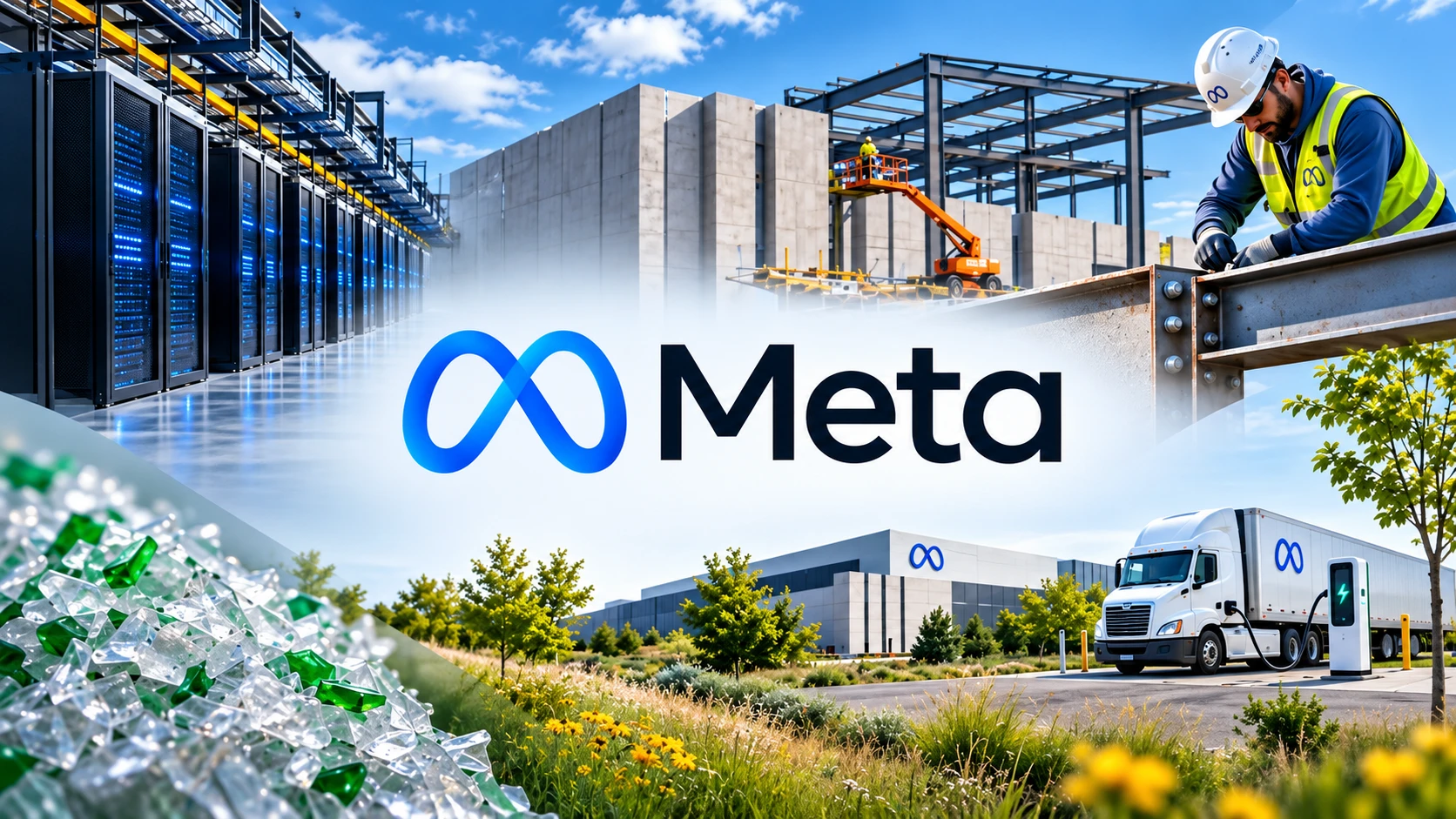
Meta is strengthening its efforts to reduce the environmental footprint of its data centre construction and supply chains through a new series of long-term purchasing commitments across four industrial sectors: cement, steel, freight transportation and recycled plastics.
The agreements are designed to provide suppliers with the financial certainty needed to develop and expand commercial-scale production of lower-carbon materials and services. By committing to purchase these products over multiple years, Meta aims to support emerging technologies, encourage industrial investment and make cleaner alternatives more accessible across the wider market.
Data centres require substantial quantities of construction materials, including concrete, steel and plastics. Their development also depends on extensive freight networks to transport equipment and building materials. Reducing emissions across this infrastructure therefore requires action beyond the company’s direct operations and electricity consumption.
Meta’s latest commitments seek to address these emissions by supporting suppliers that are developing alternatives to conventional, carbon-intensive industrial processes.
Meta Expands Lower-Carbon Cement and Concrete Commitments
Cement and concrete are among the key materials used in large-scale infrastructure construction. Conventional cement production is energy-intensive and contributes significantly to industrial emissions, making lower-carbon alternatives important for more sustainable building projects.
Meta has signed a multi-year agreement with Sublime Systems to support the production of at least 180,000 tonnes of lower-carbon cement.
The commitment is intended to help Sublime Systems establish its first commercial-scale manufacturing facility. In return, Meta will receive priority access to Sublime Cement® for its future data centre construction requirements.
The company has also entered into an agreement with Fortera, a lower-carbon cement producer, to support the development of a new facility in Ste. Genevieve, Missouri.
Both projects are expected to expand domestic production capacity for lower-carbon cement while supporting new employment opportunities in the United States.
These partnerships build on Meta’s previous work with lower-carbon concrete innovators, including CarbonBuilt and CarbiCrete. The company has also explored mass timber construction and used AI models to support the development of faster-curing, lower-carbon concrete formulations.
Partnership With Stegra Supports Near-Zero-Emission Steel
Steel is another essential material used in data centre construction, particularly for structural applications. However, conventional steelmaking can be highly emissions-intensive, especially when coal is used in the iron-reduction process.
Meta is extending its clean materials strategy through a new multi-year agreement with Sweden-based Stegra to support near-zero-emission primary steel production.
The production process supported by the agreement is designed to eliminate coal entirely from iron reduction, offering an alternative to conventional steelmaking methods.
The commitment follows Meta’s earlier agreement with Electra, which supports domestic clean iron production from the company’s first demonstration plant in Jefferson County, Colorado.
By moving from clean iron to lower-emission steel, Meta is seeking to support the development of cleaner materials that can eventually be incorporated into its data centre supply chain.
Supporting an emerging production facility through its commercial ramp-up can also help demonstrate the viability of alternative steelmaking technologies and encourage wider adoption across the global steel industry.
Electric Truck Corridors Target Freight Emissions
Meta’s supply chain decarbonisation strategy also includes the transportation networks that move construction materials and other goods.
The company is expanding its partnership with Nevoya to support a zero-emission freight route connecting California and Arizona along the Interstate 10 corridor.
The initiative builds on earlier partnerships involving NFI in Virginia and Nevoya, working with the Center for Green Market Activation, in Texas.
Heavy-duty electric trucks offer the potential to eliminate tailpipe emissions and reduce noise compared with conventional diesel-powered vehicles. However, their wider deployment requires dependable charging infrastructure along major freight routes.
Through these partnerships, Meta is supporting electric trucking operations and dedicated charging infrastructure in Virginia, Texas, California and Arizona.
The charging stations are intended to remain permanently available through open access, allowing other commercial fleet operators to use the infrastructure as well.
This approach could help address one of the barriers to wider electric freight adoption: the availability of reliable charging facilities along key transportation corridors.
MacroCycle Agreement Supports Commercial-Scale Recycled PET Production
Plastic waste is another area covered by Meta’s long-term purchasing commitments.
The company has signed a purchase agreement with MacroCycle Technologies to support financing for its first commercial plant in the southeastern United States.
The proposed facility aims to divert hard-to-recycle plastic waste that would otherwise go to landfills or local incineration facilities. Its planned output is approximately 5,000 tonnes of high-value recycled PET annually.
The agreement is intended to provide the commercial support required to move the technology towards larger-scale production.
Expanding the availability of recycled plastics could help manufacturers incorporate more recovered materials into their supply chains and reduce reliance on virgin plastic feedstocks.
For Meta, the partnership supports its broader effort to increase the use of recycled materials in the infrastructure and equipment associated with its operations.
Supporting US Manufacturing and Local Employment
Alongside environmental objectives, Meta’s commitments are intended to strengthen domestic industrial capacity.
By supporting manufacturing facilities and cleaner supply-chain services in the United States, the company aims to encourage investment in sectors where domestic supplies of lower-carbon materials remain limited.
The planned and expanded facilities associated with these partnerships are estimated to support hundreds of jobs across construction and long-term manufacturing.
These projects could generate economic benefits in the communities where the suppliers operate, while helping establish production capabilities for cleaner industrial materials.
Long-term purchase agreements can be particularly important for emerging technologies because they provide suppliers with greater visibility into future demand. That certainty can help companies secure financing, invest in facilities and move from demonstration projects to commercial production.
How Meta Plans to Address Supply-Chain Emissions
Meta’s climate strategy covers emissions from its direct operations, energy use and wider supply chain.
The company says that since 2020, it has matched 100% of its annual electricity consumption with clean and renewable energy. It also highlights measures such as improving infrastructure efficiency, extending hardware lifespans, reusing server equipment and prioritising recycled materials.
However, reducing emissions from suppliers and industrial processes presents a different challenge. Companies often have less direct influence over activities deeper within their supply chains, while lower-carbon alternatives may not yet be available at sufficient scale.
Meta’s long-term purchasing commitments are designed to help address this gap.
The agreements use Environmental Attribute Certificates (EACs) as one mechanism for supporting lower-carbon production. Under this structure, a supplier produces verified lower-carbon materials or services, while Meta pays for the associated environmental benefit. The materials or services are then used in the local market.
Where possible, Meta also aims to secure priority access to use these products directly in future data centre projects as new manufacturing facilities become operational and supply chains develop.
This model allows companies to support cleaner industrial production even when the full supply chain is not yet capable of supplying lower-carbon alternatives at scale.
Building a Market for Lower-Carbon Industrial Materials
Meta’s latest agreements represent more than procurement arrangements for its own data centre expansion. They are also intended to demonstrate the commercial potential of emerging industrial technologies.
Long-term demand commitments can help lower-carbon cement, alternative steelmaking, electric freight and recycled plastics move beyond pilot projects and into larger-scale manufacturing.
The wider ambition is to make these products and services commercially viable options for other infrastructure developers and industrial buyers.
As demand for data centres, digital services and AI infrastructure continues to grow, the materials and logistics required to build and operate these facilities will remain an important part of the industry’s environmental footprint.
By supporting suppliers early in their commercial development, Meta is seeking to accelerate the availability of cleaner alternatives across its supply chain.
The long-term impact will depend on whether these projects achieve their planned production targets, attract further investment and encourage adoption beyond Meta’s own operations. If successful, the commitments could help establish a broader market for lower-carbon industrial materials and services.
Quest Global Acquires US-Based Tests Assured to Expand Wearable Technology Testing Capabilities

Ruchi Kumar is the associate editor at Entrepreneur News Network and TVW News India, where she leads editorial strategy, brand storytelling, and startup ecosystem coverage. With a strong focus on innovation, business, and marketing insights, he curates impactful narratives that spotlight India’s evolving entrepreneurial landscape. She has written extensively on fintech, AI and emerging startups.